Facts
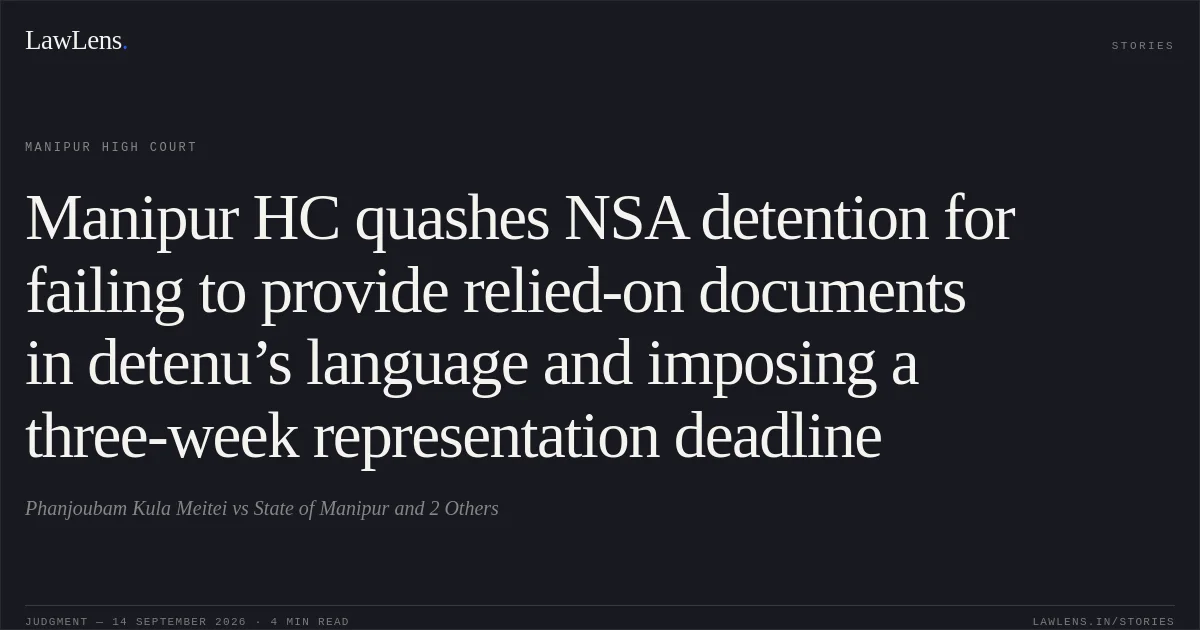
The petitioner, father of the detenu Phanjoubam Rabi Meitei @ Luwangamba, challenged the preventive detention order dated 21 April 2026 passed by the District Magistrate, Imphal East under the National Security Act, 1980 (“NSA”), along with the State Government’s approval orders dated 29 April and 1 May 2026 and confirmation order dated 27 May 2026.
Source reference: paras. 2–3The detenu had studied only up to Class II and was conversant only with Manipuri in the Meitei Mayek script.
Source reference: para. 11On 4 May 2026, he requested translated copies of the detention order, grounds of detention and the documents referred to therein.
Source reference: para. 6(i)The authorities subsequently supplied translated copies of only the detention order and grounds on 3 June 2026, but did not translate or supply any of the 11 documents listed in the grounds of detention.
Source reference: paras. 6(i), 10, 14Issues
Whether failure to furnish translated copies of the documents relied upon or referred to in the grounds of detention, in the language and script understood by the detenu, violated the detenu’s constitutional right under Article 22(5) of the Constitution.
Source reference: paras. 10–14Whether prescribing a three-week time limit for submitting representations to the State and Central Governments amounted to an impermissible restriction on the detenu’s right to make an effective representation under Article 22(5).
Source reference: paras. 15–20Law Applied
Article 22(5) of the Constitution requires that the grounds of preventive detention be communicated to the detenu in a manner enabling an effective representation.
Source reference: paras. 3, 15–16Under Sections 3(2), 3(4), 8, 10, 12(1) and 14 of the NSA, the detention order, its approval and confirmation, the reference to the Advisory Board, and the power of revocation are governed by statutory safeguards.
Source reference: paras. 3, 15–16In Lallubhai Jogibhai Patel v. Union of India, (1981) 2 SCC 427, the Supreme Court held that oral explanation is insufficient; the grounds must be supplied in writing in a language understood by the detenu.
Source reference: para. 12Powanammal v. State of Tamil Nadu, (1999) 2 SCC 413, extended this principle to translated copies of the grounds and supporting material.
Source reference: para. 13Under Prem Lata Sharma v. District Magistrate, Mathura, (1998) 4 SCC 260, the detenu’s right to make a representation, and the Government’s corresponding obligation to consider it, continues so long as the detention order remains operative; no limitation period can be imposed on that right.
Source reference: paras. 15–16Section 10 of the NSA requires the appropriate Government to place the grounds and any representation before the Advisory Board within three weeks; it does not impose a three-week limitation on the detenu’s right to make a representation.
Source reference: paras. 15–16Reasoning
The Court found that the detenu’s limited literacy and lack of familiarity with English were undisputed, and that the State had translated only the detention order and grounds, not any of the 11 documents identified in the grounds of detention.
Source reference: paras. 10–11Applying Lallubhai Jogibhai Patel and Powanammal, the Court held that mere oral explanation could not substitute for written translations in the language understood by the detenu.
Source reference: paras. 12–14The non-supply of translated copies impaired the detenu’s ability to understand the material against him and make an effective representation, thereby violating Article 22(5).
Source reference: paras. 12–14The Court separately held that the three-week stipulation was legally impermissible.
Source reference: paras. 15–16Section 10 of the NSA fixes a deadline for the Government to place the matter before the Advisory Board, not a deadline for the detenu to submit a representation.
Source reference: paras. 15–16Relying on Prem Lata Sharma, the Court held that the right to make a representation subsists throughout the operation of the detention order.
Source reference: paras. 17–20The State’s contention that the time limit was merely directory and caused no prejudice was rejected because the detenu, who had studied only up to Class II, could not reasonably be expected to understand that the stated deadline was non-mandatory; in any event, he had not made any representation at all, much less an effective one.
Source reference: paras. 17–20The Court also observed that the detaining authority had apparently misread Section 10 of the NSA in prescribing the deadline, indicating non-application of mind.
Source reference: para. 21Holding
The Court answered both issues in favour of the petitioner.
It held that failure to provide translations of the supporting documents and the imposition of a three-week time limit for representations violated the detenu’s rights under Article 22(5).
Source reference: paras. 14, 17, 20Accordingly, the preventive detention order dated 21 April 2026, the State Government’s approval orders dated 29 April and 1 May 2026, and the confirmation order dated 27 May 2026 were set aside.
Source reference: para. 22The detenu was directed to be released forthwith, unless required in any other case.
Source reference: para. 22The writ petition was allowed with no order as to costs.
Source reference: para. 22Acts & Sections Cited
14 provisions across 4 statutes referred to in this judgment. Each provision opens on LawLens.
National Security Act, 19806
Unlawful Activities (Prevention) Act, 19673
Bharatiya Nyaya Sanhita, 20234
Arms Act, 19591
Original Court PDF
Phanjoubam Kula MeiteivsState of Manipur and 2 Others
Click to open original judgment
Original judgment, available to read, download and summarize on LawLens.in