Facts
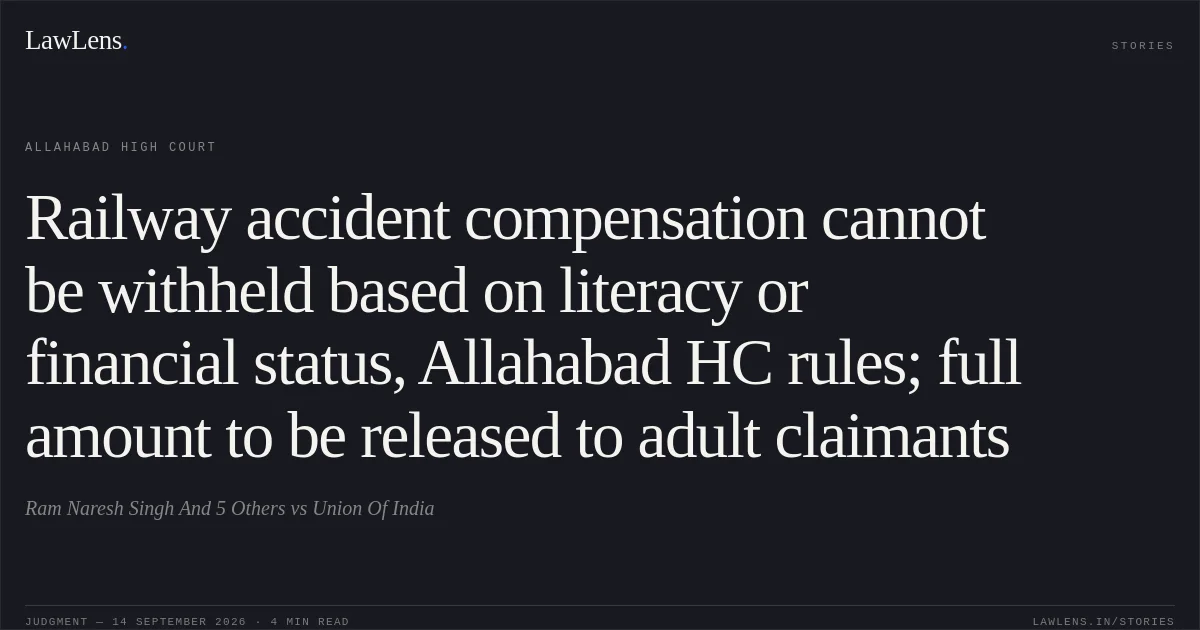
The petitioners were dependants, legal representatives, or injured passengers who had obtained compensation awards from the Railway Claims Tribunal (RCT) for death or injury arising from railway accidents or untoward incidents.
Source reference: para. 4Relying on Rule 5 of the Railway Accidents and Untoward Incidents (Compensation) Rules, 1990, the RCTs released only a portion—frequently 10%—of the awarded amount and directed that the balance be kept in fixed deposits or annuities in nationalised banks.
Source reference: paras. 4–5, 21The petitioners challenged the constitutional validity of these provisions, principally on the ground that they violated Article 14 by differentiating between literate and illiterate claimants and between financially strong and weak claimants.
Source reference: paras. 13–16They also challenged the consequential RCT orders withholding part of the compensation.
Source reference: para. 2Issues
Whether Rule 5.1 and Rule 5.4.1(i) of the 1990 Rules, by permitting the RCT to withhold or defer disbursement of compensation based on a claimant’s literacy, financial condition, or assessed needs, violate Article 14 of the Constitution.
Source reference: paras. 13–15, 23–29Whether Rule 5.4.1(ii), by permitting restrictions on the issuance and use of cheque books and debit cards and by regulating withdrawals from the claimant’s bank account, is constitutionally valid and within the authority of the RCT.
Source reference: paras. 16, 30–31Whether subordinate legislation can restrict or defer the benefit of compensation awarded under Sections 123, 124, and 124A of the Railways Act, 1989.
Source reference: paras. 32–34, 42–43Whether the impugned provisions could be preserved through the doctrine of reading down rather than being declared wholly invalid.
Source reference: paras. 35–38Law Applied
The Court applied Sections 123, 124, 124A, 125, and 129 of the Railways Act, 1989, which establish railway liability and provide for compensation for death or injury arising from railway accidents and untoward incidents.
Source reference: paras. 9–10, 32–34It considered Rule 3 of the 1990 Rules, which prescribes the compensation payable, including compensation up to ₹8 lakh in cases of death or incapacitating injury.
Source reference: para. 11Rule 5 was examined as the provision regulating the mode of payment.
Source reference: para. 12The Court held that subordinate legislation must facilitate, and cannot substantially curtail, the statutory benefit conferred by the parent enactments.
Source reference: paras. 33–34Applying Article 14, it found that differential treatment based on literacy or financial condition must have a rational and constitutionally permissible basis.
Source reference: paras. 23–29The Court relied on Runna v. Vth Additional District Judge/Motor Accidents Claims Tribunal and Kabi Pradhan v. Union of India for the principle that the State cannot impose unwarranted restrictions on compensation awarded to a major claimant.
Source reference: para. 31It also relied on B.R. Enterprises v. State of U.P., Calcutta Gujarati Education Society v. Calcutta Municipal Corporation, and Authorized Officer, Central Bank of India v. Shanmugavelu for the doctrine of reading down, under which a provision should be given a constitutionally valid, workable interpretation where possible, with invalidation being a last resort.
Source reference: paras. 35–38Reasoning
The Court reasoned that Rule 5.1 and Rule 5.4.1(i) created an impermissible distinction between literate and illiterate claimants and between financially strong and financially weak claimants by authorising the RCT to release only a small portion of the compensation and retain the balance in fixed deposits.
Source reference: paras. 23–29The protective rationale concerning possible exploitation by touts, agents, or intermediaries did not justify withholding 90% of the awarded compensation, particularly when claimants generally possessed bank accounts linked with Aadhaar and mobile numbers and there was no material showing that illiterate or financially weak persons were incapable of managing their funds.
Source reference: paras. 24–28The Court further held that the statutory compensation was intended to reach the claimant and that Rule 5 could not operate as a substantive barrier to the benefit granted under the Railways Act, 1989.
Source reference: paras. 32–34, 39–43However, instead of invalidating Rule 5 in its entirety, the Court read down the impugned provisions: compensation was to be released to major claimants except those covered by Rule 5.2, and bank-account safeguards were retained only in a limited form for claimants who did not already possess an individual savings account near their permanent residence.
Source reference: para. 44Holding
The writ petitions were partly allowed.
Rule 5.1 was read down to require release of the awarded amount to the claimant, except in cases covered by Rule 5.2 concerning minors or persons of unsound mind.
Source reference: para. 44(a)Rule 5.4.1(i) and (ii) were read down so that the RCT could direct opening of an individual savings account only where the claimant did not already have a verified account in a nationalised bank near the place of permanent residence; in a newly opened account, the bank could withhold issuance of a debit card, but the claimant could withdraw funds by cheque or withdrawal form.
Source reference: para. 44(b)The RCTs were directed to release the entire awarded amount to the petitioners who were majors and not governed by Rule 5.2, including amounts already placed in fixed deposits, and the impugned RCT orders were modified accordingly.
Source reference: para. 45Acts & Sections Cited
9 provisions across 2 statutes referred to in this judgment. Each provision opens on LawLens.
Railway Claims Tribunal Act, 19874
Railways Act, 19895
Original Court PDF
Ram Naresh Singh And 5 OthersvsUnion Of India
Click to open original judgment
Original judgment, available to read, download and summarize on LawLens.in
![Pending compassionate appointment claims are governed by amended rules requiring legally recognized adoption.. Mohamad Ibrahim Banday vs D/o General Administration Ut Of J&k. CAT - ['Srinagar']. LawLens](/stories/thumbnails/pending-compassionate-appointment-claims-are-governed-by-amended-rules-requiring-legally-r-d755224cdde6404bb0519eb6ca7033bc.webp)
![Compassionate appointment may exclude adopted children where applicable personal law does not recognize adoption.. Manzoor Ahmad Teeli vs D/o General Administration Ut Of J&k. CAT - ['Srinagar']. LawLens](/stories/thumbnails/compassionate-appointment-may-exclude-adopted-children-where-applicable-personal-law-does-19b1491613b04d9da519bfb1cb6993a0.webp)