Facts
The complainant claimed title over land forming part of Survey No. 34/2, Block Nos. A/1 and A/6, Final Plot No. 20, Katargam, Surat, on the basis of an alleged Will executed by Jimmy Barjorji in her and her son’s favour.
Source reference: pp. 2–4, 15–17She alleged that Dhanmai, who had died in 1946, was falsely represented as having executed a Power of Attorney in 1988; that, pursuant to that document, the land was sold to Devjibhai Vitthalbhai, who later executed a Power of Attorney in favour of Gordhanbhai Vadodaria in 2001 despite Devjibhai having died in 1994; and that Gordhanbhai thereafter sold the disputed plots to applicant Gunvantbhai Ambaliya through a registered sale deed dated 27 February 2012.
Source reference: pp. 2–4, 15–17The complainant alleged forgery, cheating, use of forged documents and abetment under Sections 406, 420, 465, 467, 468, 471 and 114 IPC, leading to registration of FIR C.R. No. I-04 of 2016 at Chowk Bazaar Police Station, Surat.
Source reference: para. 1; pp. 1–4Gunvantbhai, a subsequent purchaser for consideration, sought quashing of the FIR and charge-sheet under Section 482 Cr.P.C., contending that he was neither the maker nor signatory of the disputed Powers of Attorney and that the dispute was essentially civil in nature.
Source reference: paras. 3–3.33, 4.4–4.5; pp. 5–18The complainant had also instituted Regular Civil Suit No. 119 of 2016 challenging the relevant conveyances; the plaint was rejected under Order VII Rule 11 CPC, although the appeal against that order remained pending.
Source reference: paras. 3–3.33, 4.4–4.5; pp. 5–18Issues
Whether a subsequent purchaser under a registered sale deed can be criminally prosecuted for forgery, use of forged documents and cheating merely because antecedent Powers of Attorney were allegedly executed on behalf of deceased persons, absent material showing the purchaser’s participation in their fabrication?
Source reference: para. 5, Issue 1; pp. 19–22Whether an informant claiming title through an unprobated Will, whose civil suit challenging the same conveyances was rejected under Order VII Rule 11 CPC, can maintain criminal proceedings against the subsequent registered purchaser?
Source reference: para. 5, Issue 2; pp. 19, 23–24Whether filing of the charge-sheet bars the High Court from exercising its inherent jurisdiction under Section 482 Cr.P.C. to quash the criminal proceedings where the uncontroverted allegations do not disclose the ingredients of the alleged offences?
Source reference: para. 5, Issue 3; pp. 19, 24–25Law Applied
The Court applied Sections 463 and 464 IPC, holding that forgery requires the accused to have made, signed or executed a false document with the requisite intent; a person who is not the maker of the document cannot ordinarily be prosecuted for forgery merely because he relies upon it.
Source reference: paras. 6.3–6.5; pp. 20–22It relied on Mohammed Ibrahim v. State of Bihar, (2009) 8 SCC 751, and Sheila Sebastian v. R. Jawaharaj, (2018) 7 SCC 581, for the distinction between a civil claim of ownership and the making of a false document.
Source reference: paras. 6.4–6.5Section 201 of the Indian Contract Act, 1872, was referred to for the civil consequence that an agency terminates on the death of the principal, while the Court distinguished civil invalidity from criminal culpability.
Source reference: para. 6.2; p. 20For cheating under Sections 415 and 420 IPC, the Court required fraudulent or dishonest inducement causing delivery of property.
Source reference: paras. 7.1–7.3; p. 22The Court further relied on Bhajan Lal, 1992 Supp (1) SCC 335, Paramjeet Batra v. State of Uttarakhand, (2013) 11 SCC 673, and G. Sagar Suri v. State of U.P., (2000) 2 SCC 636, to hold that criminal proceedings may be quashed where a predominantly civil title dispute is given a criminal cloak and continuation would constitute abuse of process.
Source reference: paras. 8.3–9; pp. 23–24It relied on Anand Kumar Mohatta v. State (NCT of Delhi), (2019) 11 SCC 706, for the principle that filing of a charge-sheet does not extinguish the High Court’s inherent power under Section 482 Cr.P.C.
Source reference: para. 10.1; p. 25Reasoning
The Court held that the alleged execution of Powers of Attorney after the death of the stated principals could render the instruments and resulting conveyances void or vulnerable in civil proceedings, but did not, without more, establish that Gunvantbhai had committed forgery.
Source reference: paras. 6.1–6.3; pp. 20–21Gunvantbhai was neither the maker, signatory nor witness to the 1988 or 2001 Powers of Attorney; he purchased the property in 2012 through a registered sale deed from the recorded Power of Attorney holder and there was no charge-sheet material showing prior knowledge of the deaths or participation in any fabrication.
Source reference: para. 6.6; pp. 21–22The allegations also did not disclose cheating because Gunvantbhai had not induced the complainant to deliver property and the complainant’s asserted title was derivative and based on an unprobated Will.
Source reference: paras. 7.1–7.3; p. 22The Court considered the pending civil appeal but held that it did not justify using criminal prosecution to pressure a registered purchaser in a title dispute.
Source reference: paras. 8.1–8.4; pp. 23–24Although mala fides alone would not ordinarily justify quashing, the absence of the statutory ingredients, the applicant’s status as a subsequent purchaser for value, and the lack of material connecting him with the alleged antecedent forgery brought the case within the Bhajan Lal principles.
Source reference: paras. 9, 13.3, 14–14.1; pp. 24, 29, 31–32In contrast, the Court found a prima facie case against Hemant Dusputre because the 1988 Power of Attorney apparently bore the signatures of persons who had already died and was allegedly used by him to execute six sale deeds.
Source reference: para. 14.2; p. 32Holding
The Court answered the issues in favour of Gunvantbhai Ambaliya.
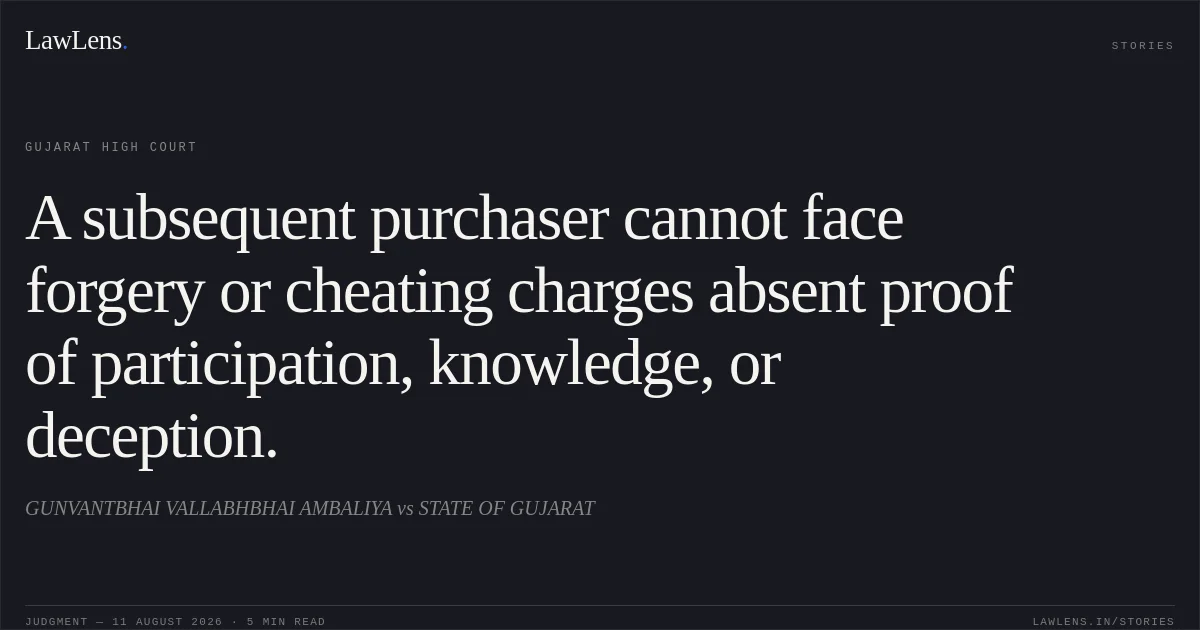
It held that a subsequent registered purchaser could not be subjected to criminal proceedings for forgery, cheating or allied offences solely on account of alleged defects or falsity in antecedent Powers of Attorney, absent proof of authorship, knowledge, participation or deception attributable to him.
Source reference: paras. 14–14.1; pp. 31–32Criminal Misc. Application No. 5275 of 2016 was allowed, and FIR C.R. No. I-04 of 2016, the charge-sheet and all consequential criminal proceedings were quashed only insofar as they concerned Gunvantbhai Vallabhbhai Ambaliya.
Source reference: para. 15; p. 33Criminal Misc. Application No. 7386 of 2016 filed by Hemant Ramakant Dusputre was rejected, and any interim relief in that application stood vacated.
Source reference: para. 15.1; p. 33The Court clarified that its observations were confined to deciding the quashing applications and would not affect the pending or future civil proceedings.
Source reference: para. 15.2; p. 33Acts & Sections Cited
25 provisions across 4 statutes referred to in this judgment. Each provision opens on LawLens.
Code of Criminal Procedure, 19738
Indian Penal Code, 1860
Bharatiya Nagarik Suraksha Sanhita, 20231
Indian Contract Act, 18721
Original Court PDF
GUNVANTBHAI VALLABHBHAI AMBALIYAvsSTATE OF GUJARAT
Click to open original judgment
Original judgment, available to read, download and summarize on LawLens.in