Facts
Pursuant to an advertisement dated 22.07.2007 for appointment as Panchayat Karmi in Gram Panchayat Dharharkala, nine candidates, including the appellant and Respondent No. 6, applied.
Source reference: para. 2Although the appellant obtained higher marks and figured higher in the merit list, the Gram Panchayat selected Respondent No. 6 by majority resolution dated 10.08.2007, followed by an appointment order dated 11.08.2007.
Source reference: para. 2Respondent No. 6 joined on 12.08.2007 and continued uninterruptedly as Panchayat Karmi/Secretary.
Source reference: para. 2The appointment was challenged through multiple proceedings before the Sub-Divisional Officer, Collector, High Court, Division Bench, Additional Commissioner and, finally, the learned Single Judge.
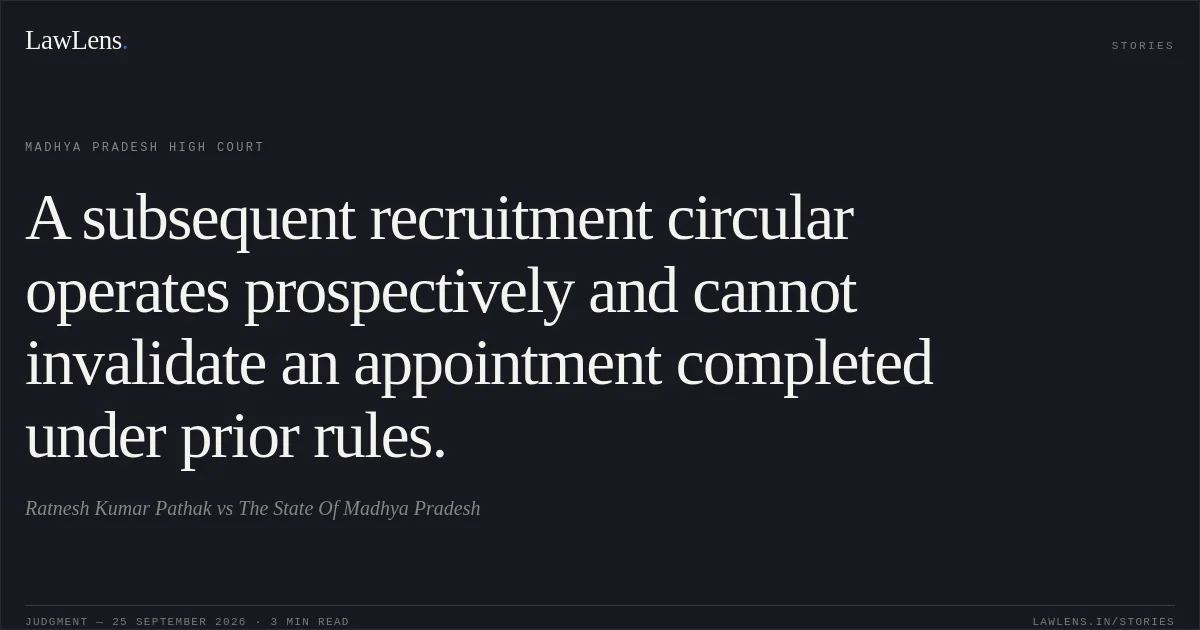
Source reference: para. 3The learned Single Judge dismissed the appellant’s writ petition on 05.12.2019, holding that the circular dated 13.08.2007, which introduced marks in the qualifying examination as the exclusive criterion, was prospective and did not invalidate the earlier appointment.
Source reference: para. 4Issues
Whether the appointment of Respondent No. 6 made on 11.08.2007 could be invalidated by applying the subsequent circular dated 13.08.2007 retrospectively.
Source reference: paras. 4, 11Whether the circular dated 27.01.2006 required selection solely on the basis of qualifying-examination marks in an appointment made by the Gram Panchayat, notwithstanding its preference clause for Scheduled Castes, Scheduled Tribes, Backward Classes and women.
Source reference: paras. 8–10Whether the learned Single Judge was justified in distinguishing the Division Bench decision in Suresh v. Chief Executive Officer & Others, ILR (2012) M.P. 698, and in declining relief on the ground of delay and laches.
Source reference: paras. 12–13Law Applied
The Court applied Section 70 of the Madhya Pradesh Panchayat Raj Avam Gram Swaraj Adhiniyam, 1993 and the Panchayat Karmi Yojna, under which the Gram Panchayat possesses the power of appointment.
Source reference: para. 8Section 86(1) empowers the prescribed authority to direct a Panchayat to perform a duty it has failed to perform, while Section 86(2) permits departmental performance of that duty through the Chief Executive Officer where the Panchayat fails to comply.
Source reference: para. 8The circular dated 27.01.2006 was construed as governing the Section 86(2) appointment process, including merit-based selection and preference for SCs, STs, Backward Classes and women.
Source reference: paras. 8–10The circular dated 13.08.2007 was held to operate prospectively; a subsequent recruitment policy ordinarily cannot retrospectively invalidate a completed selection absent express or necessary retrospective intent.
Source reference: para. 11The Court also applied the restricted scope of writ appellate review, under which interference is warranted only for perversity, illegality, jurisdictional error or misreading of the record.
Source reference: para. 7The Court also applied the principles of delay and laches governing discretionary relief under Article 226, relying on Mrinmoy Maity v. Chhanda Koley & Others, 2024 LiveLaw (SC) 318.
Source reference: para. 13Reasoning
The Division Bench held that Respondent No. 6’s appointment was completed on 11.08.2007, before issuance of the circular dated 13.08.2007; the later circular contained no express or implied retrospective intent and therefore could not be used to unsettle the appointment.
Source reference: para. 11The Court further accepted the distinction between a Gram Panchayat appointment under the existing statutory scheme and a departmental appointment by the Chief Executive Officer under Section 86(2).
Source reference: paras. 8–10Even assuming applicability of the circular dated 27.01.2006, its preference clause expressly supported candidates from specified socially disadvantaged categories, and Respondent No. 6 belonged to the Scheduled Caste (Charmakar) community.
Source reference: paras. 8–10Accordingly, the selection could not be treated as contrary to that circular.
Source reference: paras. 8–10The Court found the learned Single Judge’s distinction of Suresh reasoned and permissible because that decision had not considered the distinction between Sections 86(1) and 86(2) or the separate operation of the two circulars.
Source reference: para. 12Sarita Bai Patel was distinguishable on facts.
Source reference: para. 12Independently, Respondent No. 6 had served continuously for nearly two decades through several rounds of litigation, and the appellant had not satisfactorily explained the prolonged delay; disturbing the appointment at that stage would be inequitable and administratively disruptive.
Source reference: para. 13Holding
The Court answered the issues against the appellant.
It held that the circular dated 13.08.2007 was prospective, that Respondent No. 6’s appointment was not shown to violate the applicable statutory or policy framework, and that the appellant was additionally disentitled to discretionary relief by delay and laches.
Source reference: paras. 11–13Writ Appeal No. 395 of 2020 was dismissed, the learned Single Judge’s order dated 05.12.2019 was affirmed, and Respondent No. 6 was permitted to continue as Panchayat Karmi/Secretary of Gram Panchayat Dharharkala, District Anuppur.
Source reference: para. 15No order as to costs was made; pending interlocutory applications were closed.
Source reference: para. 15Acts & Sections Cited
3 provisions across 2 statutes referred to in this judgment. Linked provisions open on LawLens.
M.P. Uchcha Nyayalaya (Khand Nyayapeeth Ko Appeal) Adhiniyam, 20051
M.P. Panchayat Raj Avam Gram Swaraj Adhiniyam, 19932
Original Court PDF
Ratnesh Kumar PathakvsThe State Of Madhya Pradesh
Click to open original judgment
Original judgment, available to read, download and summarize on LawLens.in