Facts
The petitioner sought regular bail in FIR No. 121/2025 registered at Police Station Chhawla for offences under Sections 103(1), 238(b), 61(2) and 3(5) of the Bharatiya Nyaya Sanhita, 2023 (“BNS”).
Source reference: p.1, para.1On 15 March 2025, a decomposed body wrapped in a bedsheet and tied with a wire and concrete stone was recovered from the Najafgarh drain.
Source reference: p.2, para.3The body was subsequently identified through a nose pin and DNA profiling as that of Seema, who had been missing for approximately 15–20 days.
Source reference: p.2, para.3The petitioner had remained in custody since 4 April 2025. At the time of the bail hearing, 7 of 57 prosecution witnesses had been examined.
Source reference: p.3, para.4Issues
Whether the petitioner was entitled to regular bail in a case based principally on circumstantial evidence, including the alleged last-seen circumstance and the recovery of the deceased’s body.
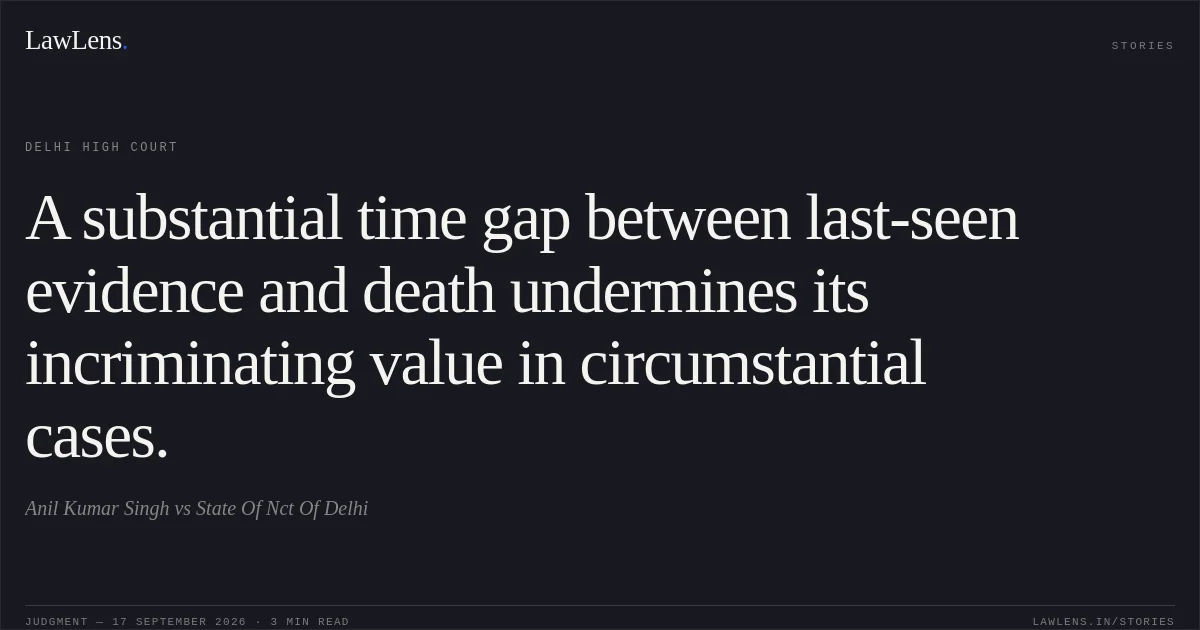
Source reference: p.4–5, paras.7–8Whether the alleged last-seen circumstance—that the deceased was seen with the petitioner on 11 March 2025—was sufficiently proximate to the estimated date of death to constitute incriminating evidence.
Source reference: p.3–5, paras.4, 7–8Whether the material relied upon by the prosecution, including the alleged strained relationship and WhatsApp chats, disclosed a prima facie motive or otherwise justified continued incarceration pending trial.
Source reference: p.3–4, paras.4–6Law Applied
The prosecution case invoked Sections 103(1), 238(b), 61(2) and 3(5) of the BNS.
Source reference: p.1, para.1The Court applied the principles governing bail in cases based on circumstantial evidence. It held that the chain of circumstances must be complete and every circumstance must be proved beyond reasonable doubt; the prosecution must bridge the distance between what “might have been” and what “must have been”.
Source reference: p.4–5, para.7The Court further applied the rule that a last-seen circumstance is incriminating only when it is incompatible with any reasonable hypothesis of innocence and is sufficiently proximate to the time of death.
Source reference: p.5, para.8At the bail stage, the Court also considered whether the material collected during investigation sufficiently justified continued deprivation of liberty, while cautioning that its prima facie observations would not bind the trial court.
Source reference: p.5, paras.9–10Reasoning
The Court found that the prosecution’s alleged last-seen circumstance lacked sufficient proximity because the petitioner was allegedly seen with the deceased on 11 March 2025, whereas the post-mortem evidence placed the estimated date of death on 13 March 2025, or at least 12 March 2025.
Source reference: p.3, para.4; p.5, para.8The Court held that it was not plausible to assume that the deceased could not have met anyone else during the intervening period; consequently, the circumstance did not inspire confidence at the bail stage.
Source reference: p.3, para.4; p.5, para.8The WhatsApp chats showed friction between the petitioner and the deceased, but even the prosecution conceded that they did not disclose such an extreme relationship or motive as could support an inference of an intention to kill.
Source reference: p.4, para.6Further, there was no clear evidence connecting the petitioner with the act of dumping the body in the drain, and the initial allegation of poisoning was contradicted by the post-mortem and viscera analysis.
Source reference: p.2–4, paras.3, 6In view of the incomplete circumstantial chain, the petitioner’s prolonged custody, and the fact that only 7 of 57 witnesses had been examined, continued incarceration was held to be unfair and legally unacceptable.
Source reference: p.3, para.4; p.5, para.10Holding
The Court allowed the bail application and directed that Anil Kumar Singh be released on regular bail, subject to furnishing a personal bond of ₹25,000 with one surety of the like amount to the satisfaction of the Trial Court or Duty Magistrate.
The accompanying application was disposed of, and the Jail Superintendent was directed to communicate the order to the petitioner.
Source reference: p.6, paras.11–12The Court clarified that its observations were confined to the determination of bail and would not influence the trial court’s final assessment of the evidence.
Source reference: p.5, para.9Acts & Sections Cited
4 provisions across 1 statute referred to in this judgment. Each provision opens on LawLens.
Bharatiya Nyaya Sanhita, 20234
Original Court PDF
Anil Kumar SinghvsState Of Nct Of Delhi
Click to open original judgment
Original judgment, available to read, download and summarize on LawLens.in