Facts
On 18.09.1984, the Union of India placed an order with the appellant for 48,310 boxes.
Source reference: p.2, para. 3After a dispute concerning non-supply of the first instalment, the matter was referred to arbitration.
Source reference: p.2, para. 3The first arbitrator recorded that the time to make the award had expired and adjourned the proceedings sine die, leaving the respondent to seek an extension from a competent court.
Source reference: pp.2–3, paras. 4–5Without obtaining a court extension, the respondent appointed a new arbitrator, who rejected the appellant’s jurisdictional objection and made an award for Rs.4,64,552 on 24.08.1992.
Source reference: p.3, paras. 5–6; p.1, para. 1The ADJ dismissed the appellant’s objections under Sections 16, 30 and 33 of the Arbitration Act, 1940, and made the award a rule of the court.
Source reference: pp.1, 3, paras. 1, 7The appellant challenged that decision under Section 39 of the Act.
Source reference: p.1, para. 1Issues
Whether, after the first arbitrator’s time to make the award had expired and the proceedings had been adjourned sine die, a succeeding arbitrator could proceed and make an award without a court order extending time under Section 28 of the Arbitration Act, 1940.
Source reference: pp.3–4, paras. 8–9Whether the appellant was precluded from raising that jurisdictional objection because it had not separately challenged the succeeding arbitrator’s order rejecting the objection.
Source reference: p.7, para. 14Law Applied
Rule 3 of the First Schedule to the Arbitration Act, 1940 provides the applicable period for making an award.
Source reference: p.4, paras. 10–11Under Section 28, the power to enlarge that period rests with the court; an arbitrator cannot extend the time, subject to the statutory qualification concerning the parties’ agreement identified in Hari Krishna Wattal v. Vaikunth Nath Pandya [(1973) 2 SCC 510].
Source reference: pp.4–5, 5–6, paras. 10–11In Hari Shanker Lal v. Shambhu Nath [AIR 1962 SC 78], the Supreme Court held that, once the applicable period expires, arbitrators become functus officio unless the court extends time.
Source reference: pp.4–5, para. 10Applying these principles, the Delhi High Court in Union of India v. Woodspot [2009 SCC OnLine Del 3059] and Union of India v. Peeco Hydraulic (P) Ltd. [2012 SCC OnLine Del 2495] held that, absent a lawful extension, a succeeding arbitrator cannot continue the reference and an award made by that arbitrator is vitiated.
Source reference: pp.6–7, paras. 12–13Reasoning
The first arbitrator expressly recorded that the time to make the award had expired and adjourned the proceedings sine die, directing the respondent to obtain a court extension.
Source reference: pp.2–3, para. 4The respondent obtained no such extension and instead appointed a succeeding arbitrator; nor was there an agreement between the parties extending time in accordance with law.
Source reference: p.7, para. 14Applying Section 28 and the cited authorities, the Court held that the succeeding arbitrator lacked jurisdiction to continue the reference.
Source reference: p.7, para. 14The appellant’s failure to separately challenge the arbitrator’s order rejecting its objection did not bar the jurisdictional challenge to the award, which was subsequently raised in objections under Sections 16, 30 and 33.
Source reference: p.7, para. 14Holding
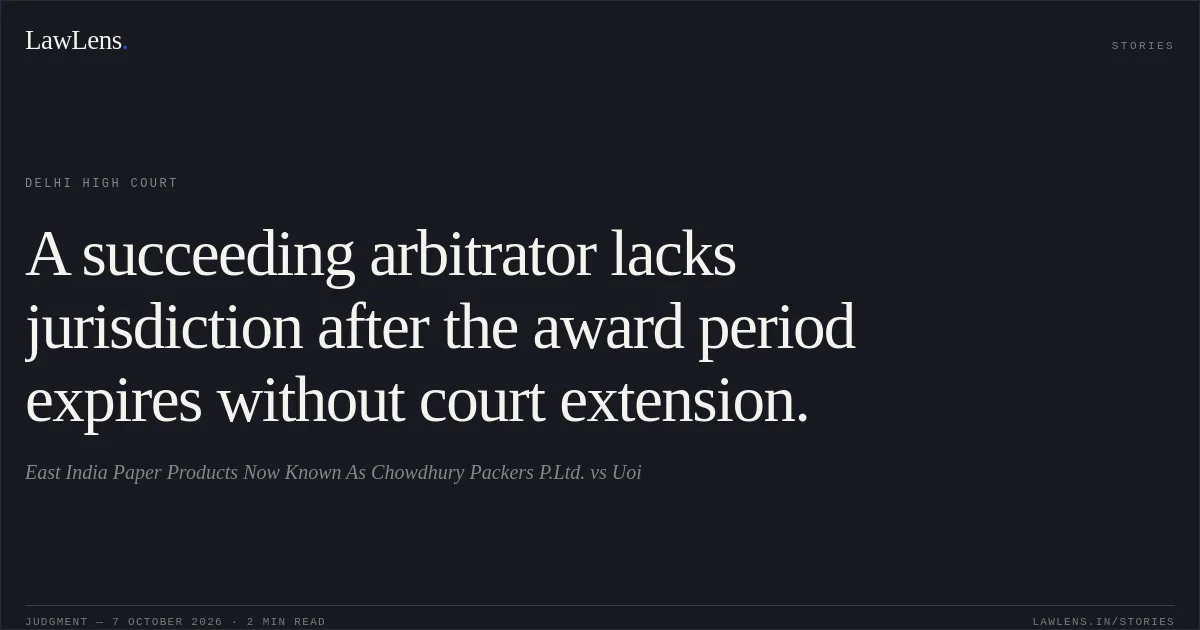
The Court held that the succeeding arbitrator could not proceed without a court-ordered extension of time under Section 28; the award was therefore vitiated as a nullity.
It allowed the appeal and set aside both the ADJ’s judgment and decree dated 19.12.2007 and the arbitral award dated 24.08.1992.
Source reference: p.8, para. 16Acts & Sections Cited
5 provisions across 1 statute referred to in this judgment. Linked provisions open on LawLens.
Arbitration Act, 19405
Original Court PDF
East India Paper Products Now Known As Chowdhury Packers P.Ltd.vsUoi
Click to open original judgment
Original judgment, available to read, download and summarize on LawLens.in