Facts
The petitioners sought a succession certificate for service and terminal benefits of late R. Sundar Singh, who died intestate on 21 November 2017.
Source reference: pp. 2–7, paras. 2–14The first petitioner, now deceased, claimed to have married him in 1997; petitioners 2 and 3 claimed to be their children. Prema @ Fathima contested the petition, asserting that she had married the deceased in 1986 and had a son with him.
Source reference: pp. 2–7, paras. 2–14The employer and Tahsildar had declined to act on the competing claims. The evidence included a photocopy of the petitioners’ alleged marriage certificate, service records and nominations identifying the petitioners as family members, and testimony from both sides. The first petitioner died before cross-examination; the petition was continued by petitioners 2 and 3.
Source reference: pp. 2–7, paras. 2–14Issues
Whether the petitioners established a prima facie best title to the deceased’s estate sufficient to warrant a succession certificate under Section 373(3) of the Indian Succession Act, 1925.
Source reference: p. 8, para. 15; p. 10, para. 21Whether the competing claims to marital status, parentage and heirship could be determined in these summary proceedings.
Source reference: pp. 9–10, paras. 17–21Whether family pension could be included in a succession certificate as a debt due to the deceased.
Source reference: p. 11, para. 22Law Applied
Under Section 372 of the Indian Succession Act, 1925, an applicant may seek a succession certificate in respect of debts and securities of a deceased person. Section 373(3) permits the court, even where questions of law or fact arise, to grant a certificate to the person who appears to have prima facie the best title; succession-certificate proceedings are summary and are not the forum for finally resolving complex disputes of status or heirship.
Source reference: p. 10, para. 21Section 387 provides that a decision in such proceedings does not bar a subsequent suit on the same questions.
Source reference: p. 11, para. 23The court also noted that family pension payable under service rules to an eligible family member is not a debt due to the deceased.
Source reference: p. 11, para. 22It referred to the Hindu Marriage Act, 1955 and the Indian Christian Marriage Act, 1872 in considering the legal requirements for the alleged marriage, but found compliance with neither established on the evidence.
Source reference: p. 9, para. 17Reasoning
The court found that the petitioners had not demonstrated a sufficiently clear prima facie best title. The alleged 1997 marriage was supported principally by a photocopy of a certificate; the original was not produced, and neither an authorised solemniser, a relevant register custodian nor a marriage witness testified.
Source reference: pp. 8–9, paras. 16–18The service records and nominations naming the petitioners could not determine the validity of the marriage or conclusively establish entitlement, particularly given the respondent’s competing claim.
Source reference: pp. 8–9, paras. 16–18The respondent’s alleged 1986 marriage and the related questions of marital status, parentage and heirship likewise raised matters too intricate for final determination in summary proceedings.
Source reference: p. 10, paras. 20–21Family pension was outside the scope of a succession certificate because it was not a debt due to the deceased.
Source reference: p. 11, para. 22Holding
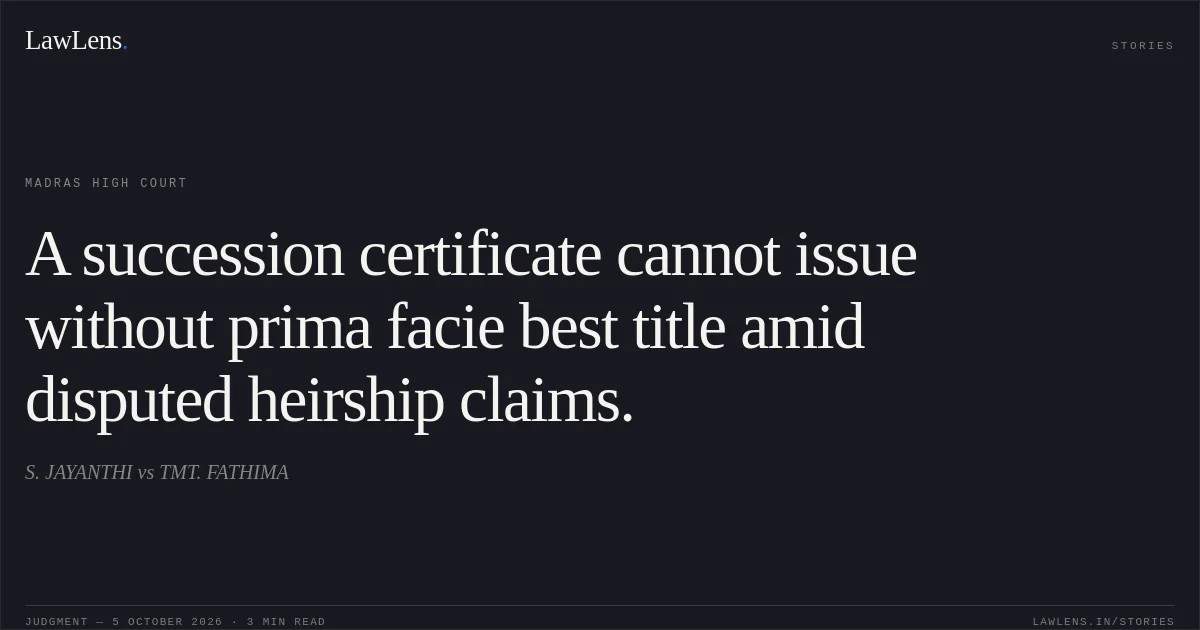
The court held that the petitioners had not established a prima facie best title to justify a succession certificate.
The court dismissed O.P. No. 624 of 2019 without costs.
Source reference: p. 11, para. 24It made no final determination on either alleged marriage, the status of petitioners 2 and 3, or the parties’ ultimate succession rights, leaving those matters open for adjudication before a competent civil court; the decision does not bar such proceedings under Section 387.
Source reference: p. 11, para. 23Entitlement to family pension was left to the employer to determine under the applicable service rules.
Source reference: p. 11, para. 22Acts & Sections Cited
3 provisions across 1 statute referred to in this judgment. Each provision opens on LawLens.
Indian Succession Act, 19253
Original Court PDF
S. JAYANTHIvsTMT. FATHIMA
Click to open original judgment
Original judgment, available to read, download and summarize on LawLens.in