Facts
The plaintiffs, children of late Raghuraje Urs and defendant No. 1 Lakshmamma, sought partition and separate possession of their claimed shares in A- and B-schedule properties.
Source reference: pp. 3–5, 8–13They pleaded that the properties were acquired with joint-family funds and contributions, although certain properties stood in Lakshmamma’s name; they also challenged a sale deed concerning one property.
Source reference: pp. 3–5, 8–13Lakshmamma’s written statement admitted the plaintiffs’ material claims and supported partition, while defendants Nos. 2 and 3 did not file written statements before the Trial Court.
Source reference: pp. 5, 14–16The Trial Court dismissed the suit, treating the properties standing in Lakshmama’s name as her absolute property under Section 14(1) of the Hindu Succession Act, and the First Appellate Court affirmed that decision.
Source reference: pp. 6–7The plaintiffs appealed to the High Court, which framed two substantial questions of law concerning the use of Order XII Rule 6 CPC and the finding that the properties were Lakshmamma’s self-acquired properties without a trial.
Source reference: p. 8Issues
1. Whether the Trial Court and First Appellate Court were justified in invoking Order XII Rule 6 CPC in the circumstances of the case.
Source reference: p. 82. Whether the courts below erred in concluding, without trial or evidence, that the suit properties were Lakshmamma’s absolute, separate and self-acquired properties.
Source reference: p. 8Law Applied
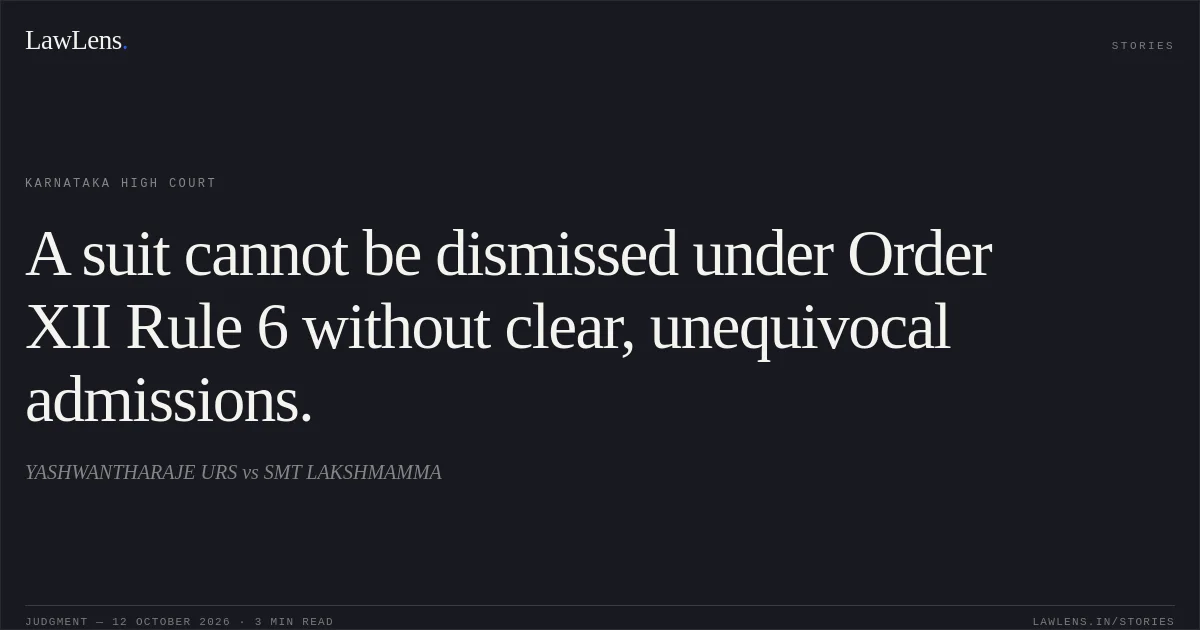
Order XII Rule 6 CPC permits a court to enter judgment on admissions made in pleadings or otherwise, but its discretionary power should be exercised only where the admission is clear, categorical, unambiguous and unequivocal; where material disputes or triable questions remain, the court may require evidence rather than deny a party a trial.
Source reference: pp. 17–18, 54–55The judgment relies on Rajiv Ghosh v. Satya Naryan Jaiswal, 2025 SCC OnLine SC 751, and Pushpa v. Dayawati, 2026 SCC OnLine SC 1013, for these principles.
Source reference: pp. 18–54Section 14(1) of the Hindu Succession Act was the basis of the lower courts’ conclusion about Lakshmamma’s ownership, but the High Court did not decide its application on the merits.
Source reference: pp. 6–7, 55–56Reasoning
The High Court found no clear admission in the plaint that could justify disposing of the suit under Order XII Rule 6 CPC.
Source reference: pp. 55–56The plaintiffs’ case was that the properties were joint-family properties acquired through family funds and contributions, notwithstanding registration in Lakshmamma’s name.
Source reference: pp. 55–56Further, Lakshmamma’s written statement admitted those claims, including the plaintiffs’ asserted entitlement to shares; it therefore did not support dismissing the suit on an admission against the plaintiffs.
Source reference: pp. 14–16, 55–56The courts below had treated title standing in Lakshmamma’s name as sufficient to determine the properties’ character under Section 14(1), without a trial or evidence.
Source reference: pp. 55–56The High Court held that Order XII Rule 6 CPC did not permit that disposition on these pleadings.
Source reference: pp. 55–56Having answered the first substantial question in the plaintiffs’ favour, it held that the second question did not survive for consideration.
Source reference: pp. 55–56Holding
The appeal was allowed, and the judgments and decrees of the Trial Court and First Appellate Court were set aside.
The matter was remitted to the Trial Court for fresh consideration; defendants Nos. 2 and 3 were directed to file their written statement within one month of the parties’ appearance, and the parties were permitted to file responsive pleadings and adduce evidence.
Source reference: pp. 56–58The Trial Court was directed to frame issues after completion of pleadings and decide the suit expeditiously, uninfluenced by the High Court’s observations; all contentions on the merits were left open.
Source reference: pp. 56–58Acts & Sections Cited
6 provisions across 3 statutes referred to in this judgment. Each provision opens on LawLens.
Code of Civil Procedure, 19083
Hindu Succession Act, 19561
Original Court PDF
YASHWANTHARAJE URSvsSMT LAKSHMAMMA
Click to open original judgment
Original judgment, available to read, download and summarize on LawLens.in