Facts
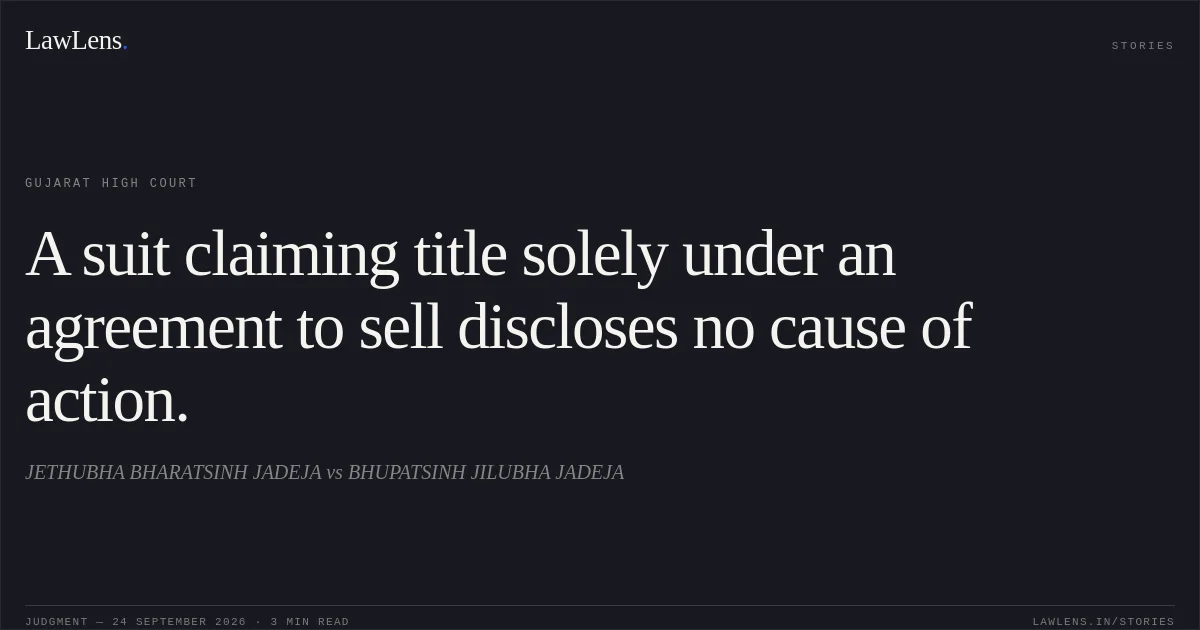
The plaintiff instituted Regular Civil Suit No. 108 of 2023 seeking a declaration that he had right, title and interest in the suit land, together with partition, possession of a 1/3rd share and permanent injunction.
Source reference: paras. 6–6.1, 13His claim was founded on an agreement to sell dated 11 April 1992, allegedly executed by defendant Nos. 1 and 6 in favour of the plaintiff’s uncle, Gajrajsinh, who was also stated to have been placed in possession.
Source reference: paras. 6–6.1, 13Gajrajsinh died issueless on 21 September 2013 without seeking specific performance of the agreement. The plaintiff claimed succession to Gajrajsinh’s alleged rights and filed the suit approximately ten years after his death.
Source reference: paras. 6–6.1, 13The original defendant Nos. 1 to 8 filed an application under Order VII Rule 11(a) and (d) of the Code of Civil Procedure, 1908, contending that the plaint disclosed no cause of action and that the suit was barred by limitation.
Source reference: paras. 4, 6.1, 7The trial court rejected the application on 21 August 2024, leading to the present revision application under Section 115 CPC.
Source reference: paras. 4, 6.1, 7Issues
1. Whether the plaint disclosed a cause of action when the plaintiff’s claim to title was based solely on an unregistered agreement to sell executed in favour of his deceased uncle, without any sale deed or decree for specific performance.
Source reference: paras. 14–162. Whether the plaintiff could maintain claims for partition, possession and permanent injunction as consequential reliefs in the absence of a legally sustainable claim to title.
Source reference: paras. 16.1, 173. Whether the suit was barred by limitation under Order VII Rule 11(d) CPC.
Source reference: paras. 8–8.2, 18Law Applied
The Court applied Order VII Rule 11(a) CPC, under which a plaint must be rejected where it does not disclose a cause of action, and Section 54 of the Transfer of Property Act, 1882, which provides that an agreement to sell does not, by itself, create any interest or charge in immovable property.
Source reference: para. 14Relying on Suraj Lamp & Industries (P) Ltd. v. State of Haryana, (2012) 1 SCC 656, the Court reiterated that rights, title or interest in immovable property cannot be transferred without a duly executed, stamped and registered conveyance deed.
Source reference: para. 14The Court further held that consequential reliefs cannot survive when the principal declaratory relief is legally unsustainable.
Source reference: paras. 16.1, 17Although limitation was raised under Order VII Rule 11(d) CPC, the Court expressly declined to adjudicate that issue.
Source reference: para. 18Reasoning
The Court found that the plaintiff’s entire claim rested on the 1992 agreement to sell in favour of Gajrajsinh.
Source reference: paras. 14–16Since an agreement to sell does not transfer title, and no registered conveyance deed had been executed in favour of either Gajrajsinh or the plaintiff, no right, title or interest in the suit land had accrued to them.
Source reference: paras. 14–16Gajrajsinh had also never sought specific performance during his lifetime, while the plaintiff did not seek specific performance in the present suit.
Source reference: paras. 15–17The Court therefore held that the plaintiff could not inherit or assert a title that had never vested in his uncle.
Source reference: paras. 15–17The claims for partition, possession and permanent injunction were consequently unsustainable because they depended upon the defective declaration of title.
Source reference: paras. 15–17The Court characterised the pleading as an attempt to obtain title through an agreement to sell by means of declaratory relief and held that it disclosed no enforceable cause of action.
Source reference: para. 19Holding
The Gujarat High Court allowed the revision application and held that the plaint did not disclose a cause of action under Order VII Rule 11(a) CPC.
It quashed and set aside the trial court’s order dated 21 August 2024, allowed the defendants’ application below Exhibit 10, and rejected the plaint in Regular Civil Suit No. 108 of 2023.
Source reference: paras. 18–21The Court did not express any opinion on the limitation issue.
Source reference: paras. 18–21Rule was made absolute, with no order as to costs.
Source reference: paras. 18–21Acts & Sections Cited
2 provisions across 2 statutes referred to in this judgment. Each provision opens on LawLens.
Code of Civil Procedure, 19081
Transfer of Property Act, 18821
Original Court PDF
JETHUBHA BHARATSINH JADEJAvsBHUPATSINH JILUBHA JADEJA
Click to open original judgment
Original judgment, available to read, download and summarize on LawLens.in