Facts
The plaintiff sued for specific performance of an agreement of sale dated 24 January 2006, alleging that the full consideration had been paid and that completion was to follow the defendant’s name being entered in the revenue records.
Source reference: pp. 3–6The trial court accepted that the agreement was lawfully executed and the consideration paid, but dismissed the suit; the first appellate court affirmed, holding that the suit was time-barred.
Source reference: pp. 3–6The plaintiff had issued a notice demanding performance on 12 March 2014, and the defendant refused by reply dated 5 April 2014.
Source reference: pp. 3–6The suit was filed on 2 June 2017.
Source reference: pp. 3–6The plaintiff appealed to the High Court under Section 100 CPC.
Source reference: pp. 3–6Issues
1. Whether the suit for specific performance was barred by limitation under Article 54 of the Limitation Act, 1963, when the defendant refused performance on 5 April 2014 and the suit was filed on 2 June 2017
Source reference: pp. 6–92. Whether the limitation period should instead be reckoned from the defendant’s subsequent entry in the revenue records, as contended by the plaintiff
Source reference: pp. 6–7Law Applied
Article 54 of the Limitation Act, 1963 prescribes a three-year limitation period for a suit for specific performance, running from the date fixed for performance or, where no such date is fixed, from when the plaintiff has notice that performance is refused.
Source reference: pp. 8–9In a second appeal under Section 100 CPC, interference requires a substantial question of law.
Source reference: pp. 8–9The Court also stated that limitation bars the remedy, though not the right.
Source reference: pp. 8–9Reasoning
Although the agreement specified no date for completion and contemplated completion after the defendant’s name was entered in the revenue records, the plaintiff had demanded performance by notice and received an unequivocal refusal on 5 April 2014.
Source reference: pp. 7–9That refusal triggered Article 54’s three-year period.
Source reference: pp. 7–9The plaintiff did not dispute the reply or the refusal, and filing on 2 June 2017 was beyond the prescribed period.
Source reference: pp. 7–9The later revenue-record entry did not alter the limitation calculation in light of the earlier refusal.
Source reference: pp. 7–9The High Court found no substantial question of law warranting intervention.
Source reference: pp. 7–9Holding
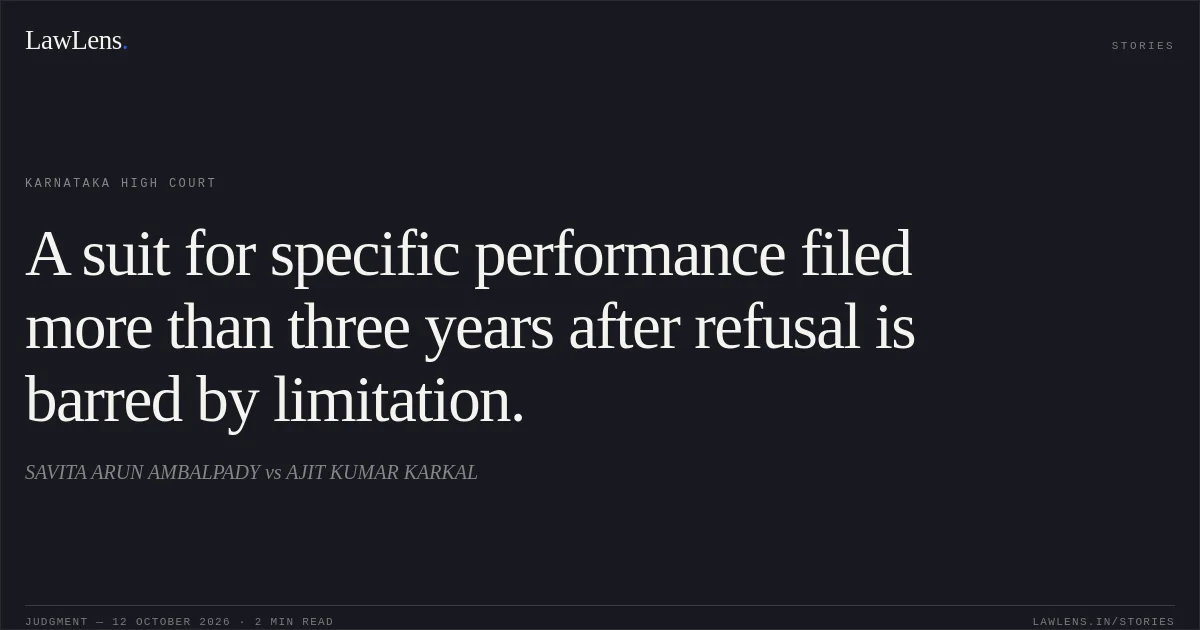
The High Court held that the suit was barred by limitation under Article 54 and that no substantial question of law arose for consideration.
It dismissed the second appeal, leaving undisturbed the judgments and decrees of the trial court and first appellate court.
Source reference: p. 9Acts & Sections Cited
2 provisions across 2 statutes referred to in this judgment. Each provision opens on LawLens.
Code of Civil Procedure, 19081
Limitation Act, 19631
Original Court PDF
SAVITA ARUN AMBALPADYvsAJIT KUMAR KARKAL
Click to open original judgment
Original judgment, available to read, download and summarize on LawLens.in


