Facts
The petitioner, a retired Senior Wardner, was suspended by Order No. 17 dated 7 February 2022 issued by the Superintendent, District Prison, Biharsharif, Nalanda.
Source reference: p. 2, para. 2His suspension continued from February to December 2022. He received subsistence allowance only for December 2022 and sought payment for the remaining period.
Source reference: pp. 2–3, paras. 2–4The State contended that, under the proviso to Rule 10(1) of the Bihar Government Servants (Classification, Control and Appeal) Rules, 2005, payment was conditional upon daily attendance at the designated headquarters.
Source reference: pp. 2–3, paras. 2–4Since the petitioner reported to the Hajipur headquarters only on 3 August 2022 and marked attendance for only 20 days between August and November 2022, the State paid him ₹23,612 for those 20 days and denied the balance.
Source reference: pp. 2–3, paras. 2–4The petitioner challenged the withholding of subsistence allowance and also sought interest.
Source reference: p. 2, para. 2Issues
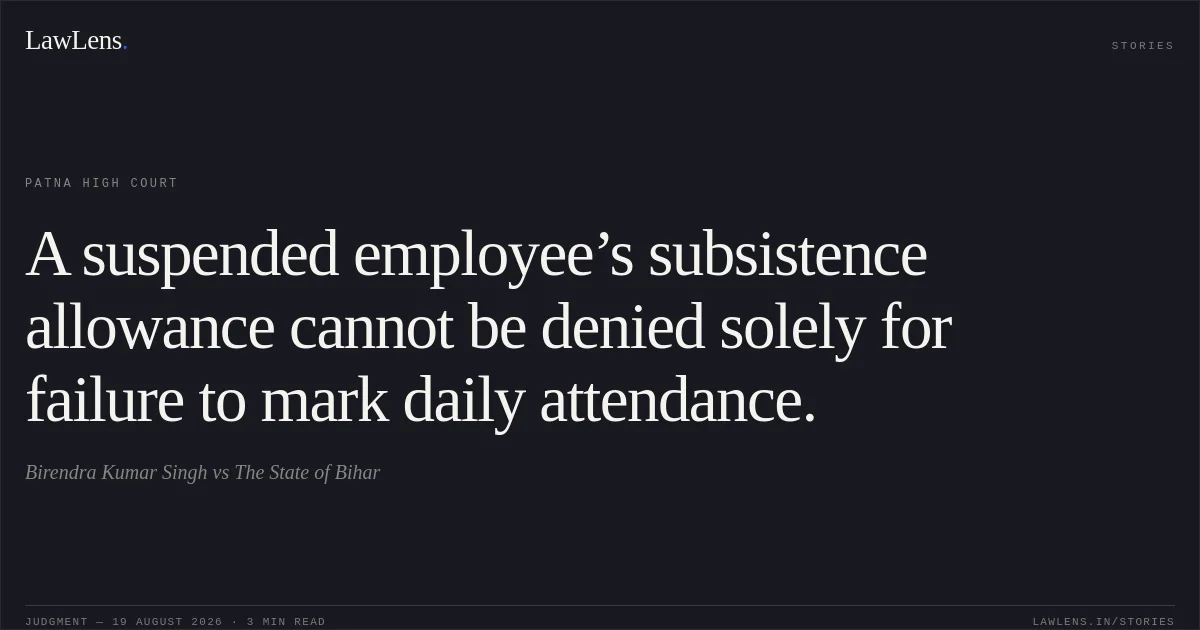
Whether a suspended employee’s entitlement to subsistence allowance can be denied or extinguished solely because he did not mark daily attendance at the designated headquarters under the proviso to Rule 10(1) of the 2005 Rules.
Source reference: p. 3, para. 5Whether non-marking of attendance by a suspended employee can be treated as unauthorised absence so as to justify withholding subsistence allowance.
Source reference: p. 5, para. 9Whether the petitioner was entitled to payment of subsistence allowance for the period from February to November 2022 and to appropriate directions concerning the pending departmental proceeding.
Source reference: p. 6, para. 12Law Applied
The Court applied the proviso to Rule 10(1) of the Bihar Government Servants (Classification, Control and Appeal) Rules, 2005, in light of the principle that subsistence allowance is a legal right and not a bounty, as held in Jagdamba Prasad Shukla v. State of U.P., 2000 AIR SC 2806.
Source reference: p. 3, para. 6Relying on State of Bihar v. Arbind, (2013) 16 SCC 615, and O.P. Gupta v. Union of India, (1987) 4 SCC 328, the Court recognised subsistence allowance as a minimum means of maintenance and survival during suspension.
Source reference: p. 4, para. 7It further relied on Anwarun Nisha Khatoon v. State of Bihar, (2002) 6 SCC 703, for the principle that a suspended employee cannot be mechanically compelled to mark attendance every day as a condition for receiving subsistence allowance.
Source reference: p. 4, para. 8The Court also applied the maxim lex non cogit ad impossibilia—the law does not compel the impossible—and treated subsistence allowance as connected with the right to life under Article 21 of the Constitution.
Source reference: pp. 3, 5–6, paras. 5, 10–11It further relied on Dr. Arun Kumar Prasad v. State of Bihar, LPA No. 752 of 2017, for the proposition that failure to sign the attendance register during suspension cannot automatically be treated as unauthorised absence.
Source reference: p. 5, para. 9Reasoning
The Court held that the State could not rely mechanically on the attendance requirement to deny the petitioner subsistence allowance.
Source reference: pp. 4, 5–6, paras. 7, 10–11Subsistence allowance exists to provide a suspended employee with the minimum means necessary for sustenance, and its non-payment may make it financially impossible for the employee to survive and participate meaningfully in the disciplinary process.
Source reference: pp. 4, 5–6, paras. 7, 10–11The Court found that treating the petitioner’s failure to mark attendance as unauthorised absence was legally unsustainable because suspension itself keeps an employee away from regular duties and is intended to prevent interference with official records or witnesses.
Source reference: p. 5, para. 9Requiring the petitioner to relocate to and maintain himself at another headquarters without first providing subsistence allowance would amount to compelling the impossible and would be inconsistent with Article 21.
Source reference: pp. 3, 5–6, paras. 5, 11Accordingly, the State’s payment limited to the 20 days of recorded attendance did not discharge its legal obligation.
Source reference: no citationHolding
The writ petition was disposed of with a direction to the concerned respondent to pay the petitioner the subsistence allowance claimed for the period from February to November 2022, in accordance with law.
The authority was also directed to conclude the pending departmental proceeding, which had continued beyond the statutory period prescribed under the 2005 Rules.
Source reference: p. 6, para. 12The petitioner was given liberty to submit a detailed representation to the competent authority for redressal of his grievance.
Source reference: p. 6, para. 13Original Court PDF
Birendra Kumar SinghvsThe State of Bihar
Click to open original judgment
Original judgment, available to read, download and summarize on LawLens.in