Facts
The first respondent, an employee/Secretary of the appellant Co-operative Society, challenged proceedings dated 07.09.2021 by which he was placed under suspension, seeking certiorarified mandamus to quash the proceedings.
Source reference: p.2The learned Single Judge allowed the writ petition, treating the proceedings dated 07.09.2021 as a charge memo and holding that its contents were verbatim identical to an earlier charge memo dated 31.05.2021; the Court consequently found the subsequent proceedings to have been issued without reference to the earlier charge memo and with mala fide intent.
Source reference: p.2During the pendency of the appeal, a regular charge memo was issued, the respondent submitted his statement of defence, an Enquiry Officer was appointed, disciplinary proceedings were conducted, and findings were returned.
Source reference: p.2Issues
1. Whether the learned Single Judge was justified in quashing the proceedings dated 07.09.2021 on the basis that they constituted a duplicative and mala fide charge memo.
Source reference: p.22. Whether an order of suspension could be quashed when the subsequent disciplinary proceedings had already progressed to the stage of completion of enquiry and submission of findings.
Source reference: p.2–33. Whether the validity of the suspension order had to be examined independently from the validity or contents of the charge memo.
Source reference: p.2–3Law Applied
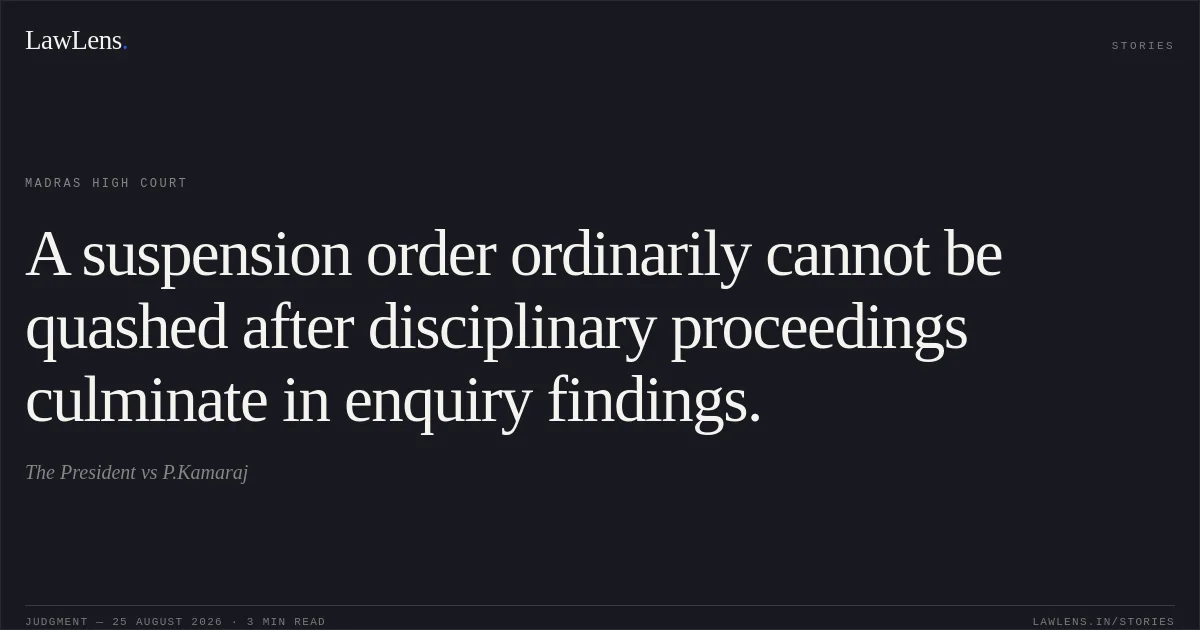
The Court applied the principle that an order of suspension ordinarily should not be quashed at the threshold, particularly where disciplinary proceedings are proposed or are already underway; the normal course is to permit disciplinary proceedings to continue when the explanation to the charge memo is found unsatisfactory.
Source reference: p.3Interference with or quashing of a suspension order is warranted only in an extremely rare circumstance.
Source reference: p.3The Court further applied the procedural distinction between an order of suspension and a charge memo, holding that the legality of the suspension must be assessed as the issue actually challenged, and not by treating it as a challenge to the contents or duplication of the charge memo.
Source reference: p.2–3No specific statutory provision or judicial precedent was cited in the judgment.
Source reference: no citationReasoning
The learned Single Judge proceeded on the premise that the proceedings dated 07.09.2021 were a charge memo and focused on their alleged identity with the earlier charge memo dated 31.05.2021.
Source reference: p.2The Division Bench held that the challenged proceedings were, in substance, an order of suspension, and that the issue before the Single Judge was the validity of the suspension rather than the merits or wording of the charge memo.
Source reference: p.3Since a regular charge memo had subsequently been issued, a defence had been filed, an enquiry had been conducted, and findings had been returned, the suspension order no longer survived independently and had merged into the subsequent disciplinary process.
Source reference: p.2In the absence of an extremely rare circumstance warranting judicial interference, the disciplinary proceedings were required to be allowed to take their course.
Source reference: p.3Holding
The Division Bench answered the issues in favour of the appellants.
It held that the learned Single Judge had incorrectly proceeded on the basis that the disputed proceedings were a charge memo, whereas the actual subject matter was an order of suspension.
Source reference: p.3The order dated 14.11.2024 in W.P.(MD) No.22296 of 2022 was set aside, the writ appeal was allowed, and no costs were imposed.
Source reference: p.3The connected miscellaneous petition was closed.
Source reference: p.3Original Court PDF
The PresidentvsP.Kamaraj
Click to open original judgment
Original judgment, available to read, download and summarize on LawLens.in
![Courts will not interfere with transfers absent mala fides or violation of statutory rules.. M Ramya vs EMPLOYEES STATE INSURANCE CORPORATION (ESIC). CAT - ['Chennai']. LawLens](/stories/thumbnails/courts-will-not-interfere-with-transfers-absent-mala-fides-or-violation-of-statutory-rules-a6845e9ca6f548fca284c51c8351957f.webp)
![Courts cannot direct one-time recruitment age relaxation absent authority in the governing rules or advertisement.. UT OF PUDUCHERRY vs M ANDAL. CAT - ['Chennai']. LawLens](/stories/thumbnails/courts-cannot-direct-one-time-recruitment-age-relaxation-absent-authority-in-the-governing-895d78fde47143e2a8ed0207c4b6a44f.webp)
![A review cannot correct an allegedly erroneous decision absent an error apparent on the record.. Ajit Kumar Jha vs RAILWAY BOARD. CAT - ['Delhi']. LawLens](/stories/thumbnails/a-review-cannot-correct-an-allegedly-erroneous-decision-absent-an-error-apparent-on-the-re-8ac952fd4eba470c92f7da20af72a220.webp)