Facts
The parties married on 13 July 2016 and lived separately from 26 February 2017.
Source reference: para. 1–2The husband sought divorce under Section 13(1)(ia) of the Hindu Marriage Act, 1955 (“HMA”), alleging cruelty; the wife sought restitution of conjugal rights under Section 9.
Source reference: para. 1–2The Family Court granted divorce, dismissed the restitution petition and awarded the wife ₹16,00,000 as permanent alimony.
Source reference: para. 1–2, 5On appeal, the wife’s counsel stated that she no longer challenged the divorce decree and confined the challenge to alimony and return of dowry articles.
Source reference: para. 3, 23The husband had placed the original alimony amount before the High Court during the appeal.
Source reference: para. 4Issues
1. Whether the evidence established cruelty under Section 13(1)(ia) HMA, warranting dissolution of the marriage.
Source reference: para. 6, 212. Whether the wife was entitled to restitution of conjugal rights under Section 9 HMA, given the circumstances of the separation.
Source reference: para. 6, 223. Whether the permanent alimony awarded by the Family Court required enhancement.
Source reference: para. 25–27Law Applied
Sections 13(1)(ia) and 9 HMA governed the claims for divorce on cruelty and restitution of conjugal rights, respectively.
Source reference: para. 2, 6Cruelty may be physical or mental; mental cruelty is assessed by drawing an inference from the facts and circumstances cumulatively, rather than treating an incident in isolation (*Suman Kapur v. Sudhir Kapur*, quoting *Parveen Mehta v. Inderjit Mehta*).
Source reference: para. 7Its assessment is contextual and depends on the parties’ circumstances and proved conduct (*Vishwanath Agrawal v. Sarla Vishwanath Agrawal*).
Source reference: para. 8Under *V. Bhagat v. D. Bhagat (Mrs.)*, mental cruelty is conduct causing such pain and suffering that the parties cannot reasonably be expected to live together; the assessment is fact-specific.
Source reference: para. 19*Samar Ghosh v. Jaya Ghosh* identifies illustrative, non-exhaustive instances of mental cruelty, including a prolonged separation where the matrimonial bond is beyond repair.
Source reference: para. 20The Court assessed permanent alimony in light of the parties’ financial circumstances, qualifications, employment and needs.
Source reference: para. 25–27Reasoning
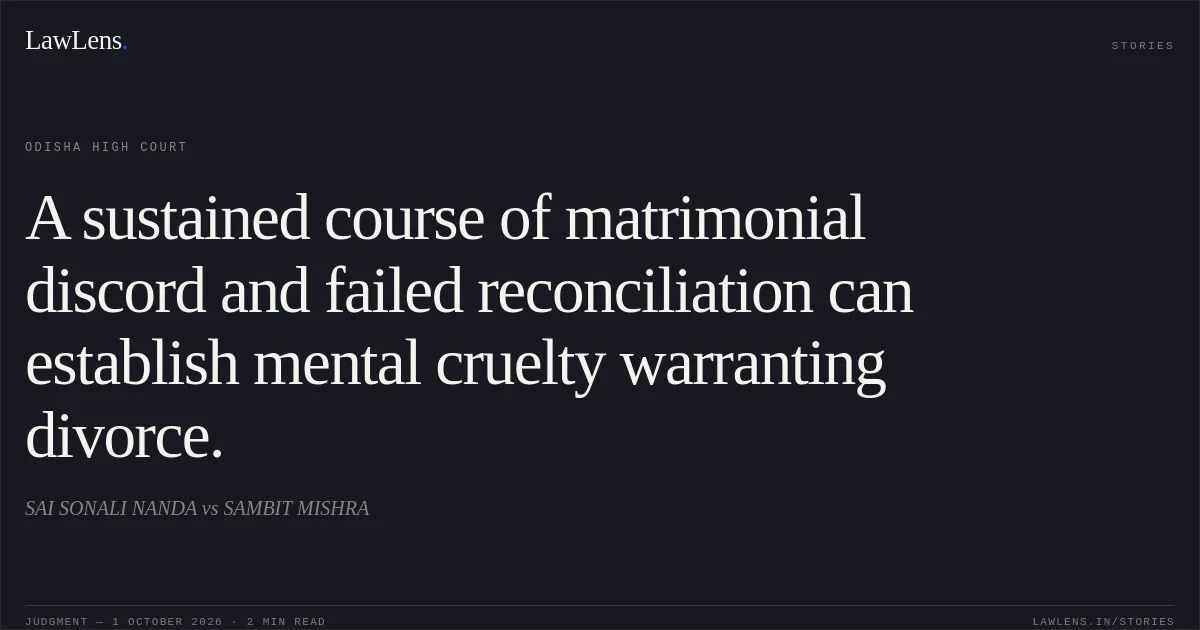
The Court considered the short period of cohabitation, separation since February 2017, absence of conjugal relations and communication, failed reconciliation efforts, and the serious allegations exchanged between the parties.
Source reference: para. 9–18, 21It found that the cumulative course of the relationship went beyond ordinary matrimonial discord and established mental cruelty; the wife’s allegations, including dowry demands and harassment, were not sufficiently proved.
Source reference: para. 9–18, 21In that context, the husband’s refusal to resume cohabitation was not withdrawal without reasonable cause, so the restitution claim failed.
Source reference: para. 22For alimony, the Court weighed the husband’s disclosed income and expenditure against the wife’s professional qualifications, prior employment and present non-employment, and concluded that an additional award was reasonable.
Source reference: para. 25–26Holding
The Court affirmed the divorce decree and dismissal of the wife’s Section 9 petition.
It enhanced permanent alimony by ₹9,00,000, making the total award ₹25,00,000; the additional amount was ordered in full and final satisfaction of the alimony claim.
Source reference: para. 26–28The Family Court’s judgment was modified to that extent and otherwise affirmed, and both appeals were disposed of.
Source reference: para. 28The operative portion records no separate direction concerning return of dowry articles.
Source reference: para. 28Acts & Sections Cited
3 provisions across 1 statute referred to in this judgment. Each provision opens on LawLens.
Hindu Marriage Act, 19553
Original Court PDF
SAI SONALI NANDAvsSAMBIT MISHRA
Click to open original judgment
Original judgment, available to read, download and summarize on LawLens.in