Facts
Sudhir Kumar Das, the appellant in a second appeal pending since 1974, died on 3 July 2002.
Source reference: para. 3–5His legal representatives applied in 2022 to be substituted, seeking condonation of a delay of nearly 20 years.
Source reference: para. 3–5They stated that they had learned of the appeal in April 2022 while making inquiries about land records and had not previously known of the litigation or its status.
Source reference: para. 3–5They also sought to bring on record the legal representatives of a deceased son of the appellant.
Source reference: para. 3–5The applicants attributed their lack of knowledge partly to the former advocate’s failure to inform them of the appeal.
Source reference: para. 6–8The Court considered whether to condone the delay in filing the substitution application.
Source reference: para. 18–22Issues
Whether the applicants showed “sufficient cause” under Section 5 of the Limitation Act, 1963, to condone the nearly 20-year delay in seeking substitution.
Source reference: para. 18–22Whether the subsequent application to bring the deceased respondents’ legal representatives on record could be entertained after the substitution-related application was dismissed.
Source reference: para. 23Law Applied
Section 3 of the Limitation Act bars proceedings filed after the prescribed limitation period, while Section 5 permits condonation where sufficient cause is shown; the discretion must be exercised judicially and on the facts of the case.
Source reference: para. 11–12Collector, Land Acquisition, Anantnag v. Mst. Katiji supports a liberal construction of “sufficient cause” in the interests of substantial justice, but Balwant Singh v. Jagdish Singh and Esha Bhattacharjee v. Managing Committee of Raghunathpur Nafar Academy clarify that liberal construction does not excuse negligence, inaction or lack of bona fides.
Source reference: para. 13–15The length of delay is not conclusive, but the explanation must be satisfactory and account for the delay; a litigant must also exercise reasonable diligence, and an advocate’s failure to inform the party does not, by itself, establish sufficient cause (B. Madhuri Goud v. B. Damodar Reddy).
Source reference: para. 16–17Although delay in substitution may differ from delay in filing an appeal, the distinction does not remove the requirement to explain the delay and demonstrate diligence (Om Prakash Gupta v. Satish Chandra).
Source reference: para. 19The Court also relied on Shivamma v. Karnataka Housing Board for the requirement that the entire period of delay be satisfactorily explained.
Source reference: para. 21Reasoning
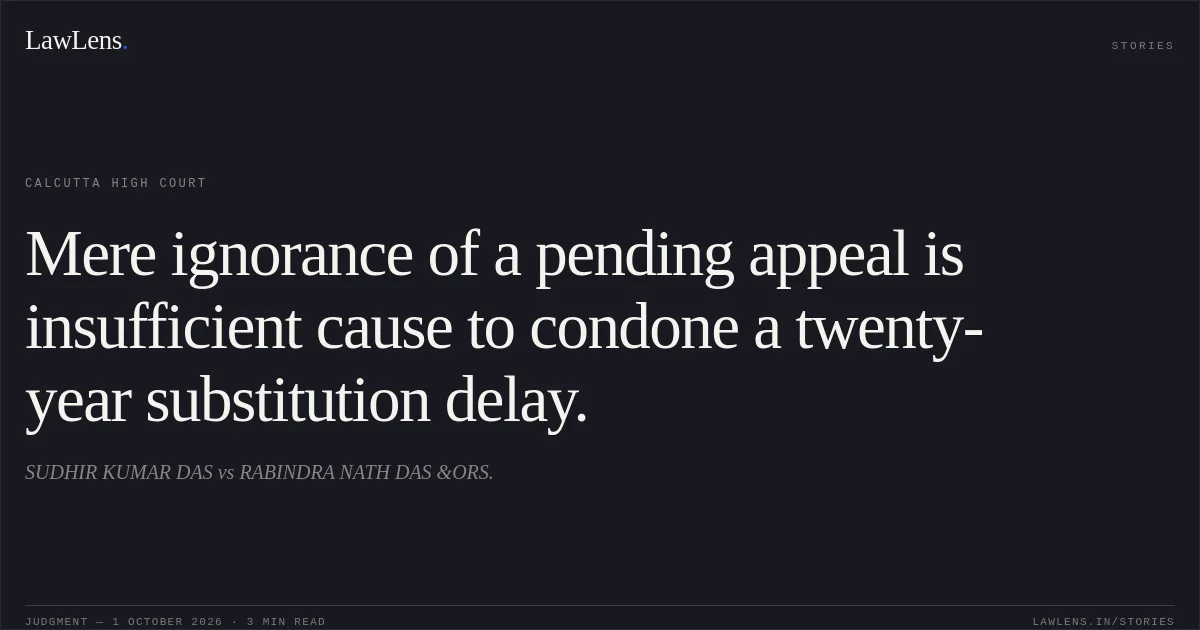
The applicants’ principal explanation was that they did not know the appeal was pending until April 2022, almost 20 years after the appellant’s death.
Source reference: para. 18, 20–22The Court found that they had not satisfactorily accounted for that prolonged period or shown the required diligence; alleged ignorance of the appeal was insufficient on these facts.
Source reference: para. 18, 20–22Nor did the asserted failure of the former advocate to provide information excuse the applicants’ own prolonged inaction.
Source reference: para. 17The Court distinguished Om Prakash Gupta, noting that the circumstances there did not displace the need for a satisfactory explanation in this case.
Source reference: para. 19Holding
The Court dismissed CAN 2 of 2022, refusing to condone the delay in seeking substitution.
It also dismissed the subsequent application, stating that it could not be entertained because CAN 1 of 2022 had not been admitted.
Source reference: para. 23The judgment identifies the later application in its opening as CAN 4 of 2026, but refers to CAN 1 of 2022 in the concluding paragraph.
Source reference: para. 23Acts & Sections Cited
2 provisions across 1 statute referred to in this judgment. Each provision opens on LawLens.
Original Court PDF
SUDHIR KUMAR DASvsRABINDRA NATH DAS &ORS.
Click to open original judgment
Original judgment, available to read, download and summarize on LawLens.in