Facts
The appeals challenged the appellants’ convictions under Sections 302/34, 201/34 and 120B of the Indian Penal Code (IPC), and Section 27 of the Arms Act, arising from the murder of Md. Abdul Kalam Ansari.
Source reference: paras. 2, 7The prosecution relied principally on evidence that the deceased had gone to meet Mannu Khan, last-seen evidence from Israil Haque, and recoveries said to have been made near Mannu Khan’s almirah godown.
Source reference: paras. 3, 11–18The High Court noted that the alleged call was not independently verified; the investigating officer did not establish ownership of the deceased’s phone or SIM; seizure lists were sent to court about a month after their preparation; and no seizure list was prepared for the motorcycle.
Source reference: paras. 29–31, 34The trial court convicted the appellants, who appealed against the judgment of conviction dated 5 December 2022 and sentence order dated 12 December 2022.
Source reference: paras. 2, 18–19Issues
1. Whether the circumstantial evidence, including the alleged last-seen evidence and recoveries, established a complete chain proving the appellants’ guilt beyond reasonable doubt.
Source reference: paras. 35, 39–402. Whether the delay in lodging the FIR and forwarding the seizure lists, considered with the investigative deficiencies, rendered the prosecution case unreliable.
Source reference: paras. 27–28, 31, 34, 37–39Law Applied
In a case based solely on circumstantial evidence, each circumstance must be fully established, consistent only with guilt, conclusive in nature, and form a complete chain excluding every reasonable hypothesis of innocence; the court relied on Sharad Birdhichand Sarda v. State of Maharashtra, (1984) 4 SCC 116.
Source reference: para. 35The prosecution must establish the material links in the criminological chain, including why, where, when, how and who committed the offence; a break or weakness in a link undermines the case, as explained in Dilavar Hussain v. State of Gujarat, (1991) 1 SCC 253.
Source reference: para. 36Prompt registration and transmission of an FIR are important safeguards against embellishment, although delay is assessed in the circumstances of each case; the court referred to Chotkau v. State of U.P., (2023) 6 SCC 742, quoting Meharaj Singh v. State of U.P., (1994) 5 SCC 188.
Source reference: paras. 37–38The court also relied on State of Gujarat v. Kishanbhai, (2014) 5 SCC 108, regarding review of investigative and prosecutorial failures following acquittal.
Source reference: paras. 45–47Reasoning
The alleged phone call that supposedly prompted the deceased to meet Mannu Khan was unsupported by call records or evidence establishing the relevant phone and SIM ownership.
Source reference: para. 29The court also found Israil’s account uncorroborated and considered his conduct in leaving the deceased with the accused without informing the family to undermine confidence in his testimony.
Source reference: paras. 33–34, 39The recoveries were doubtful in light of the delayed forwarding of seizure lists, the absence of a motorcycle seizure list, and inconsistencies concerning the alleged recovery of the lungi.
Source reference: paras. 27–31, 34No motive was reliably established, and the deceased’s wife testified that he had no dispute with the accused.
Source reference: paras. 32–33, 39Taken together, these deficiencies left gaps in the circumstantial chain; the court held that it was unsafe to sustain the convictions.
Source reference: paras. 39–40Holding
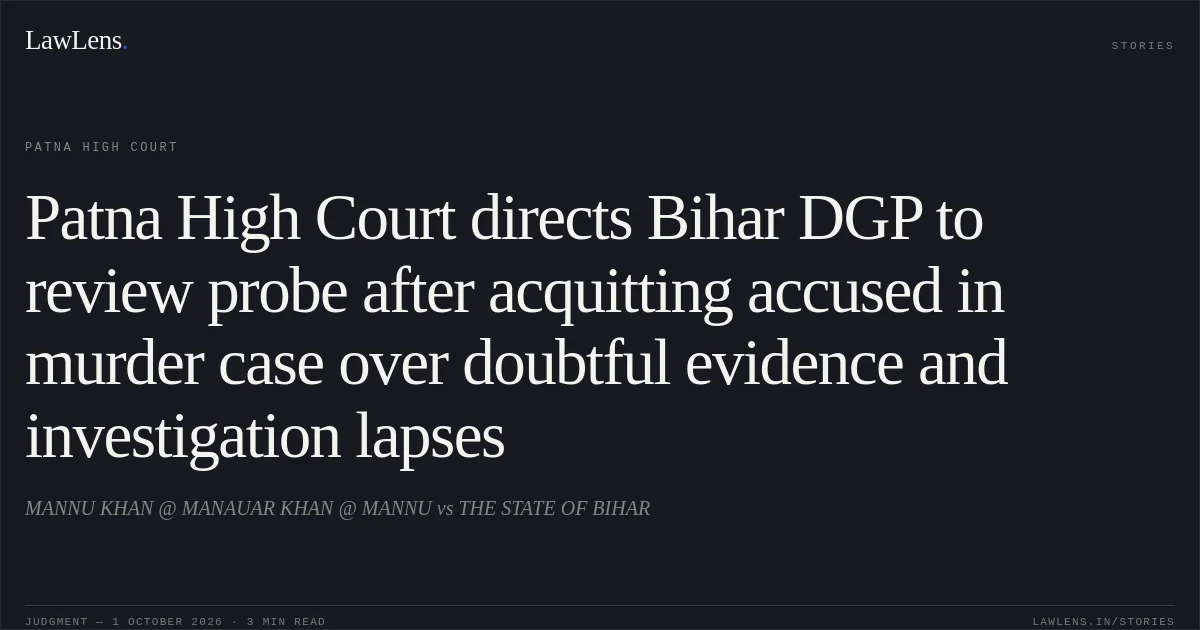
The High Court allowed both appeals, set aside the convictions and sentences, and acquitted the appellants on the benefit of doubt.
Mannu Khan was ordered released forthwith unless required in another case; the appellants on bail were discharged from their bail bonds and sureties.
Source reference: paras. 42–43The Court further directed the Director General of Police, Bihar, to constitute a three-member committee of senior police officers to review the investigation and take appropriate administrative action within three months, with the action taken to be communicated to the appellants.
Source reference: paras. 46–48Acts & Sections Cited
6 provisions across 3 statutes referred to in this judgment. Each provision opens on LawLens.
Indian Penal Code, 18603
Arms Act, 19591
Code of Criminal Procedure, 19732
Original Court PDF
MANNU KHAN @ MANAUAR KHAN @ MANNUvsTHE STATE OF BIHAR
Click to open original judgment
Original judgment, available to read, download and summarize on LawLens.in