Facts
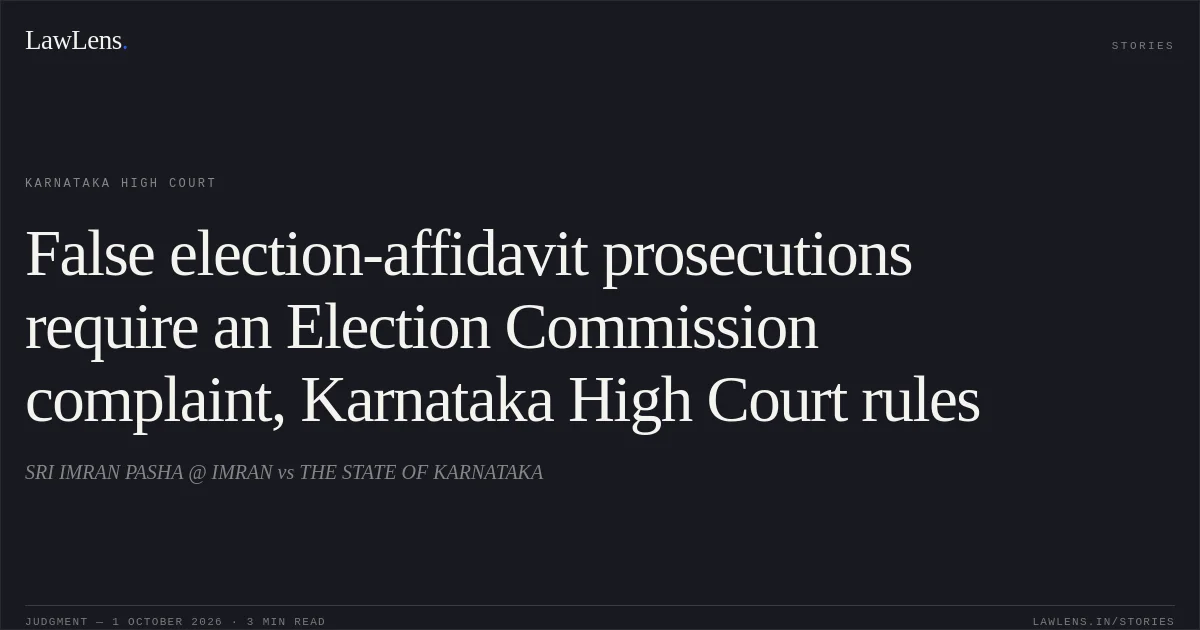
Respondent No. 2 filed a private complaint under Section 200 Cr.P.C. alleging offences under Sections 181, 191 and 193 IPC and Section 125A of the Representation of the People Act, 1951.
Source reference: para. 2–12The Magistrate referred the complaint for investigation under Section 156(3) Cr.P.C.; police registered a crime and filed a charge sheet, which was registered as C.C. No. 2761/2018.
Source reference: para. 2–12The petitioner sought to quash the charge sheet, contending that the offences could not be prosecuted on a private complaint because the required statutory complaints had not been made.
Source reference: para. 2–12Respondent No. 2 opposed the petition, including on the ground of delay; the petition was filed in 2024 while the case remained pending.
Source reference: para. 2–12, 17.1Issues
1. Whether a private citizen could file a private complaint for the alleged offences under Sections 181, 191 and 193 IPC and Section 125A of the Representation of the People Act, 1951.
Source reference: para. 14(i)2. Whether the High Court should intervene to quash the proceedings despite the petitioner’s delay in approaching it.
Source reference: para. 14(ii)Law Applied
Section 195(1)(a)(i) Cr.P.C. bars a court from taking cognisance of offences punishable under Sections 172–188 IPC, including Section 181, except on a written complaint by the public servant concerned or a public servant to whom that person is administratively subordinate.
Source reference: para. 16.1–16.3, 16.7, 16.11–16.12Under Section 195(1)(b)(i) Cr.P.C., cognisance of an offence punishable under Section 193 IPC is barred, where the alleged offence was committed in or in relation to a court proceeding, unless the complaint is made by the concerned court, an authorised court officer, or a superior court as specified in that provision.
Source reference: para. 16.1–16.3, 16.7, 16.11–16.12Section 191 IPC defines the offence of giving false evidence, while Section 193 prescribes its punishment.
Source reference: para. 16.1–16.3, 16.7, 16.11–16.12The Court also applied the coordinate Bench decision in Smt. Manjula S. @ Manjula Limbavali v. Sri Nagesh T. @ Nallurhalli Nagesh, Crl.P. No. 2756/2024 c/w W.P. No. 7458/2024, dated 7 March 2025, which it understood to require initiation of a Section 125A prosecution by the competent electoral authority, namely the Election Commission.
Source reference: para. 6, 16.18–16.22A statutory bar on cognisance is not cured by delay or by the later progress of the proceedings.
Source reference: para. 16.24–16.26, 17.5–17.7Reasoning
The complaint was admittedly brought by respondent No. 2 as a private complainant, and there was no complaint by the public servant required under Section 195(1)(a)(i) Cr.P.C. for the Section 181 allegation.
Source reference: para. 16.7–16.16The allegations under Sections 191 and 193 concerned court proceedings, but no complaint had been made by the court or other authority specified in Section 195(1)(b)(i); the private complaint could not substitute for it.
Source reference: para. 16.7–16.16Applying Manjula S., the Court likewise held that respondent No. 2’s private complaint could not found the Section 125A prosecution in the absence of initiation by the competent electoral authority.
Source reference: para. 16.18–16.22Although the petitioner waited nearly six years after cognisance, the Court held that delay and the advanced stage of the case could not validate cognisance taken contrary to a mandatory statutory restriction.
Source reference: para. 17.1–17.7, 17.16–17.25Holding
The Court answered the first issue in the petitioner’s favour, holding that the Magistrate could not take cognisance of the alleged offences on the basis of respondent No. 2’s private complaint in the circumstances presented.
It also held that the petitioner’s delay did not bar relief because it could not cure the statutory defect.
Source reference: para. 17.27The petition was allowed, the charge sheet in C.C. No. 2761/2018 was quashed, and respondent No. 2 was left at liberty to pursue any other remedy available under law.
Source reference: para. 18.1Acts & Sections Cited
41 provisions across 3 statutes referred to in this judgment. Each provision opens on LawLens.
Code of Criminal Procedure, 19734
Bharatiya Nagarik Suraksha Sanhita, 20231
Indian Penal Code, 1860
Original Court PDF
SRI IMRAN PASHA @ IMRANvsTHE STATE OF KARNATAKA
Click to open original judgment
Original judgment, available to read, download and summarize on LawLens.in