Facts
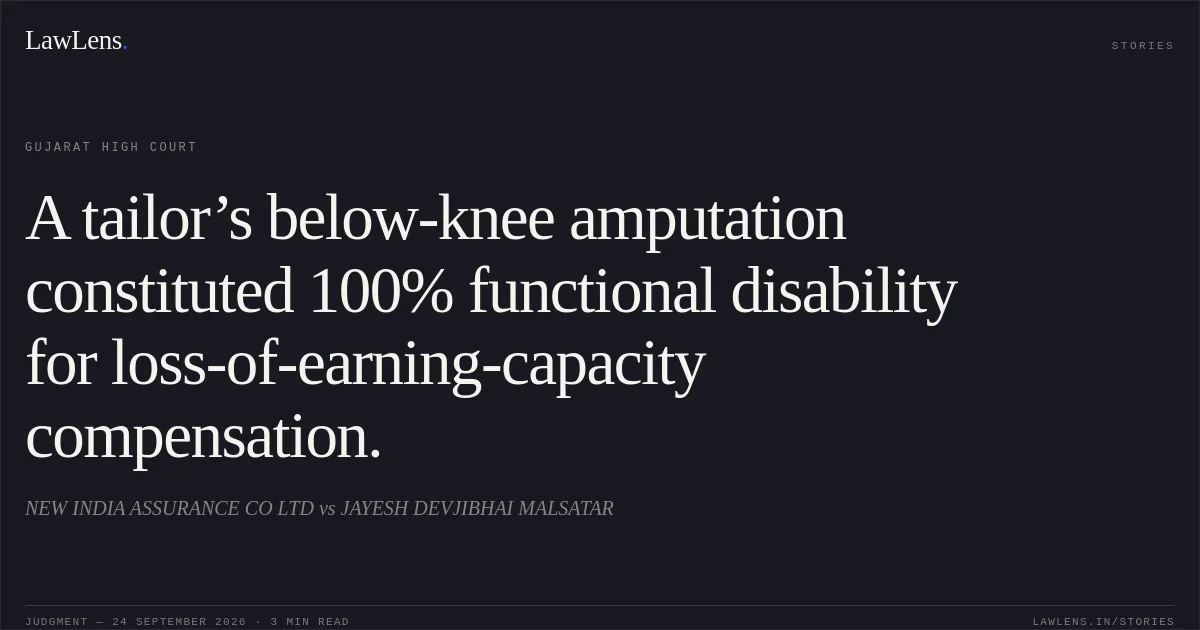
On 19 March 2003, the claimant, aged 23 years, was travelling as a pillion rider on a motorcycle driven by his brother when a scooter allegedly driven rashly and negligently collided with it at Anjar. The claimant suffered multiple injuries, including amputation of his left leg below the knee. He claimed to be a specialised tailor earning Rs.4,500 per month and sought Rs.15 lakhs as compensation
Source reference: paras. 3.1–3.2; pp. 2–3The Motor Accident Claims Tribunal held the scooterist solely negligent and awarded Rs.5,97,000 with interest at 10% per annum. The scooter’s insurer challenged the finding of negligence, while the claimant filed a cross-objection seeking enhancement. The claimant was also the owner of the motorcycle, and the insurer of that vehicle was subsequently joined in the proceedings
Source reference: paras. 4–5; pp. 3–4Issues
Whether the insurer could seek apportionment of negligence between the scooter and the motorcycle in a claim involving composite negligence
Source reference: paras. 7–9; pp. 4–5Whether the claimant’s below-knee amputation resulted in 100% functional disability, having regard to his occupation as a tailor, notwithstanding the lower percentage of physical disability assessed by the Tribunal
Source reference: paras. 10–14; pp. 5–7Whether the compensation, including loss of earning capacity, future prospects, non-pecuniary damages and interest, required enhancement
Source reference: paras. 15–18; pp. 7–9Law Applied
The Court exercised appellate jurisdiction under Section 173 of the Motor Vehicles Act, 1988, and considered the claimant’s cross-objection under Order XLI Rule 22 of the Code of Civil Procedure
Source reference: paras. 1–2; p. 1In cases of composite negligence, an injured claimant may recover the entire compensation from any one of the joint tortfeasors; inter se apportionment is generally a matter between the tortfeasors and is not necessary for determining the claimant’s entitlement. The Court relied on Khenyei v. New India Assurance Co. Ltd., AIR 2014 SC 2261, as referred to in Manomati Chouhan v. Oriental Insurance Co. Ltd.
Source reference: para. 7; pp. 3–5For functional disability, the Court applied Raj Kumar v. Ajay Kumar, 2011 ACJ 1, and M. Parmesh v. VRL Logistics Ltd., 2026 LiveLaw (SC) 641, under which the percentage of physical disability is not conclusive and the loss of earning capacity must be assessed in light of the injured person’s actual occupation
Source reference: paras. 10–14; pp. 5–7For computation, the Court applied National Insurance Co. Ltd. v. Pranay Sethi, (2017) 16 SCC 680, allowing 40% future prospects and applying the multiplier of 18, and referred to Magma General Insurance Co. Ltd. v. Nanu Ram, (2018) 18 SCC 130, concerning non-pecuniary compensation
Source reference: para. 16; p. 8Reasoning
The Court rejected the insurer’s challenge to the finding of negligence because the claimant was a victim of composite negligence and could recover the full award from any liable tortfeasor; therefore, determining the precise inter se negligence of the scooterist and motorcyclist was unnecessary in the claimant’s proceedings
Source reference: paras. 7–9; pp. 3–5On disability, the Court found that the claimant had proved both his below-knee amputation and his specialised tailoring qualification through medical and documentary evidence. Since tailoring was his principal occupation and the amputation prevented him from effectively continuing that work, the Court treated his functional disability as 100%, rather than the 45% adopted by the Tribunal
Source reference: paras. 11–14; pp. 6–7The claimed monthly income of Rs.4,500 was rejected because the supporting certificates were unproved; instead, the Court adopted the skilled-worker minimum wage of Rs.2,300 per month. It added 40% for future prospects and applied the multiplier of 18, resulting in Rs.6,95,520 for loss of earning capacity
Source reference: paras. 15–17; p. 8Adding amounts for pain and suffering, medical expenses, attendant charges and loss of amenities, the total compensation was recalculated at Rs.12,45,520. The interest rate was reduced from 10% to 9% per annum as the former rate lacked justification
Source reference: paras. 17–18; pp. 8–9Holding
The appeal filed by New India Assurance Co. Ltd. was dismissed, and the claimant’s cross-objection was partly allowed
The total compensation was enhanced from Rs.5,97,000 to Rs.12,45,520, with the additional amount payable being Rs.6,48,520. Interest was modified to 9% per annum from the date of filing of the claim petition until realization
Source reference: paras. 17–18; pp. 8–9The insurer was directed to deposit the enhanced amount before the Tribunal within eight weeks, after which the Tribunal was directed to disburse the awarded amount with accrued interest in accordance with law
Source reference: paras. 19.2–19.5; p. 10Acts & Sections Cited
1 provisions across 1 statute referred to in this judgment. Each provision opens on LawLens.
Motor Vehicles Act, 19881
Original Court PDF
NEW INDIA ASSURANCE CO LTDvsJAYESH DEVJIBHAI MALSATAR
Click to open original judgment
Original judgment, available to read, download and summarize on LawLens.in