01Facts
The petitioner challenged an order dated 24 February 2025 passed under Section 73 of the CGST/WBGST Act, 2017 for the tax period April 2020 to March 2021.
¶ 3The petitioner preferred a statutory appeal under Section 107, after making the requisite pre-deposit of 10% of the disputed tax, but the appellate authority rejected the appeal on 30 January 2026 as time-barred without examining its merits.
¶ 3 · ¶ 6Before the High Court, the petitioner contended that the demand-cum-show-cause notice was limited to ₹9,38,898, whereas the adjudication order in Form GST DRC-07 determined the demand at ₹10,27,788, contrary to Section 75(7) of the Act.
¶ 4 · ¶ 8The CGST authorities argued that the petitioner had challenged only the appellate order and should approach the Appellate Tribunal under Section 112, which was stated to be functional.
¶ 5 · ¶ 702Issues
i.Whether the proper officer acted without jurisdiction by confirming a tax demand exceeding the amount specified in the show-cause notice, contrary to Section 75(7) of the CGST/WBGST Act, 2017?
¶ 4 · ¶ 7–8ii.Whether the High Court should entertain the writ petition despite the availability of an alternative statutory remedy before the Appellate Tribunal under Section 112?
¶ 5 · ¶ 7iii.Whether the appellate authority was justified in rejecting the statutory appeal solely on the ground of limitation without examining the alleged jurisdictional defect in the original order?
¶ 4 · ¶ 6–703Law Applied
The Court applied Section 75(7) of the CGST/WBGST Act, 2017, which mandates that the tax, interest and penalty demanded in the adjudication order shall not exceed the amount specified in the notice and that no demand may be confirmed on grounds other than those stated in the notice.
¶ 7The Court also considered the statutory appellate remedies under Sections 107 and 112, including the requirement of a 10% pre-deposit for maintaining an appeal under Section 107.
¶ 3 · ¶ 6It applied the principle that the existence of an alternative remedy does not bar writ jurisdiction where the impugned action discloses a patent jurisdictional error.
¶ 7 · ¶ 9Provisions in the judgment · 8 · Linked ones open on LawLens
Central Goods and Services Tax Act, 2017 Section 73Section 107Section 75Section 112
West Bengal Goods And Services Tax Act, 2017 Section 73Section 107Section 75Section 112
04Reasoning
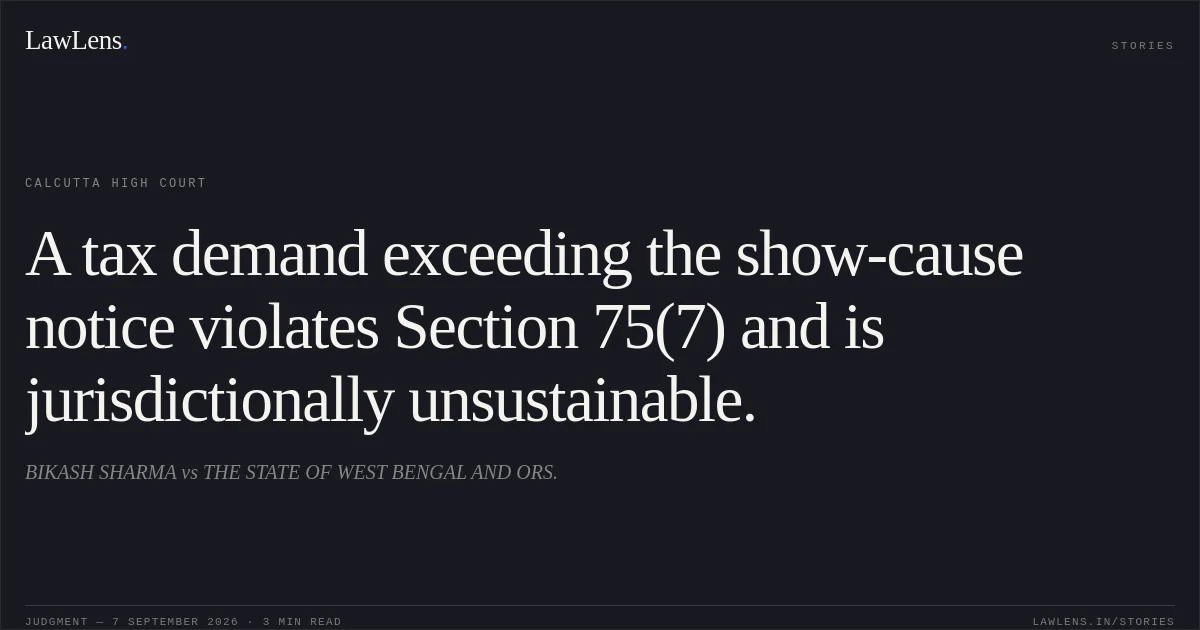
The show-cause notice restricted the proposed demand to ₹9,38,898, but the proper officer ultimately determined the demand at ₹10,27,788, thereby exceeding the statutory limit imposed by Section 75(7).
¶ 7–8This was treated as a jurisdictional error rather than a mere error on the merits.
¶ 7–8Although the Appellate Tribunal was available and the petitioner had challenged the appellate order, the High Court held that relegating the petitioner to the Tribunal would serve no useful purpose because the original adjudication itself was legally unsustainable.
¶ 7 · ¶ 9The appellate authority’s rejection of the appeal on limitation did not cure or address the fundamental defect in the original order.
¶ 4 · ¶ 605Holding
The High Court allowed the writ petition, holding that the demand confirmed by the proper officer exceeded the amount specified in the show-cause notice and therefore violated Section 75(7).
¶ 8–9It set aside both the adjudication order dated 24 February 2025 and the appellate order dated 30 January 2026.
¶ 9The matter was remanded to the proper officer for fresh consideration in accordance with law, after affording the petitioner an opportunity of hearing.
¶ 10–11The proper officer was directed to issue notice to the petitioner through the common portal and dispose of the proceedings, preferably within six weeks from communication of the judgment.
¶ 10–11Original Court PDF
BIKASH SHARMAvsTHE STATE OF WEST BENGAL AND ORS.
Click to open original judgment
Original judgment, available to read, download and summarize on LawLens.in