Facts
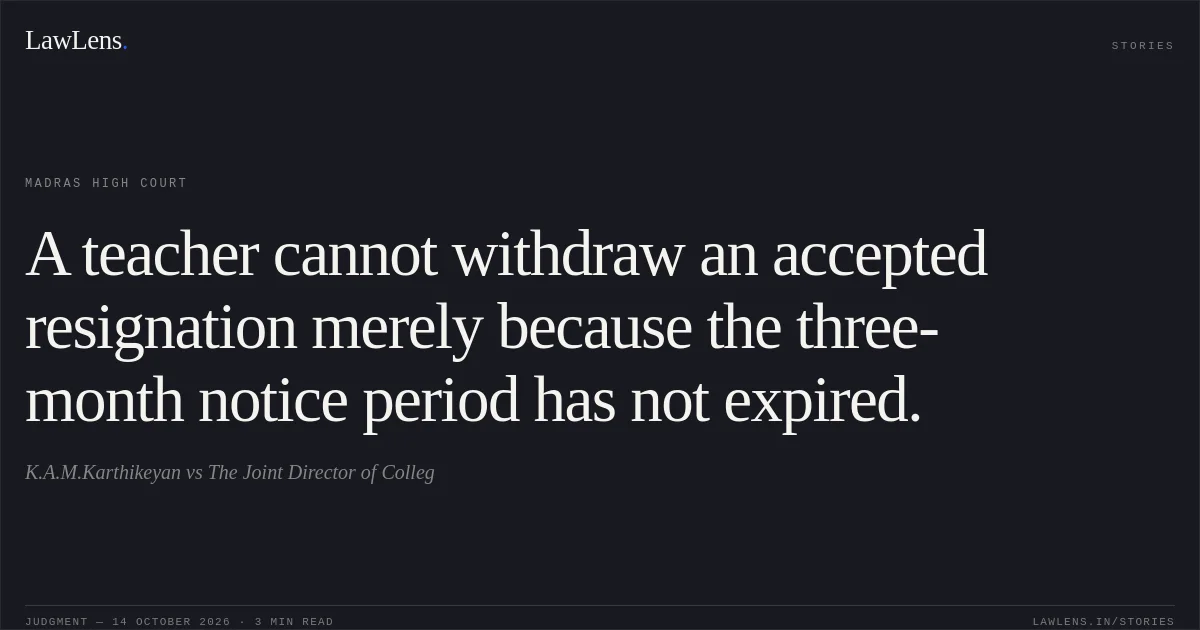
The petitioner, an Assistant Professor in the second respondent college, submitted a resignation on 15 April 2023, stating that he could not continue because of family circumstances and seeking immediate relief.
Source reference: pp. 2–4The college issued a relieving order that day; the College Committee ratified the action by resolution dated 31 May 2023, and the petitioner received communication of the relieving order on 1 July 2023.
Source reference: pp. 2–4The college had also sent a proposal to fill the vacancy on 12 May 2023. On 6 July 2023, 82 days after resigning, the petitioner sought to withdraw his resignation. The college rejected the request, and a subsequent representation was also rejected.
Source reference: pp. 2–4, 10–12, 18, 28Issues
Whether the petitioner could withdraw his resignation 82 days after submitting it, before expiry of the three-month period under Clause 9 of Form 7-A
Source reference: p. 14, para. 18Whether the resignation and the college’s action upon it were invalid because the College Committee had not initially approved the resignation, or because the petitioner’s withdrawal preceded expiry of the notice period
Source reference: pp. 10–12, 22–24, 28–29Law Applied
Section 14 of the Tamil Nadu Private Colleges (Regulation) Act, 1976 assigns the College Committee functions including administration, appointment, and disciplinary action, and treats its decisions within its jurisdiction as those of the educational agency; Section 55 addresses the Act’s prospective application to certain persons.
Source reference: pp. 15–16Rule 11(2)(i) of the Tamil Nadu Private Colleges (Regulation) Rules, 1976 requires a teacher’s service agreement to be in Form 7-A, whose Clause 9 permits a permanent teacher to terminate services by giving three months’ written notice or paying three months’ pay and allowances in lieu of notice.
Source reference: pp. 16–17Relying on Director General of Police v. M. Jeyanthi, (2021) 14 SCC 677, the Court held that a notice period does not, by itself, confer an unconditional right to withdraw after acceptance; acceptance may take effect before the notice period expires.
Source reference: pp. 24–25Under Air India Express Ltd. v. Capt. Gurdarshan Kaur Sandhu, (2019) 17 SCC 129, a prospective resignation may ordinarily be withdrawn before it becomes effective, but the right may be displaced where the employer has acted on the resignation to arrange a replacement. The Court also relied on Delhi Technological University v. B.S. Rawat, 2026 LiveLaw (SC) 761, for the principles that competent-authority ratification may cure an initially unauthorised act retrospectively, and that conduct treating a resignation as final and altering positions accordingly may make the transaction irrevocable.
Source reference: pp. 22–27Reasoning
The Court found that the petitioner’s resignation was voluntary and sought immediate relief; neither the resignation, the withdrawal request, nor the writ petition alleged coercion, threat, or undue influence. It therefore distinguished V.R. Palanisamy, R. Jesudasan, and Stella Jeyaraj, which concerned materially different circumstances, including alleged coercion or an immediate oral resignation later withdrawn.
Source reference: pp. 17–22The Court held that Clause 9’s notice requirement did not entitle the petitioner to withdraw after acceptance. It further found that the college had acted on the resignation by issuing the relieving order, seeking to fill the vacancy, and obtaining the Committee’s subsequent ratification; the petitioner had not returned to work during the intervening period.
Source reference: pp. 22–29In those circumstances, the resignation had been treated as final by both sides, and the petitioner could not undo it by withdrawing after 82 days.
Source reference: pp. 23–24, 28–29Holding
The Court held that the petitioner had no right, on these facts, to withdraw the resignation after it had been accepted, acted upon, and ratified by the College Committee.
Finding no grounds to interfere with the impugned orders, it dismissed the writ petition, made no order as to costs, and closed the connected miscellaneous petition.
Source reference: p. 29, para. 34Acts & Sections Cited
3 provisions across 2 statutes referred to in this judgment. Each provision opens on LawLens.
Tamil Nadu Private Colleges (Regulation) Act, 19762
Tamil Nadu Government Servants (Conditions of Service) Act, 20161
Original Court PDF
K.A.M.KarthikeyanvsThe Joint Director of Colleg
Click to open original judgment
Original judgment, available to read, download and summarize on LawLens.in