Facts
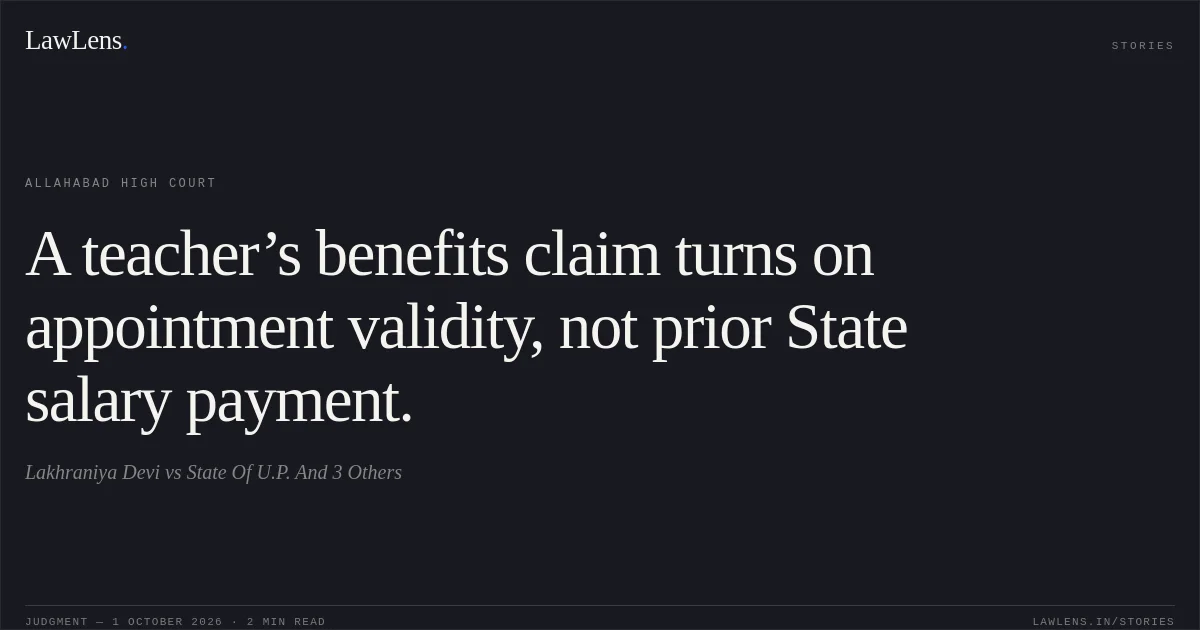
The petitioner sought arrears of salary and consequential retiral benefits arising from her husband’s service in the primary section of an institution.
Source reference: no citationThe Management stated that he had been appointed in 1964 in accordance with law, served continuously until superannuation on 30 June 2000, and died on 16 March 2004.
Source reference: para. 4, 17–18The District Inspector of Schools rejected the claim, relying on the absence of salary payments from the State Exchequer and a report questioning the appointment.
Source reference: paras. 3–5, 11, 16The petitioner challenged that decision, contending that the authorities had failed to consider documents supporting her husband’s appointment.
Source reference: paras. 3–5, 11, 16An earlier Division Bench decision had directed the authorities to examine the appointments and pass a reasoned order after hearing the affected employees.
Source reference: para. 6Issues
Whether the petitioner’s claim for salary arrears and retiral benefits could be rejected because her husband had not received salary from the State Exchequer during his service.
Source reference: paras. 3, 19–20Whether the authority had properly considered the evidence concerning the validity of her husband’s appointment before rejecting the claim.
Source reference: paras. 11, 16, 19Law Applied
The Court relied on the principle that teachers in a recognised primary section attached to a senior basic school may be entitled to salary under Section 10 of the 1978 Act, even without a separate government grant-in-aid order for that section.
Source reference: paras. 8–10, 15It also applied the Division Bench’s direction in State of U.P. v. Bhrigunath Ram, which required the authority to examine whether the appointments were lawful and, if rejecting a claim, to provide an opportunity of hearing and pass a reasoned order.
Source reference: para. 6The validity of the appointment—not the fact that salary had previously been paid from the State Exchequer—was to be the focus of the scrutiny.
Source reference: para. 20Reasoning
The authority had not adequately considered the documents produced by the petitioner and the Management concerning her husband’s appointment.
Source reference: paras. 11, 16Its reliance on an inspection report listing employees working in December 2004 was insufficient: her husband had retired in 2000 and died in 2004, so his absence from that later list did not establish that his appointment was invalid.
Source reference: paras. 7, 11, 16The Management’s affidavit also supported the assertion that he had been lawfully appointed and completed his service.
Source reference: para. 18Given the applicable salary principle and the earlier direction requiring a reasoned determination of appointment validity, the Court held that the claim could not be rejected merely because no salary had previously been paid from the State Exchequer.
Source reference: paras. 15, 19–20Holding
The Court allowed the writ petition and set aside the impugned order to the extent that it rejected the claim for salary arrears and consequential retiral benefits.
It remitted the matter to the District Inspector of Schools, Ballia, to consider the documents submitted by the petitioner and the Management, follow the principles of natural justice, and pass a reasoned order—preferably within two months after the petitioner filed a detailed representation with supporting documents.
Source reference: para. 19The authority was directed not to reject the claim merely because the husband had not received salary from the State Exchequer before retirement or death; scrutiny was to be confined to the validity of his appointment.
Source reference: para. 20Acts & Sections Cited
1 provisions across 1 statute referred to in this judgment. Linked provisions open on LawLens.
the 1978 Act (alias, unresolved)1
Original Court PDF
Lakhraniya DevivsState Of U.P. And 3 Others
Click to open original judgment
Original judgment, available to read, download and summarize on LawLens.in