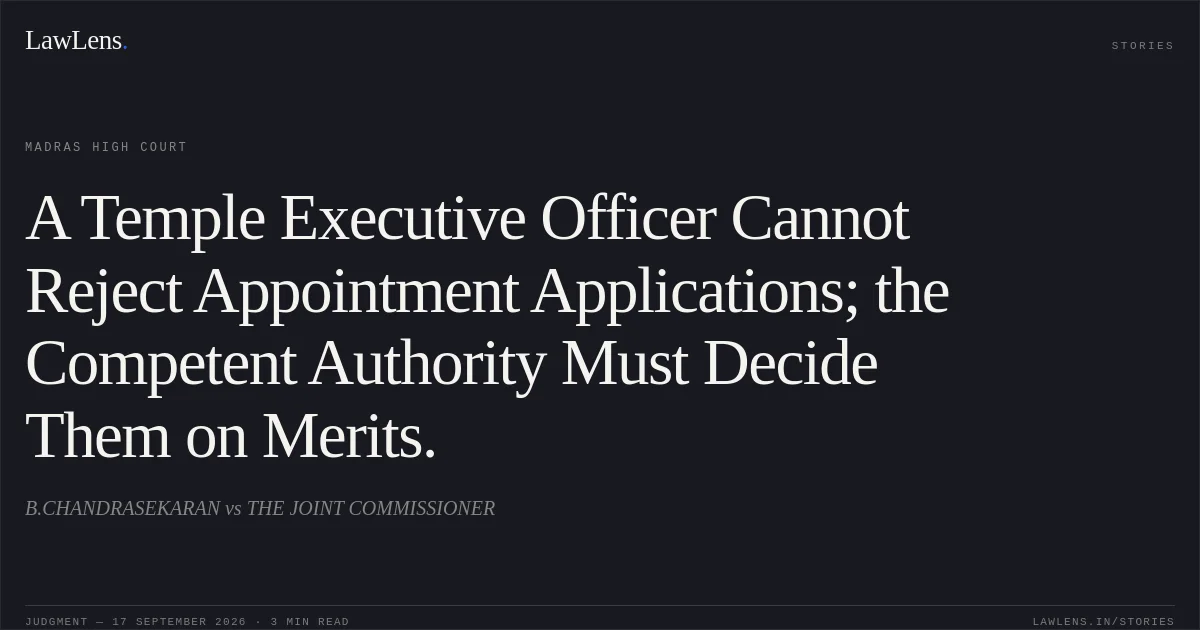
Facts
The petitioners claimed that their grandfathers, great-grandfather, fathers, or paternal uncle had served as Pujaris at Arulmigu Bhatrakaliamman Temple, Anthiyur, and that they themselves had performed Pujari duties for several years.
Source reference: pp.5–8They submitted applications dated 2 May 2019, 30 April 2019 and 30 June 2019, respectively, seeking appointment as Pujaris, addressed to the Assistant Commissioner through the Executive Officer of the temple.
Source reference: pp.5–8Instead of forwarding the applications, the third respondent–Executive Officer rejected them by order dated 6 August 2019.
Source reference: pp.5–8The petitioners challenged that order and the subsequent order dated 14 September 2023 passed by the Joint Commissioner, as well as certain appointments challenged in W.P. No.10785 of 2024.
Source reference: pp.5–9During arguments, however, the petitioners restricted their claim to the contention that the Executive Officer lacked jurisdiction to reject their applications.
Source reference: pp.5–9Issues
1. Whether the Executive Officer, who was not the appointing authority, could independently consider and reject the petitioners’ applications for appointment as Pujaris instead of forwarding them to the Assistant Commissioner.
Source reference: pp.7–82. Whether the orders dated 6 August 2019 and 14 September 2023 were liable to be set aside for having been passed by an incompetent or non-competent authority.
Source reference: p.83. Whether the petitioners’ applications were necessarily barred by Section 55(2) of the Hindu Religious and Charitable Endowments Act merely because they referred to their hereditary or succession-based claim.
Source reference: pp.6–8Law Applied
Section 55(2) of the Tamil Nadu Hindu Religious and Charitable Endowments Act provides that no person is entitled to seek appointment to a vacancy merely on the ground that he is next in the line of succession to the last holder of the office.
Source reference: p.6Independently of the merits of such a claim, an administrative decision must be made by the legally competent or appointing authority.
Source reference: pp.7–8Where an application is addressed to the competent authority through a proper channel, an intermediary officer who lacks appointment power cannot adjudicate and reject it; he must forward it to the competent authority for consideration in accordance with law.
Source reference: pp.7–8Reasoning
The Court found that the applications, on a close reading, were addressed to the Assistant Commissioner and were submitted through the proper channel.
Source reference: pp.6–7The Government Advocate fairly conceded that the Executive Officer was not the appointing authority.
Source reference: p.7Consequently, the Executive Officer’s rejection of the applications was not a valid decision by the competent authority.
Source reference: p.7Although the respondents argued that the applications were untenable under Section 55(2) because they sought appointment by succession, the Court did not decide the substantive eligibility or hereditary-appointment issue.
Source reference: pp.7–9It held only that the applications had to be considered on their merits by the Assistant Commissioner, who was the competent authority.
Source reference: pp.7–9Since the Joint Commissioner’s subsequent order was founded on or connected with the invalid rejection, that order was also liable to be interfered with.
Source reference: p.8Holding
The writ petitions were partly allowed.
The Court set aside the Executive Officer’s order dated 6 August 2019 and the Joint Commissioner’s order dated 14 September 2023.
Source reference: p.9The Assistant Commissioner was directed to consider the petitioners’ respective applications dated 2 May 2019, 30 April 2019 and 30 June 2019 on their own merits and in accordance with law, and to pass appropriate orders within eight weeks from receipt of the Court’s order.
Source reference: p.9The Court expressly left the substantive entitlement and effect of Section 55(2) to be determined by the competent authority; no costs were awarded.
Source reference: p.9Acts & Sections Cited
1 provisions across 1 statute referred to in this judgment. Each provision opens on LawLens.
Charitable Endowments Act, 18901
Original Court PDF
B.CHANDRASEKARANvsTHE JOINT COMMISSIONER
Click to open original judgment
Original judgment, available to read, download and summarize on LawLens.in
![Relief is made contingent on the Supreme Court’s eventual determination in the analogous pending case.. Ashok Tolani vs REVENUE. CAT - ['Jaipur']. LawLens](/stories/thumbnails/relief-is-made-contingent-on-the-supreme-courts-eventual-determination-in-the-analogous-pe-0a05b6600e0644cf9facfda571d15955.webp)