Facts
The plaintiff claimed ownership of property under a registered sale deed and alleged that the defendants had encroached on part of it and were attempting to encroach on a further portion, identified as the “C” schedule property.
Source reference: pp. 5–6She sought mandatory and permanent injunctions and, pending trial, an interim injunction under Order XXXIX Rules 1 and 2 CPC.
Source reference: pp. 5–6The trial court dismissed her application and allowed the defendants’ application under Order XXXIX Rule 4 CPC, vacating the interim injunction.
Source reference: pp. 5–6The plaintiff appealed under Order XLIII Rule 1(r) CPC.
Source reference: pp. 5–6The High Court heard the appeals together because they involved the same parties and common issues.
Source reference: pp. 8–10Issues
1. Whether the trial court’s common order dismissing the plaintiff’s injunction application and vacating the interim injunction warranted appellate interference
Source reference: para. 10, p. 122. Whether the plaintiff had established a sufficient basis for interim protection over the “C” schedule property, including a prima facie case and identification of the property
Source reference: paras. 16–17, pp. 13–14Law Applied
Under Order XXXIX Rules 1 and 2 CPC, interim injunction relief requires consideration of a prima facie case, balance of convenience, and the irreparable hardship likely to be caused to either party.
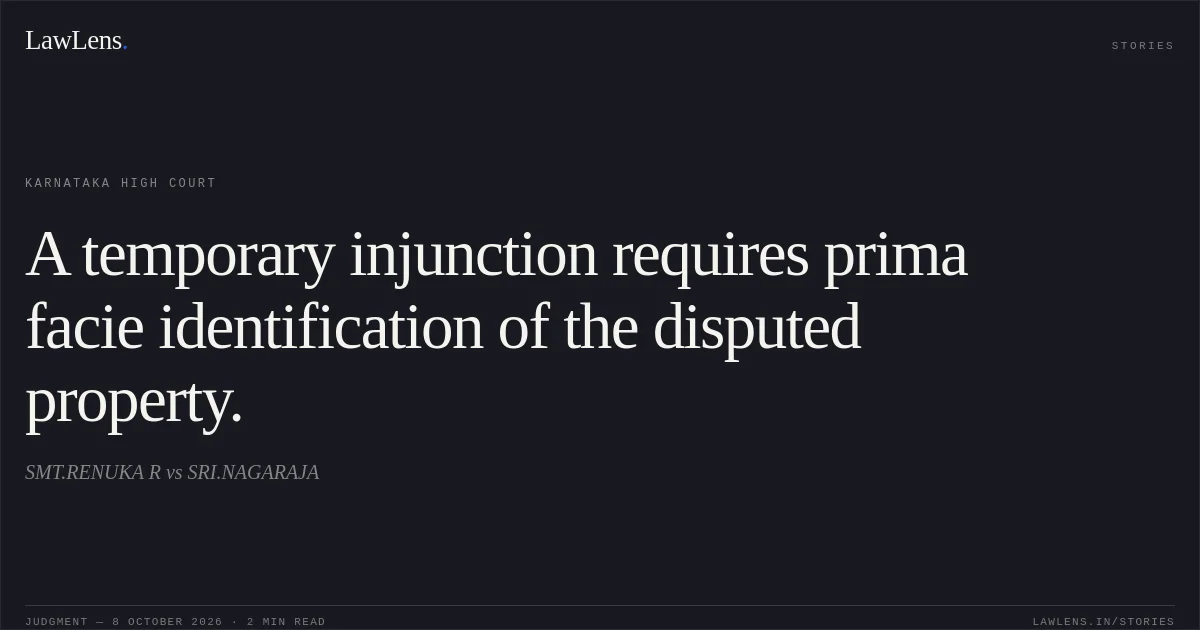
Source reference: p. 13The applicant must establish the identity and description of the property and provide material supporting the alleged encroachment or interference.
Source reference: para. 13, p. 12An appellate court will not interfere with a trial court’s discretionary order absent illegality or perversity.
Source reference: paras. 8.1, 21–22, pp. 11, 15–16The appeals were brought under Order XLIII Rule 1(r) CPC; the defendants’ application to vacate the interim order was under Order XXXIX Rule 4 CPC.
Source reference: pp. 5–6Reasoning
The plaintiff’s sale deed was not sufficient at the interim stage to resolve the disputed identity and boundaries of the “B” and “C” schedule properties.
Source reference: paras. 14–17, pp. 13–14The alleged encroachment and the defendants’ contention that the “C” schedule area was a public road used for access required determination at trial.
Source reference: paras. 14–17, pp. 13–14The High Court therefore considered the trial court justified in finding that the plaintiff had not established a prima facie case or sufficiently identified the property for interim relief.
Source reference: paras. 14–17, pp. 13–14The Court also noted that the plaintiff had subsequently erected a compound wall blocking the disputed area, and declined to disturb the order in light of that changed circumstance.
Source reference: paras. 18–21, pp. 15–16Any application concerning demolition of the wall was left for the trial court to decide independently.
Source reference: paras. 18–21, pp. 15–16Holding
The High Court answered the issue against appellate interference and dismissed both appeals, finding no perversity or illegality in the trial court’s discretionary order.
It made no observation on the merits of the suit and directed that any application concerning demolition of the wall be decided by the trial court on its own merits and in accordance with law.
Source reference: para. 22, p. 16Acts & Sections Cited
3 provisions across 1 statute referred to in this judgment. Each provision opens on LawLens.
Code of Civil Procedure, 19083
Original Court PDF
SMT.RENUKA RvsSRI.NAGARAJA
Click to open original judgment
Original judgment, available to read, download and summarize on LawLens.in