Facts
The plaintiff sought a permanent injunction against interference with her possession of Temple-owned agricultural land.
Source reference: no citationHer husband had cultivated the land as a tenant until his death in 1967, after which her name was entered in the tenancy register.
Source reference: no citationThe defendant claimed that the plaintiff had sub-let the land to him and transferred the tenancy rights for Rs.1,00,000; he relied on rent and kist receipts, cultivation records, and an unregistered lease document.
Source reference: no citationThe Trial Court dismissed the suit, and the First Appellate Court affirmed that decision.
Source reference: para. 2–3, 6–7The plaintiff appealed under Section 100 CPC.
Source reference: para. 2–3, 6–7Issues
Whether the Courts below erred by disregarding the statutory presumption said to arise under Section 15 of the Record of Tenancy Rights Act from the plaintiff’s tenancy-register entry.
Source reference: para. 5(a)Whether the Courts below were justified in finding that the plaintiff had lost her cultivating-tenancy rights based on the alleged oral sub-lease, surrender letter, and rent receipts, without cancellation of her tenancy entry.
Source reference: para. 5(b)Whether the Courts below erred in dismissing the injunction suit without properly determining the effect of the plaintiff’s recorded tenancy and the defendant’s alleged derivative tenancy.
Source reference: para. 5(c)Law Applied
The Court referred to Section 15 of the Record of Tenancy Rights Act, as raising the question of a statutory presumption arising from a tenancy-register entry.
Source reference: para. 5(a)It also applied Sections 17(1)(d) and 18 of the Registration Act, 1908: a lease from year to year, for a term exceeding one year, or reserving yearly rent requires registration, while the Court treated registration as optional for a lease not exceeding one year.
Source reference: para. 8–9Under Section 2(aa) of the Tamil Nadu Cultivating Tenants Protection Act, 1955, a cultivating tenant includes a person who contributes physical labour, personally or through a family member, to cultivation under an express or implied tenancy, and may include a qualifying sub-tenant.
Source reference: para. 11The Court also stated that concurrent findings would not warrant interference under Section 100 CPC absent a basis for such intervention.
Source reference: para. 13No precedent was cited.
Source reference: no citationReasoning
The Court found that the defendant, rather than the plaintiff, had cultivated the land and paid rent to the Temple over the relevant period.
Source reference: para. 6–7, 10, 12It relied on the rent and kist receipts and the Temple’s notices concerning arrears as evidence that the Temple had recognised the defendant as a cultivating tenant.
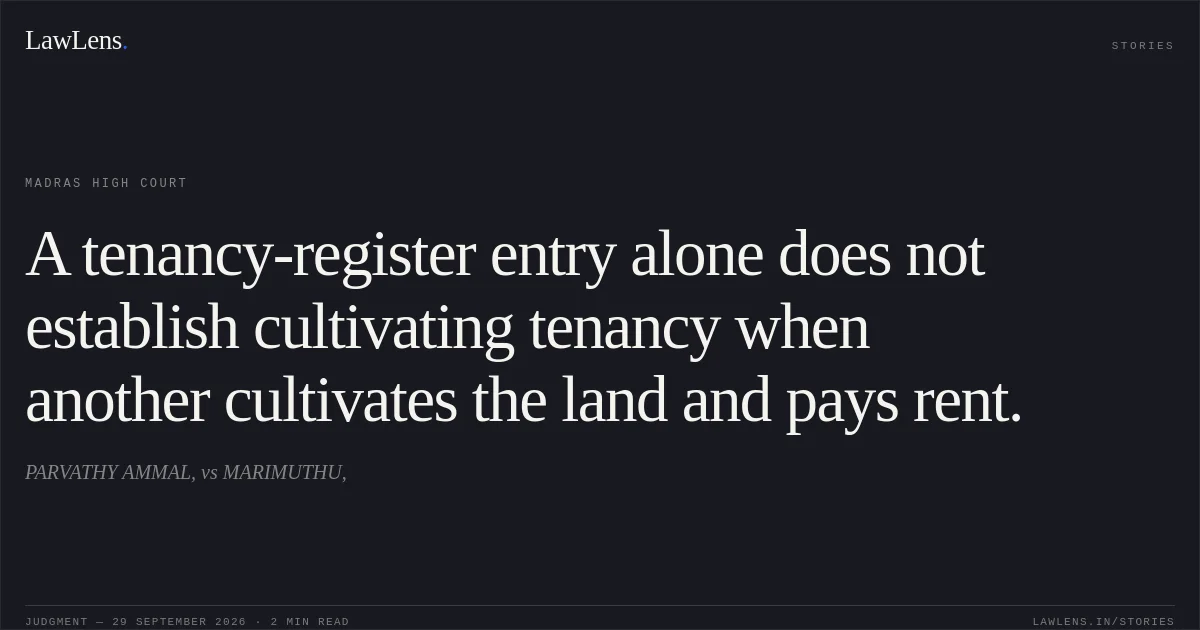
Source reference: para. 6–7, 10, 12It treated the plaintiff’s alleged oral lease and Ex.B4, the unregistered lease document, as supporting the defendant’s claim, and concluded that the plaintiff’s tenancy-register entry alone did not establish that she remained the cultivating tenant.
Source reference: para. 7–10The judgment did not separately explain the legal effect of Section 15 or the alleged absence of formal cancellation of the plaintiff’s entry; it resolved the dispute principally on its assessment of cultivation and rent-payment evidence.
Source reference: para. 10–13Holding
The Court answered all three substantial questions of law against the plaintiff, held that the concurrent findings disclosed no ground for interference under Section 100 CPC, and dismissed the second appeal without costs.
Acts & Sections Cited
4 provisions across 2 statutes referred to in this judgment. Each provision opens on LawLens.
Code of Civil Procedure, 19083
Ajmer Tenancy and Land Records Act, 19501
Original Court PDF
PARVATHY AMMAL,vsMARIMUTHU,
Click to open original judgment
Original judgment, available to read, download and summarize on LawLens.in