Facts
The petitioner claimed to be a tenant of the fifth respondent and to have conducted business in a shop since 2013.
Source reference: p. 2 / para. 2He challenged proceedings dated 17 September 2026, which sought police protection for an encroachment-removal drive scheduled for 30 September 2026.
Source reference: p. 2 / para. 2He alleged that no notice had been given and invoked Section 60 of the Tamil Nadu Slum Areas (Improvement and Clearance) Act, 1971, including its 60-day notice requirement.
Source reference: p. 2 / para. 2The Board submitted that the fifth respondent had been allotted 55.13 sq. metres but had encroached on an adjoining 37.62 sq. metres for commercial use.
Source reference: pp. 3–4 / paras. 3, 5The fifth respondent’s earlier writ petition challenging the eviction action, W.P. No. 39319 of 2026, had been dismissed on 25 September 2026.
Source reference: pp. 3–4 / paras. 3, 5Issues
1. Whether the petitioner, claiming possession through the fifth respondent, could maintain a separate writ petition concerning the same encroachment action after the fifth respondent’s challenge had been dismissed.
Source reference: p. 4 / para. 52. Whether the petitioner was entitled to relief against the impugned proceedings on the grounds of lack of notice and non-compliance with Section 60 of the Tamil Nadu Slum Areas (Improvement and Clearance) Act, 1971.
Source reference: p. 2 / para. 2; p. 4 / para. 5Law Applied
Section 60 of the Tamil Nadu Slum Areas (Improvement and Clearance) Act, 1971, was invoked by the petitioner as requiring notice and 60 days’ time, but the Court did not decide the provision’s application or compliance on the merits.
Source reference: p. 2 / para. 2; p. 4 / para. 5The Court’s stated basis for dismissal was that a tenant claiming through an encroacher could not maintain another writ petition concerning the same cause of action after the encroacher’s own writ petition had been dismissed.
Source reference: p. 4 / paras. 5, 7Reasoning
The Court treated the petitioner’s claim as derivative because he asserted rights only through the fifth respondent.
Source reference: p. 4 / para. 5Since the fifth respondent had already challenged the action concerning the same site and lost, the Court held that he could not pursue the same matter through his tenant.
Source reference: p. 4 / para. 5Accordingly, it did not separately decide the petitioner’s notice and Section 60 arguments.
Source reference: p. 4 / para. 5It noted that the petitioner could pursue any remedies against the fifth respondent for prejudice caused by the latter’s actions.
Source reference: p. 5 / para. 6Holding
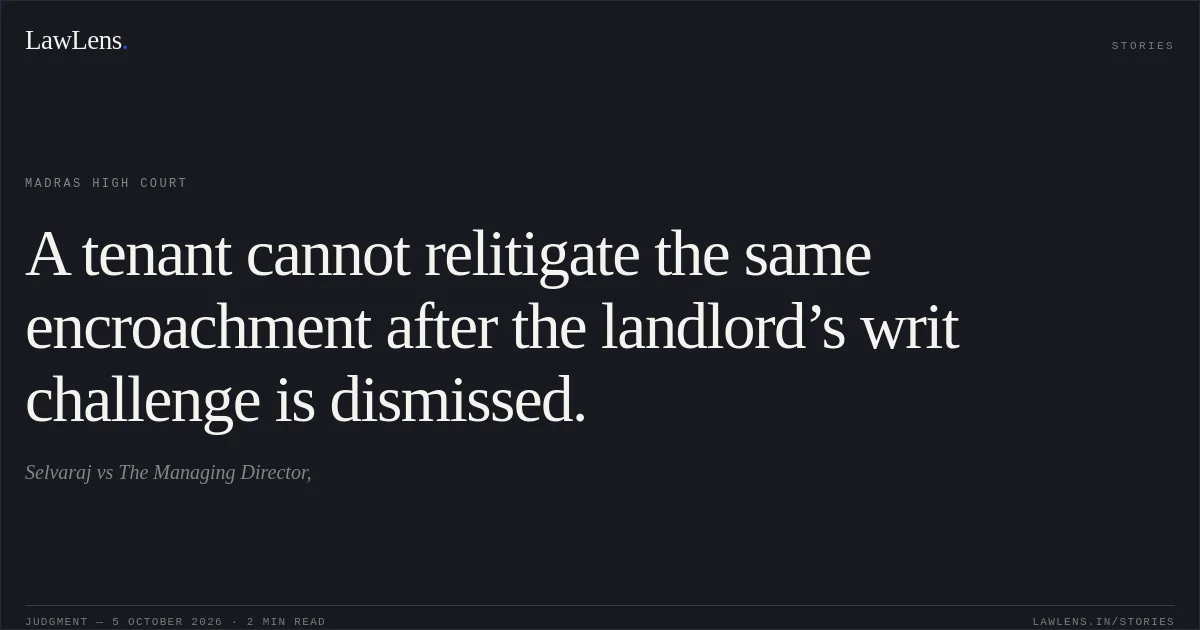
The Court dismissed the writ petition, holding that the tenant’s challenge to the same encroachment proceedings could not be entertained after the fifth respondent’s earlier writ petition had been dismissed.
It left open the petitioner’s remedies against the fifth respondent, made no order as to costs, and closed the connected miscellaneous petitions.
Source reference: p. 5 / para. 7Acts & Sections Cited
1 provisions across 1 statute referred to in this judgment. Linked provisions open on LawLens.
Tamil Nadu Slum Areas (Improvement and Clearance) Act, 19711
Original Court PDF
SelvarajvsThe Managing Director,
Click to open original judgment
Original judgment, available to read, download and summarize on LawLens.in