Facts
The plaintiff-landlord let a shop to the defendant-tenant under a rent agreement dated 7 November 2001 at Rs. 150 per month.
Source reference: pp. 2–4, paras. 2–5.2The tenant claimed that his father had occupied an earlier shop from 1974 and that the present shop was let after the original premises were demolished following an earthquake.
Source reference: pp. 2–4, paras. 2–5.2The landlord alleged rent arrears, served statutory notice, and sued for possession after the tenant did not clear the arrears within one month.
Source reference: pp. 2–4, paras. 2–5.2The trial court decreed eviction on 30 December 2022, and the appellate court dismissed the tenant’s appeal on 14 August 2026.
Source reference: pp. 2–4, paras. 2–5.2The tenant challenged those concurrent decisions under Section 29(2) of the Gujarat Rents, Hotel and Lodging House Rates Control Act, 1947 (“Rent Act”).
Source reference: pp. 2–4, paras. 2–5.2In the revision, the tenant accepted that he had not paid within one month of notice and remained in arrears when issues were framed, but argued that he later paid the arrears and was not in default when the decree was passed.
Source reference: pp. 9–10, para. 9.1Issues
Whether the eviction decree could stand where the tenant failed to clear arrears within one month of statutory notice and remained in arrears when issues were framed, although he later paid before the decree.
Source reference: pp. 9–12, paras. 9.1–11Whether the concurrent findings of the lower courts warranted interference in revision under Section 29(2) of the Rent Act.
Source reference: pp. 7–8, 14, paras. 7, 13–14Whether the tenancy created under the 7 November 2001 agreement was outside the protection of the Rent Act by virtue of amended Section 4.
Source reference: pp. 7–8, 12–14, paras. 7.2, 12Law Applied
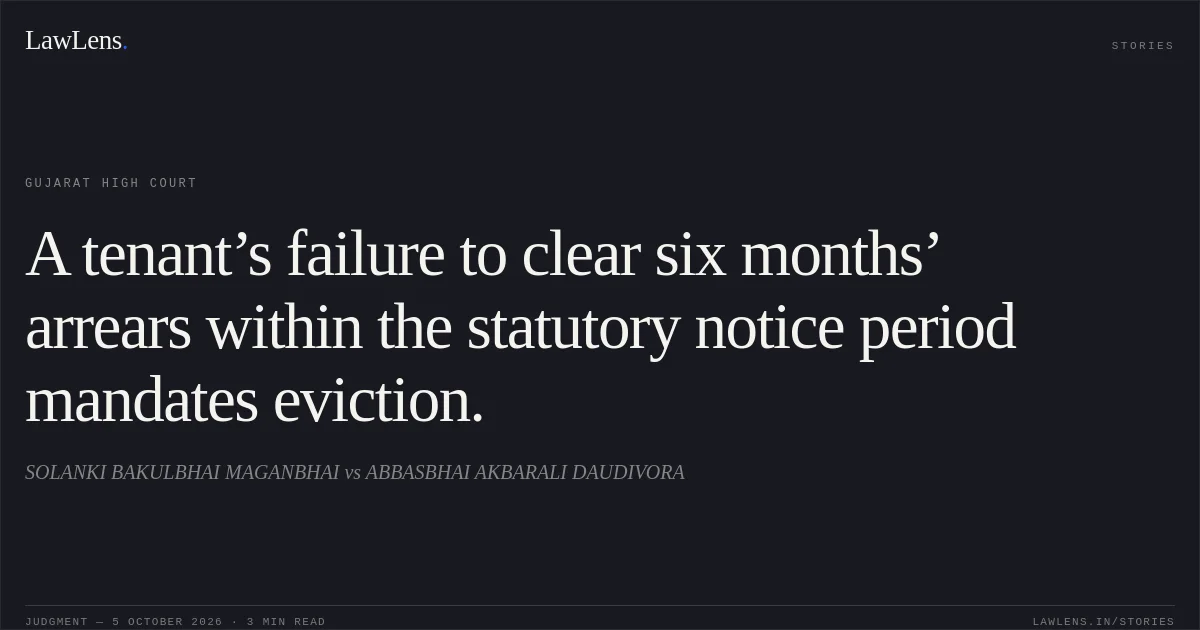
Under Section 12(3)(a) of the Rent Act, where rent is payable monthly, there is no dispute about standard rent or permitted increases, rent is in arrears for six months or more, and the tenant neglects to pay within one month after statutory notice, the court must pass a decree for eviction.
Source reference: pp. 10–12, paras. 10–11Relying on Arjun Khiamal Makhijani v. Jamnadas C. Tuliani, (1989) 4 SCC 612, and the principle discussed there from Harbanslal Jagmohandas, the Court treated the statutory conditions as requiring eviction once established.
Source reference: pp. 10–12, para. 10The Court also applied the limited revisional standard under Section 29(2): concurrent findings should not be disturbed absent perversity, egregious error, gross irregularity, or a decision contrary to settled law, relying on Hindustan Petroleum Corp. Ltd. v. Dilbahar Singh, (2014) 9 SCC 78.
Source reference: p. 14, para. 13It further referred to amended Section 4(1-A) of the Rent Act concerning premises excluded from the Act.
Source reference: pp. 12–13, para. 12Reasoning
The tenant’s concessions established that he had not paid within the statutory one-month period and was still in arrears when the issues were framed.
Source reference: pp. 9–12, paras. 9.1–11The Court therefore held that subsequent payment, and the absence of arrears by the date of decree, did not undo the consequences of the earlier default under Section 12(3)(a).
Source reference: pp. 9–12, paras. 9.1–11It also found that the parties’ written agreement provided for monthly rent, distinguishing the tenant’s contention that rent was accepted cumulatively.
Source reference: p. 12, para. 11The Court additionally observed that the 2001 agreement created a fresh tenancy after the amendment to Section 4 and that the tenancy was not protected by the Rent Act.
Source reference: pp. 12–14, para. 12Finally, it found no perversity or gross error in the concurrent factual findings that would justify revisional interference.
Source reference: p. 14, paras. 13–14Holding
The Court answered the principal issue against the tenant: his later payment did not prevent eviction after failure to clear arrears within the statutory period and continued arrears when issues were framed.
Finding no basis to interfere with the lower courts’ decisions, the High Court dismissed the revision application in limine, with no order as to costs.
Source reference: p. 15, para. 15Acts & Sections Cited
4 provisions across 1 statute referred to in this judgment. Each provision opens on LawLens.
Gujarat Rents, Hotel and Lodging House Rates Control Act, 19474
Original Court PDF
SOLANKI BAKULBHAI MAGANBHAIvsABBASBHAI AKBARALI DAUDIVORA
Click to open original judgment
Original judgment, available to read, download and summarize on LawLens.in