Facts
The respondents/plaintiffs instituted a suit seeking eviction, arrears of rent and mesne profits concerning House No. 1983, Bhoi Mohalla, Mhow. They initially alleged that Heeralal, husband and father of the appellants/defendants, had occupied the premises as an oral tenant at a monthly rent of ₹300 and that the defendants had defaulted in payment since December 2015. They also pleaded bona fide requirement and the dilapidated condition of the premises.
Source reference: para. 2The defendants denied the landlord–tenant relationship and claimed that Heeralal had encroached upon a vacant plot in 1969, constructed a hut and subsequently built the suit house. They asserted continuous, open and peaceful possession since 1969 and claimed to have perfected title by adverse possession.
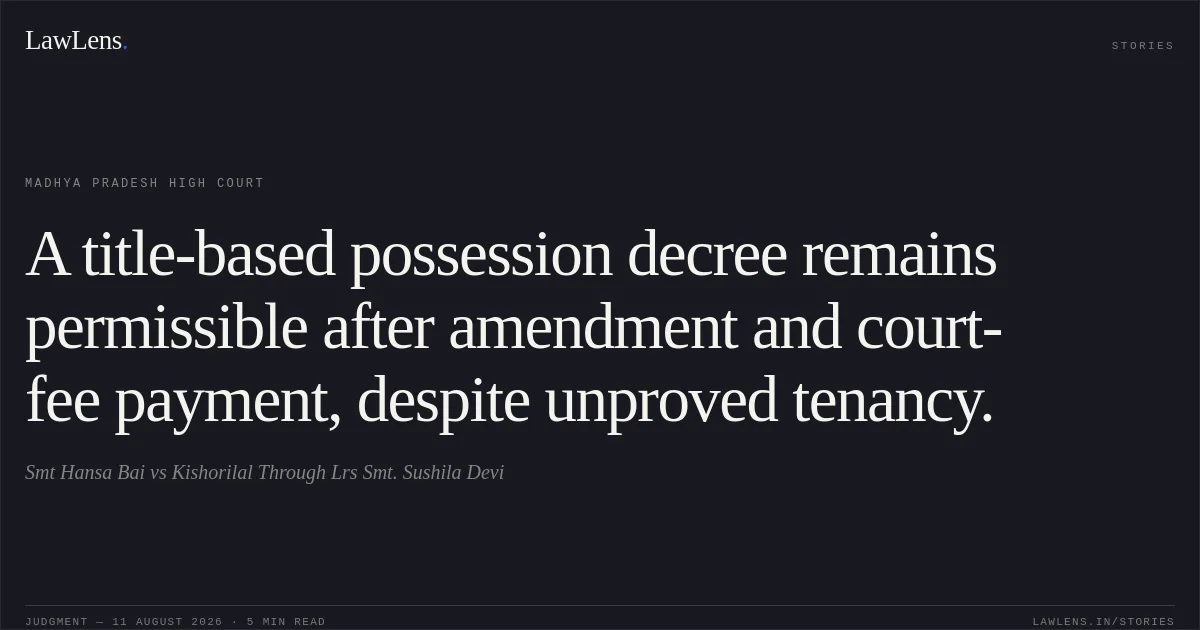
Source reference: para. 3Following the denial of the tenancy and the defendants’ assertion of adverse possession, the plaintiffs amended the plaint under Order VI Rule 17 CPC to seek possession on the basis of title, paid separate court fees and pleaded that the defendants’ adverse-possession claim was false. The amendment was allowed on 4 December 2021, and the defendants’ consequential amendment to the written statement was allowed on 20 April 2022; neither amendment order was challenged.
Source reference: paras. 4, 11–12The trial Court rejected the alleged landlord–tenant relationship and consequently declined the rent-based and bona fide-need reliefs. However, it held that the plaintiffs had established title and that the defendants had failed to prove adverse possession, and therefore decreed delivery of possession.
Source reference: para. 5The first appellate Court affirmed the findings on title, adverse possession and possession, although it independently found bona fide need and entitlement to mesne profits while observing that no decree could be granted on the tenancy-based ground because the landlord–tenant relationship was not proved. The defendants filed the present second appeal.
Source reference: para. 6Issues
1. Whether, after failure to establish the landlord–tenant relationship under the Madhya Pradesh Accommodation Control Act, 1961, the Courts could grant possession on the basis of the plaintiffs’ title?
Source reference: paras. 7–8, 11–132. Whether the plaintiffs were entitled to relief merely because the defendants failed to establish their own title or adverse possession, and whether the findings on the plaintiffs’ title were supported by evidence?
Source reference: paras. 7–8, 13–163. Whether the amendment converting or expanding the suit to include a claim for possession based on title was impermissible because it altered the nature of the original eviction suit?
Source reference: paras. 7, 11–13, 214. Whether the concurrent findings regarding the plaintiffs’ title and the defendants’ failure to prove adverse possession disclosed any substantial question of law warranting interference in second appeal?
Source reference: paras. 15–16, 24Law Applied
The Court applied the Madhya Pradesh Accommodation Control Act, 1961, and the principle that a suit founded solely on the statutory landlord–tenant relationship is confined to the grounds and jurisdiction provided by the special enactment; where that relationship is not established, a decree cannot ordinarily be granted under the Act on an unrelated equitable ground.
Source reference: paras. 17–20Order VI Rule 17 CPC permits amendment of pleadings to determine the real controversy, and Order VII Rule 7 CPC concerns the grant of appropriate relief, particularly where the plaint has been amended to seek possession based on title and requisite court fee has been paid.
Source reference: paras. 11–13, 19, 21Relying on Rajendra Tiwary v. Basudeo Prasad, (2002) 1 SCC 90, Biswanath Agarwalla v. Sabitri Bera, (2009) 15 SCC 693, and Tribhuvanshankar v. Amrutlal, (2014) 2 SCC 788, the Court distinguished cases involving suits confined to eviction under a special rent statute from cases in which an independent title-based claim had been properly pleaded and tried.
Source reference: paras. 17–21Adverse possession must be actual, open, notorious, exclusive, continuous and hostile to the true owner, and must be pleaded and proved with requisite particulars.
Source reference: para. 20Reasoning
The Court held that the present suit was not ultimately confined to eviction based simpliciter on a landlord–tenant relationship. After the defendants denied the tenancy and asserted adverse possession, the plaintiffs lawfully amended the plaint, paid the requisite court fee and expressly sought possession on the basis of title.
Source reference: paras. 11–13, 21The defendants accepted the amendment procedure by filing consequential pleadings and did not challenge the order permitting amendment. Consequently, the principle in Tribhuvanshankar, Rajendra Tiwary and Biswanath Agarwalla—that a court exercising limited jurisdiction under a special rent statute cannot grant title-based possession where the suit remains only a statutory eviction action—did not prevent adjudication of the independently pleaded title claim.
Source reference: paras. 17–22On the merits, the plaintiffs’ title was supported by the civil-court decree, documentary evidence relating to Shivcharan Shivbaksh, tax-payment and mutation records, and an admission in the defendants’ pleadings and evidence that Shivcharan Shivbaksh and his relatives, including the plaintiffs, were owners of the property.
Source reference: paras. 13–14The defendants’ adverse-possession claim failed because they did not establish hostile possession in the knowledge of the true owners; their evidence even indicated that they did not know the plaintiffs or Shivcharan Shivbaksh.
Source reference: para. 15The High Court found that both lower courts had properly appreciated the evidence and that their conclusions were not perverse. It also noted that the defendants had not pleaded or argued that title-based alternative relief was impermissible under the Madhya Pradesh Accommodation Control Act.
Source reference: paras. 16, 23Holding
The High Court answered the principal issue against the appellants. It held that, although the landlord–tenant relationship was not proved and no relief could be granted on the tenancy-based grounds, the amended plaint independently entitled the plaintiffs to seek and obtain possession on the basis of their established title.
The defendants failed to prove either title or adverse possession, and the concurrent findings of the Courts below disclosed no perversity or substantial question of law.
Source reference: paras. 21–24The second appeal was accordingly dismissed, with no order as to costs, and the record of the Courts below was directed to be returned.
Source reference: para. 24Acts & Sections Cited
2 provisions across 1 statute referred to in this judgment. Linked provisions open on LawLens.
M.P. Accommodation Control Act, 19612
Original Court PDF
Smt Hansa BaivsKishorilal Through Lrs Smt. Sushila Devi
Click to open original judgment
Original judgment, available to read, download and summarize on LawLens.in