Facts
The petitioner obtained a caste certificate as belonging to the Thakur Scheduled Tribe in 2000.
Source reference: no citationThe Scrutiny Committee invalidated his claim in 2009, relying on his failure to satisfy the affinity test.
Source reference: no citationThe High Court had earlier dismissed his challenge, but the Supreme Court set aside that decision and remanded the matter for fresh consideration in light of Maharashtra Adiwasi Thakur Jamat Swarakshan Samiti v. State of Maharashtra.
Source reference: para. 2, p. 2The petitioner contended that he was related to Vishal Subhash Thakur, whose caste validity certificate had been granted by the High Court.
Source reference: paras. 7–10, pp. 5–7The genealogy filed by the petitioner did not include Vishal, and the Court considered it unclear whether the claimed relationship had been verified by the Committee.
Source reference: paras. 7–10, pp. 5–7Issues
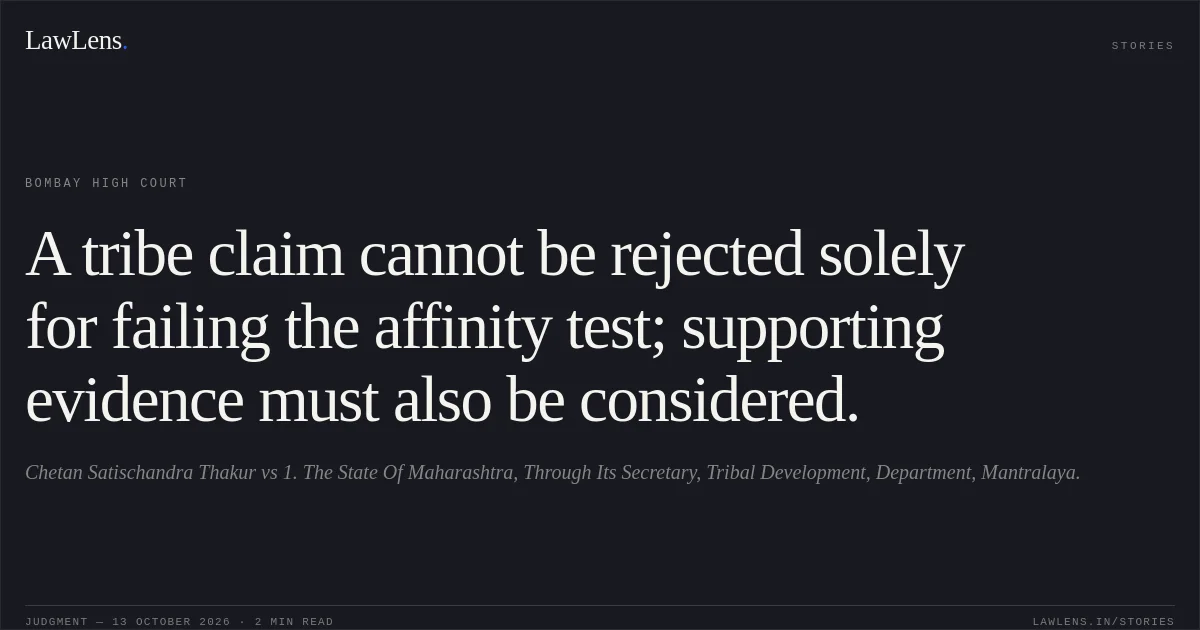
1. Whether the petitioner’s tribe claim could be rejected solely for failure to satisfy the affinity test, despite the documentary evidence relied upon.
Source reference: paras. 2, 9, pp. 2, 62. Whether the petitioner’s asserted relationship to Vishal Subhash Thakur, who had received a caste validity certificate, required examination by the Scrutiny Committee on the basis of the genealogy.
Source reference: paras. 7–10, pp. 5–7Law Applied
In Maharashtra Adiwasi Thakur Jamat Swarakshan Samiti v. State of Maharashtra, (2023) SCC OnLine SC 326, the Supreme Court held that the affinity test is not a litmus test and should not outweigh relevant documentary evidence supporting a caste or tribe claim.
Source reference: para. 9, p. 6The Court also referred to Apoorva d/o Vinay Nichale v. Divisional Caste Certificate Scrutiny Committee No. 1, 2010 (6) Mh.L.J. 401.
Source reference: para. 9, p. 6The judgment’s operative approach was that the petitioner’s claimed relationship to a person holding a validity certificate had to be established and considered by the Scrutiny Committee; it did not treat that certificate as automatically determining the petitioner’s claim.
Source reference: paras. 8–10, pp. 5–7Reasoning
The Committee had rejected the claim on affinity-test grounds, but the Court noted the Supreme Court’s direction that affinity is not conclusive where documentary evidence is available.
Source reference: para. 9, p. 6Separately, the petitioner relied on Vishal’s validity certificate and asserted a blood relationship through a common ancestor.
Source reference: paras. 8–10, pp. 5–7Because the genealogy submitted did not name Vishal and the record did not establish whether the Committee had verified the relationship, the Court did not decide the tribe claim itself.
Source reference: paras. 8–10, pp. 5–7It considered remittal necessary so the Committee could examine the genealogy and the asserted relationship.
Source reference: paras. 8–10, pp. 5–7Holding
The Court quashed the Scrutiny Committee’s order dated 24 September 2009 and remanded the matter to the Committee for reconsideration, particularly in light of the petitioner’s genealogy.
The petitioner was directed to appear before the Committee on 14 October 2026, and the Committee was requested to endeavour to decide the claim within four months from that date.
Source reference: para. 10(iii)–(v), p. 8All contentions were kept open; the petition was disposed of and the Rule made absolute in those terms.
Source reference: para. 10(iii)–(v), p. 8Original Court PDF
Chetan Satischandra Thakurvs1. The State Of Maharashtra, Through Its Secretary, Tribal Development, Department, Mantralaya.
Click to open original judgment
Original judgment, available to read, download and summarize on LawLens.in