Facts
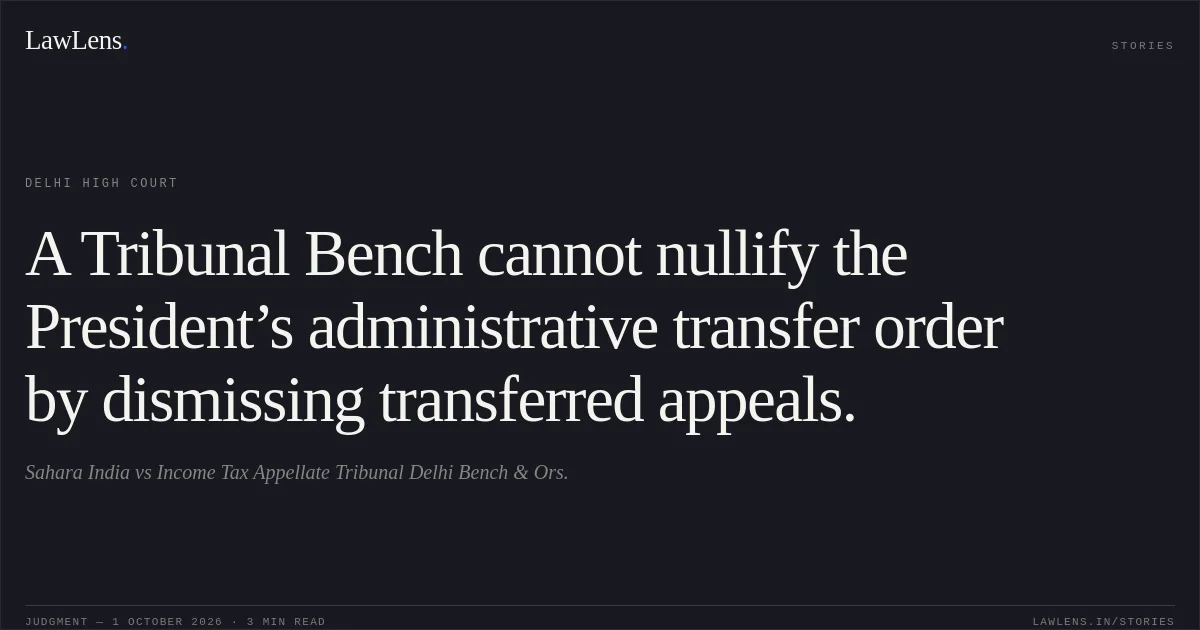
The petitioners challenged orders of the Income Tax Appellate Tribunal (ITAT) holding that their appeals and cross-appeals were not maintainable before its Delhi Bench in light of Principal Commissioner of Income Tax-1 v. ABC Papers Ltd., (2022) 447 ITR 1 (SC).
Source reference: para. 2The petitioners’ place of business and the Assessing Officer were in Lucknow, but the appeals before the Tribunal arose from orders of the CIT(A), Delhi, following a jurisdictional order under Section 120 of the Income Tax Act, 1961.
Source reference: paras. 3, 6–7The petitioners and the Revenue both sought a Delhi hearing.
Source reference: no citationThe High Court also noted its earlier decision concerning the same group companies, in which it had restored transferred appeals to the Delhi Bench.
Source reference: para. 8Issues
1. Whether the ITAT was justified in holding that the appeals were not maintainable before its Delhi Bench, having regard to the location of the petitioners and the Assessing Officer in Lucknow.
Source reference: paras. 2, 62. Whether the Supreme Court’s decision in ABC Papers Ltd. precluded the Delhi Bench from hearing the appeals, notwithstanding their transfer to that Bench by an administrative order of the ITAT President.
Source reference: para. 8, quoting paras. 19–21 of the earlier decisionLaw Applied
Rule 4 of the Income-tax (Appellate Tribunal) Rules, 1963, read with Standing Order F. No. 63 AD (AT)/97 dated 16 September 1997, bears on the territorial allocation of appeals among ITAT Benches; on the circumstances here, the petitioners’ and Assessing Officer’s Lucknow location supported the Tribunal’s view as a matter of technical application.
Source reference: para. 6The High Court distinguished ABC Papers Ltd., which concerned the High Court’s jurisdiction over an appeal under Section 260A following a transfer under Section 127 of the Income Tax Act, 1961, and did not decide the effect of an administrative transfer of appeals between ITAT Benches.
Source reference: para. 8, quoting paras. 19–21 of the earlier decisionThe Court also relied on its earlier ruling that a Tribunal Bench cannot set aside or disregard an administrative transfer order made by the President of the Tribunal.
Source reference: para. 8, quoting paras. 18, 23–25 of the earlier decisionReasoning
Although the location of the petitioners and the Assessing Officer in Lucknow meant the Tribunal’s view could not be described as technically erroneous under Rule 4 and the Standing Order, the appeals had been transferred to the Delhi Bench by administrative order and formed part of a larger group of appeals being heard there.
Source reference: paras. 6, 8–9The Court considered ABC Papers Ltd. inapplicable because it addressed the forum for a Section 260A appeal, not the consequences of an administrative transfer within the ITAT.
Source reference: para. 8, quoting paras. 19–21 of the earlier decisionIn light of the earlier ruling, the parties’ joint preference, and the connected group appeals pending in Delhi, the Court held that the challenged orders should be set aside and the appeals heard by the Delhi Bench.
Source reference: paras. 8–9Holding
The High Court allowed the writ petitions, set aside the impugned Tribunal orders, and restored the listed appeals to the Delhi Bench for decision on the merits.
Any corresponding appeals filed before the Lucknow Bench were to remain deferred; after the Delhi Bench decided the appeals, the Lucknow Bench was to close those matters upon production of the disposal order.
Source reference: para. 10The Court specified that its decision was confined to the peculiar facts and was not to be treated as a precedent.
Source reference: para. 11Pending applications were also disposed of.
Source reference: para. 12Acts & Sections Cited
3 provisions across 1 statute referred to in this judgment. Linked provisions open on LawLens.
Income Tax Act, 19613
Original Court PDF
Sahara IndiavsIncome Tax Appellate Tribunal Delhi Bench & Ors.
Click to open original judgment
Original judgment, available to read, download and summarize on LawLens.in