Facts
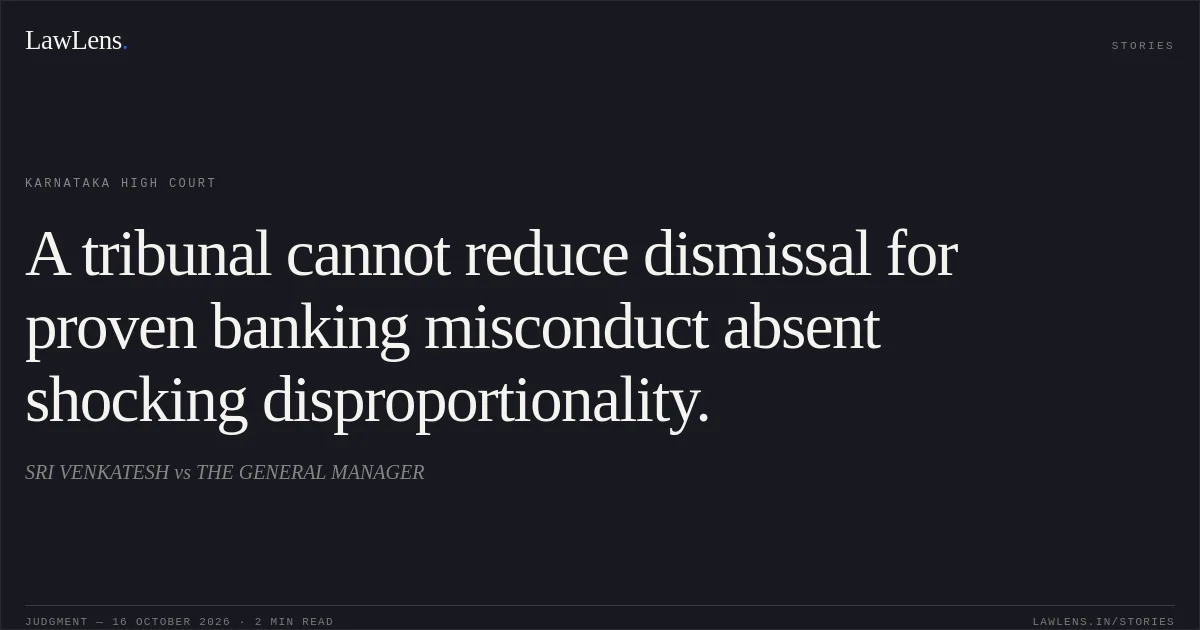
Venkatesh, an Office Assistant at the Bank’s Hiremannapur Branch, was dismissed after a domestic enquiry found him responsible for irregularities involving the collection and crediting of cheque proceeds to accounts other than those of the named beneficiaries.
Source reference: para. 3, 7–14The CGIT held the enquiry fair and proper but, under Section 11-A of the Industrial Disputes Act, 1947, set aside the dismissal and ordered reinstatement without back wages, allowing continuity of service only for terminal benefits; it relied in part on the absence of established financial loss and the lesser punishment imposed on the Branch Managers.
Source reference: para. 16, 23–26The Bank challenged the award, while Venkatesh separately sought reinstatement with back wages and consequential benefits.
Source reference: para. 27–29, 44Issues
1. Whether the CGIT was justified in interfering under Section 11-A with the Bank’s dismissal order and directing reinstatement.
Source reference: para. 31; para. 32–402. Whether the lesser punishment imposed on the Branch Managers, or the absence of established actual financial loss to the Bank, justified reducing Venkatesh’s punishment.
Source reference: para. 35, 38–40Law Applied
Section 11-A of the Industrial Disputes Act, 1947 empowers the Labour Court or Tribunal to interfere with a punishment, but the court held that such interference was not justified merely because another view on punishment was possible; the punishment must be shockingly disproportionate to the proved misconduct.
Source reference: para. 33, 37Relying on Punjab & Sind Bank v. Raj Kumar, 2026 SCC OnLine SC 519, and the authorities discussed there—including Bhagat Ram v. State of Himachal Pradesh, Ranjit Thakur v. Union of India, B.C. Chaturvedi v. Union of India and Union of India v. G. Ganayutham—the Court reiterated that judicial review of disciplinary punishment is limited and ordinarily does not permit substitution of the reviewing court’s view for that of the disciplinary authority; interference is warranted where the punishment is irrational, perverse or so disproportionate that it shocks the conscience.
Source reference: para. 41–42The Court also applied the principle that parity in punishment is not automatic where employees’ roles and responsibilities differ.
Source reference: para. 38–39Reasoning
The Court noted that the CGIT had accepted the fairness of the enquiry and had not set aside the findings that Venkatesh participated in irregular cheque processing and facilitated credits to accounts other than those of the intended beneficiaries.
Source reference: para. 16, 32–34, 38–39The absence of proof that the Bank ultimately suffered the full alleged loss did not negate the proved misconduct or the financial risk to which the Bank had been exposed.
Source reference: para. 35–36Nor did the Managers’ lesser punishment establish a right to parity, since their circumstances and roles were not identical to Venkatesh’s.
Source reference: para. 38–39Given the nature of the misconduct and the trust attached to banking duties, the dismissal was not shockingly disproportionate; the CGIT therefore lacked sufficient basis to substitute reinstatement.
Source reference: para. 37–40Holding
The Court allowed the Bank’s writ petition, set aside the CGIT award dated 16 October 2020, and dismissed Venkatesh’s writ petition seeking back wages and consequential relief, holding that consideration of that petition did not arise once the award was set aside.
Acts & Sections Cited
2 provisions across 1 statute referred to in this judgment. Linked provisions open on LawLens.
REGIONAL RURAL BANKS ACT, 19762
Original Court PDF
SRI VENKATESHvsTHE GENERAL MANAGER
Click to open original judgment
Original judgment, available to read, download and summarize on LawLens.in