Facts
The Karnataka State Pollution Control Board (KSPCB), through its Deputy Environmental Officer (DEO), filed a private complaint alleging offences under Sections 41–44 of the Water (Prevention and Control of Pollution) Act, 1974 and Section 37 of the Air (Prevention and Control of Pollution) Act, 1981. The Magistrate registered the matter as C.C. No. 5648/2020 and issued summons.
Source reference: p. 3–4The petitioners sought to quash the proceedings, contending that the DEO lacked authority to initiate the prosecution without specific authorisation from the Board or its Chairman.
Source reference: p. 4–8Issues
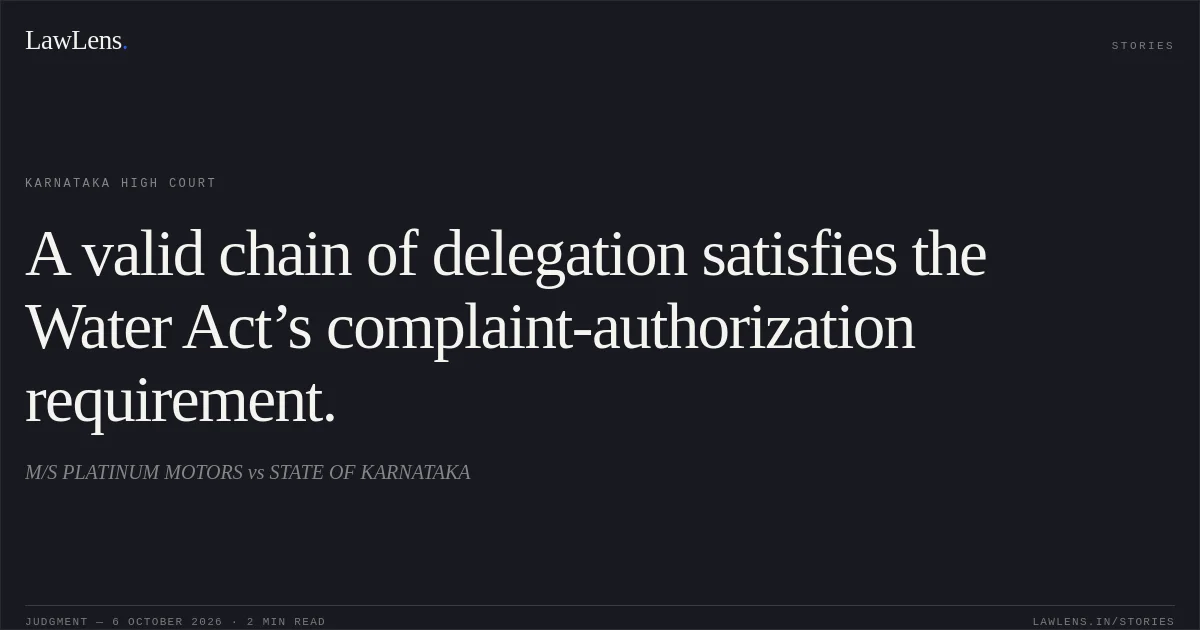
Whether the DEO’s complaint was maintainable under Section 49(1)(a) of the Water Act where the Board had delegated authority to its Chairman, who then authorised the DEO to initiate proceedings.
Source reference: para. 7, p. 8Whether a separate authorisation directly from the Board in favour of the DEO was required.
Source reference: paras. 12, 17–18, pp. 10–12Law Applied
Section 49(1)(a) of the Water Act bars a court from taking cognizance of an offence except on a complaint by the Board or an officer authorised in that behalf by the Board.
Source reference: para. 8, p. 9An officer’s authority may be traced through a valid chain of delegation; the provision does not invariably require a separate, direct authorisation from the Board to the officer filing the complaint.
Source reference: paras. 10–18, pp. 10–12In Sri B.V. Byre Gowda v. State of Karnataka, the Court held that an officer must comply with any condition or limitation attached to a delegation, including a requirement for prior approval.
Source reference: paras. 19–20, p. 12In Gujarat Pollution Control Board v. Nicosulf Industries & Exports Private Limited, the Supreme Court held that, in the context of the Water Act, sanction to file a complaint may in law amount to authorisation; a separate document bearing that title is not invariably necessary.
Source reference: paras. 23–25, pp. 14–15Reasoning
The Board’s resolutions and Official Memoranda dated 24 March 2007 and 8 March 2013 empowered the Chairman to grant administrative approval for criminal proceedings. The Chairman’s letter dated 5 October 2019 authorised the relevant regional officers, including the DEO, to initiate proceedings.
Source reference: paras. 13–15, pp. 11–12The DEO’s authority was therefore traceable through the Chairman to the Board, and the record disclosed no prohibition on the delegation or evidence that the Chairman exceeded it.
Source reference: paras. 16–18, 26–34, pp. 12–17Unlike Byre Gowda, the required Chairman’s approval had been granted; Nicosulf Industries did not require an additional, separately titled authorisation.
Source reference: paras. 20–26, pp. 12–15Holding
The Court held that the complaint was maintainable under Section 49(1)(a) of the Water Act because the DEO had been authorised through a valid chain of delegation from the Board.
It dismissed the criminal petition, reserving the petitioners’ liberty to raise other available defences before the trial court.
Source reference: para. 37, p. 17Acts & Sections Cited
15 provisions across 4 statutes referred to in this judgment. Each provision opens on LawLens.
Code of Criminal Procedure, 19732
Bharatiya Nagarik Suraksha Sanhita, 20231
Water (Prevention and Control of Pollution) Act, 19748
Air (Prevention and Control of Pollution) Act, 19814
Original Court PDF
M/S PLATINUM MOTORSvsSTATE OF KARNATAKA
Click to open original judgment
Original judgment, available to read, download and summarize on LawLens.in