Facts
The plaintiffs sought interim restraint against the transfer of 1,45,833 shares in Rehber Food Industries Pvt. Ltd. from Defendant No. 1 to Defendant No. 2.
Source reference: pp. 2–3, 14–16; paras. 2–7, 34–36They alleged that the transfer, and an earlier transfer of the same shares from Defendant No. 3 to Defendant No. 1, breached a Memorandum of Understanding (MoU) dated 12 December 2022, which required specified consent and offered Rehber Group members priority to purchase shares.
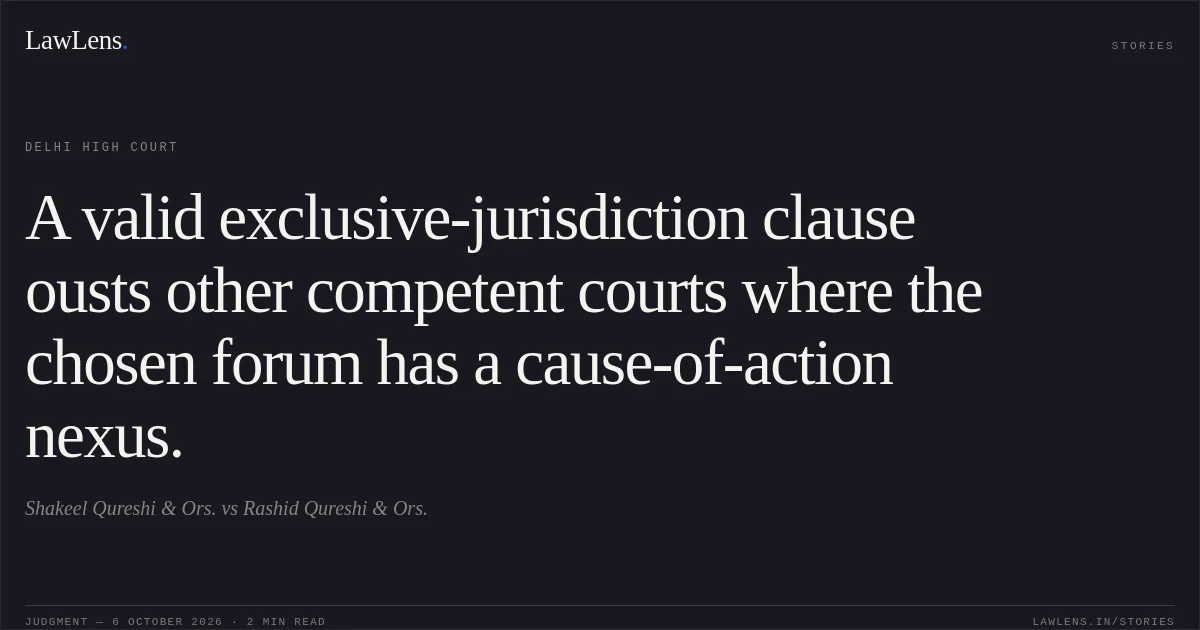
Source reference: pp. 2–3, 14–16; paras. 2–7, 34–36The defendants objected that Clause 10 of the MoU conferred exclusive jurisdiction on courts at Bareilly, Uttar Pradesh.
Source reference: p. 3; para. 8Before considering the application for interim relief, the Court addressed that territorial-jurisdiction objection.
Source reference: pp. 13–14; paras. 32–33Issues
Whether Clause 10 of the MoU excluded the Delhi High Court’s territorial jurisdiction over the suit, whose reliefs were substantially founded on the MoU
Source reference: pp. 13–16; paras. 32–36Whether the defendants were precluded, under the doctrine of approbate and reprobate, from relying on the MoU’s jurisdiction clause in light of their position in earlier suits
Source reference: pp. 16–18; paras. 37–41Law Applied
Section 20(a) CPC recognises jurisdiction where a defendant resides or carries on business, while Section 20(c) concerns where the cause of action arises; parties may, by agreement, select one among courts that otherwise have jurisdiction and exclude the others, but cannot confer jurisdiction on a court that otherwise lacks it.
Source reference: p. 20; para. 46; p. 22; para. 52Order VII Rule 10 CPC provides for return of a plaint for presentation to the proper court.
Source reference: p. 22; para. 55The Court also relied on Asma Lateef v. Shabbir Ahmad, 2024 SCC OnLine SC 42, for the need to address the court’s competence before proceeding to the merits.
Source reference: pp. 12–14; paras. 29, 33The doctrine of approbate and reprobate bars a party from accepting and rejecting the same transaction or instrument to obtain inconsistent advantages; the Court considered, but found the doctrine inapplicable on the facts.
Source reference: pp. 7–8, 16–18; paras. 18, 37–41Reasoning
The Court found that the material prayers—including declarations of invalidity and mandatory relief—depended on alleged breaches of the MoU.
Source reference: pp. 14–16; paras. 34–36It held that the earlier suits did not establish that the defendants had approbated and reprobated: Defendant No. 2 was not a party to the first suit, which was not based on the MoU, and had objected to territorial jurisdiction in the second suit; Defendant No. 1 was party to neither suit.
Source reference: pp. 16–18; paras. 38–41Although Defendant No. 1’s location brought the suit within Section 20(a) CPC, the Court held that Clause 10 selected Bareilly as the exclusive forum.
Source reference: pp. 19–22; paras. 42–52It considered Bareilly connected to the dispute because the MoU was executed there, Defendant No. 3 was located there, and the earlier share-transfer transaction was executed there.
Source reference: pp. 19–22; paras. 42–52Since the challenge to the later transfer was interlinked with the earlier transaction and the MoU, the Court concluded that Clause 10 applied to the suit.
Source reference: pp. 19–22; paras. 42–52Holding
The Court upheld the objection that Delhi was not the proper forum under the MoU’s exclusive-jurisdiction clause and returned the plaint under Order VII Rule 10 CPC for presentation before a court of competent territorial jurisdiction.
It disposed of the interim-injunction application without deciding its merits and vacated any earlier interim arrangement or order.
Source reference: pp. 22–23; paras. 53–57All questions concerning the merits, including fraud, collusion, breach, liability and the MoU’s validity, were left open.
Source reference: pp. 22–23; paras. 53–57Acts & Sections Cited
6 provisions across 4 statutes referred to in this judgment. Each provision opens on LawLens.
Code of Civil Procedure, 19082
Indian Contract Act, 18721
Companies Act, 20132
Commercial Courts Act, 20151
Original Court PDF
Shakeel Qureshi & Ors.vsRashid Qureshi & Ors.
Click to open original judgment
Original judgment, available to read, download and summarize on LawLens.in