01Facts
Fouziya sustained injuries in a road traffic accident on 21 November 2019 involving a scooter owned by Sharath.
pp. 4–6 · ¶ 1–5The Motor Accident Claims Tribunal awarded her approximately Rs. 2,23,000 with interest at 6% per annum, but directed the insurer to pay and recover the amount from the owner.
pp. 4–6 · ¶ 1–5Sharath appealed against the pay-and-recover direction, while Fouziya appealed seeking enhancement of compensation.
pp. 4–6 · ¶ 1–5The Tribunal had found that the scooter rider held a learner’s licence on the date of the accident.
p. 8 · ¶ 1302Issues
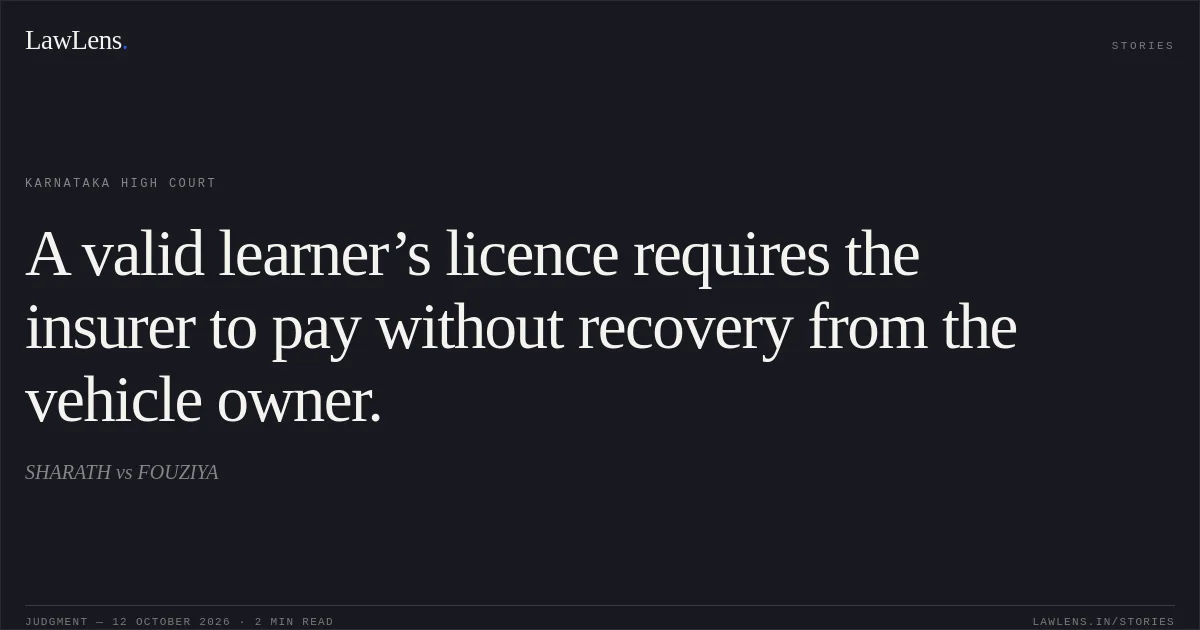
i.1. Whether the Tribunal erred in directing the insurer to pay the compensation and recover it from the owner, despite finding that the rider held a valid learner’s licence.
pp. 6–9 · ¶ 7, 13ii.2. Whether the compensation awarded by the Tribunal required enhancement in light of the claimant’s injuries, disability, medical expenses, and period of recovery.
pp. 6–11 · ¶ 8, 14–1703Law Applied
The appeals were brought under Section 173(1) of the Motor Vehicles Act.
pp. 2–3The Court relied on Senior Divisional Manager, National Insurance Co. Ltd. v. Jyotiba Appaji and Others (2020 ACJ 1), as cited in the judgment, for the proposition that a learner’s licence is valid for riding a two-wheeler and that an instructor is not required in that situation.
p. 8 · ¶ 13For assessing compensation, the Court applied the Karnataka State Legal Services Authority’s notional income of Rs. 14,000 per month for 2019, treated one-third of the assessed lower-limb disability as whole-body disability, and applied the multiplier appropriate to the claimant’s age.
pp. 10–11 · ¶ 16Provisions in the judgment · 1 · Linked ones open on LawLens
Motor Vehicles Act, 1988 Section 173
04Reasoning
The Tribunal’s finding that the rider held a learner’s licence was consistent with the cited authority on two-wheeler learner’s licences.
pp. 8–9 · ¶ 13Accordingly, the Court held that the Tribunal had no basis to direct pay and recovery and that the insurer was liable to satisfy the award.
pp. 8–9 · ¶ 13On enhancement, the Court reassessed compensation to account for the claimant’s fractures and other injuries, allowed supported handwritten medical bills, and added compensation for loss of amenities and income during the 16-week recovery period.
pp. 9–12 · ¶ 14–18It also revised the notional income to Rs. 14,000 per month and the whole-body disability to 5.11%, applying multiplier 16.
pp. 9–12 · ¶ 14–1805Holding
The Court allowed Sharath’s appeal and set aside the pay-and-recover direction, holding the insurer liable for the full compensation.
pp. 13, order clauses (i)–(ii)It partly allowed Fouziya’s appeal, enhancing the total compensation to Rs. 4,40,174—an increase of Rs. 2,17,174—with interest at 6% per annum from the petition date, except for the 537-day delay period in filing her appeal.
pp. 12–14 · ¶ 19 and order clauses (iii)–(viii)The insurer was directed to deposit the enhanced compensation within six weeks, and the claimant was entitled to its release; Sharath was also entitled to a refund of his statutory deposit.
pp. 12–14 · ¶ 19 and order clauses (iii)–(viii)Original Court PDF
SHARATHvsFOUZIYA
Click to open original judgment
Original judgment, available to read, download and summarize on LawLens.in