Facts
The informant alleged that she married the petitioner on 08.01.2017 according to Hindu rites and customs. Both parties had been previously married. She alleged that, after marriage, the petitioner and his family subjected her to physical and mental cruelty, prevented her from meeting others, threatened her, refused to enter her name in the petitioner’s service book, caused her pregnancy to terminate by administering a substance in milk, and retained her stridhan, jewellery and other articles. She also alleged threats and harassment by the petitioner and his family members.
Source reference: para. 2On the basis of her complaint, FIR No. 22 of 2021 was registered at Women Police Station, Nahan, under Sections 498-A, 406 and 506 IPC. After investigation, the police filed a charge-sheet before the competent court.
Source reference: paras. 1–2The petitioner sought quashing of the FIR and consequential proceedings under Section 528 BNSS, contending that no valid marriage had taken place, that Section 498-A IPC was therefore inapplicable, and that the allegations were vague and false.
Source reference: para. 3The State and the informant opposed the petition, relying on the marriage certificate, photographs, other documents and the petitioner’s own proceedings challenging the validity of the marriage.
Source reference: paras. 4–6Issues
Whether the FIR and consequential criminal proceedings under Sections 498-A, 406 and 506 IPC were liable to be quashed under Section 528 BNSS on the ground that the petitioner and the informant were not validly married?
Source reference: paras. 3, 8, 14–19Whether the allegations in the FIR were vague, inherently improbable or otherwise insufficient to disclose the commission of cognizable offences?
Source reference: paras. 3, 8, 22Whether the High Court could assess the truthfulness of the allegations or conduct a mini-trial while exercising its inherent jurisdiction after filing of the charge-sheet?
Source reference: paras. 23–27Law Applied
The Court applied Section 528 BNSS, corresponding to the inherent jurisdiction formerly exercised under Section 482 CrPC, and the principles in State of Haryana v. Bhajan Lal, permitting quashing where the allegations, even if accepted in their entirety, do not constitute an offence, disclose no cognizable offence, are inherently absurd, are legally barred, or constitute an abuse of process.
Source reference: para. 12The Court relied on B.N. John v. State of U.P. and Ajay Malik v. State of Uttarakhand for the proposition that inherent powers must be exercised sparingly and only to prevent abuse of process or secure the ends of justice.
Source reference: paras. 12–13Under Reema Aggarwal v. Anupam, A. Subhash Babu v. State of Andhra Pradesh, Rajinder Singh v. State of Punjab and Dr Lokesh B.H. v. State of Karnataka, the expression “husband” in Section 498-A IPC is to be construed purposively and may include a person who enters into a marital arrangement or feigns the status of husband, even where the validity of the marriage is disputed.
Source reference: paras. 15–18The Court further applied the rule that, at the quashing stage, the allegations are to be taken at face value; the Court cannot conduct a mini-trial or assess their reliability, as stated in Punit Beriwala v. State (NCT of Delhi), Maneesha Yadav v. State of U.P. and Dharambeer Kumar Singh v. State of Jharkhand.
Source reference: paras. 23–26Once the charge-sheet has been filed, the trial court should ordinarily examine the collected material, including in discharge proceedings, as recognised in Iqbal v. State of U.P.
Source reference: para. 27Reasoning
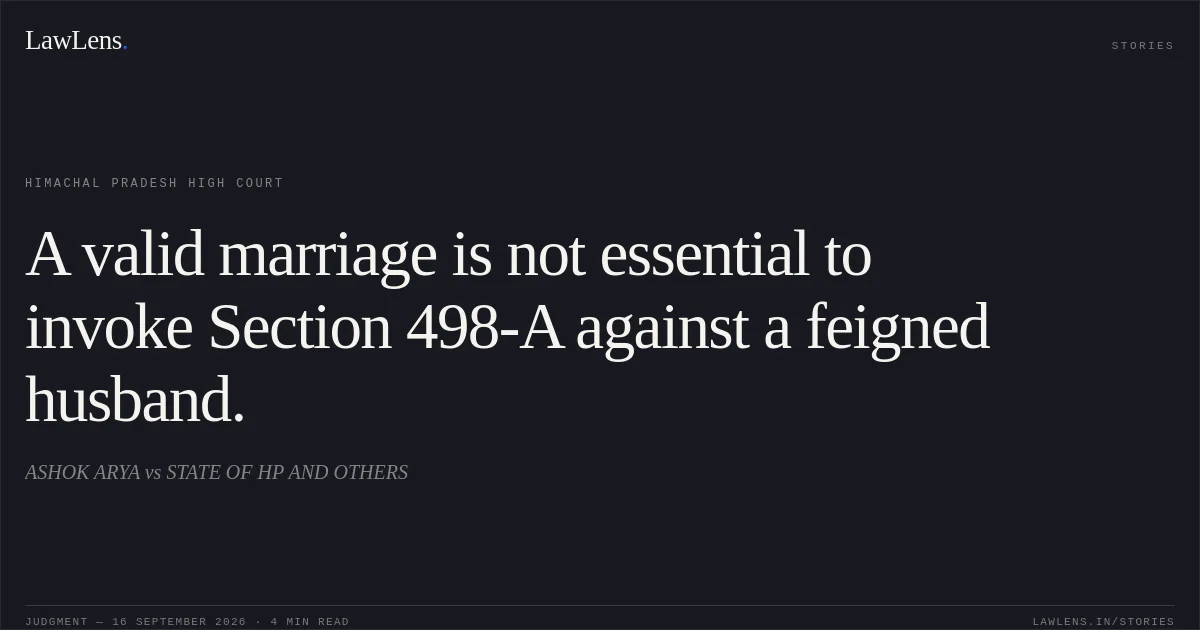
The Court rejected the petitioner’s contention that a formally valid marriage was an indispensable precondition for proceedings under Section 498-A IPC. Applying the purposive interpretation in Reema Aggarwal and the subsequent decisions approving it, the Court held that a person cannot evade Section 498-A merely by asserting that the marriage was void or invalid.
Source reference: paras. 15–19In any event, the record contained prima facie material indicating that a marriage ceremony had occurred, including photographs, marriage-related documents and the petitioner’s own pleadings alleging that the ceremony had been forcibly or improperly conducted.
Source reference: para. 20The informant’s contrary statement in proceedings under Section 127 CrPC did not conclusively negate the other material and raised a disputed factual question unsuitable for determination in a quashing petition.
Source reference: para. 21The allegations concerning refusal to enter the informant’s name in the service book, physical and mental harassment, administration of adulterated milk resulting in abortion, and retention of stridhan and jewellery were specific enough to disclose prima facie offences and could not be characterised as vague or inherently improbable.
Source reference: para. 22The petitioner’s assertion that the allegations were false required an assessment of evidence and could not be adjudicated through a mini-trial under Section 528 BNSS.
Source reference: paras. 23–26Since the investigation had concluded and the charge-sheet had been filed, the trial court was the appropriate forum to assess the evidentiary material and determine whether the petitioner was entitled to discharge or whether the case should proceed.
Source reference: para. 27Holding
The High Court held that the disputed validity of the marriage did not, by itself, bar prosecution under Section 498-A IPC, particularly where the petitioner had entered into a marital relationship with the informant and prima facie material supported the occurrence of a marriage ceremony.
The FIR contained specific allegations disclosing prima facie offences under Sections 498-A, 406 and 506 IPC, and no ground for quashing under the Bhajan Lal principles was established.
Source reference: paras. 22–27The petition under Section 528 BNSS was therefore dismissed, along with pending applications, if any.
Source reference: paras. 29–30The Court clarified that its observations were confined to disposal of the quashing petition and would not affect the merits of the trial.
Source reference: paras. 29–30Acts & Sections Cited
12 provisions across 4 statutes referred to in this judgment. Each provision opens on LawLens.
Bharatiya Nagarik Suraksha Sanhita, 20231
Indian Penal Code, 18604
Code of Criminal Procedure, 19735
Hindu Marriage Act, 19552
Original Court PDF
ASHOK ARYAvsSTATE OF HP AND OTHERS
Click to open original judgment
Original judgment, available to read, download and summarize on LawLens.in