Facts
The appellant’s wife, Suparna Mondal, was travelling with him and their two children from Jhargram towards Howrah on 21 January 2012.
Source reference: pp. 2–4, 7–8When the train stopped between Uluberia and Phuleshwar because of a signal, the appellant and the children alighted; while the deceased attempted to alight, the train started and she fell, sustaining serious head injuries.
Source reference: pp. 2–4, 7–8She was treated at Uluberia General Hospital, P.G. Hospital, Alampur Green View Hospital and Howrah General Hospital, where she died on 5 March 2012.
Source reference: pp. 2–3A police inquest/final report and the Railway’s DRM-approved enquiry recorded that she had fallen while attempting to alight from the train, although the Railway attributed the occurrence to her negligence.
Source reference: pp. 7–8The Railway Claims Tribunal dismissed the claim under Sections 124A and 125 of the Railways Act, 1989, holding that the deceased was not proved to be a bona fide passenger and that the occurrence was not an untoward incident.
Source reference: p. 2The husband appealed.
Source reference: no citationIssues
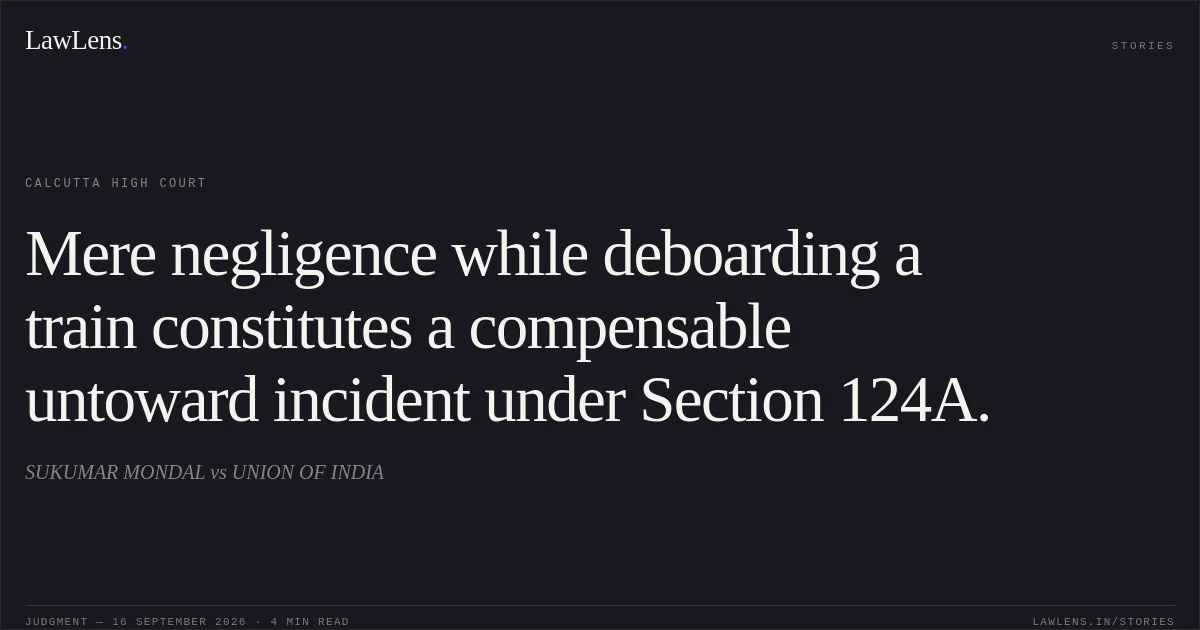
1. Whether the deceased’s fall while attempting to alight from a moving train constituted an “untoward incident” under Sections 123(c) and 124A of the Railways Act, 1989, notwithstanding alleged negligence on her part.
Source reference: pp. 6–122. Whether the absence or non-recovery of the railway ticket disentitled the appellant from claiming statutory compensation on the ground that the deceased was not proved to be a bona fide passenger.
Source reference: pp. 12–133. Whether the appellant was entitled to compensation for the deceased’s death under Section 124A of the Railways Act, 1989.
Source reference: pp. 13–14Law Applied
Section 124A of the Railways Act, 1989 imposes no-fault liability on the Railway administration for death or injury resulting from an untoward incident, subject to the statutory exceptions, including suicide, self-inflicted injury, criminal acts, intoxication or insanity, and natural causes.
Source reference: p. 6An accidental fall from a passenger train is an untoward incident under Section 123(c), and mere negligence does not amount to “self-inflicted injury” or defeat a claim under Section 124A: Jameela v. Union of India, (2010) 12 SCC 443.
Source reference: pp. 9–10The beneficial provisions of the Railways Act receive a liberal interpretation; a person attempting to board or alight from a train may fall within the expression “accidental falling of a passenger”: Union of India v. Prabhakaran Vijaya Kumar, Appeal (Civil) No. 6898 of 2002.
Source reference: pp. 10–12Under Union of India v. Rina Devi, (2019) 3 SCC 572, the Railway bears the relevant burden concerning the bona fide status of the passenger, and non-production of a ticket is not, by itself, conclusive against the claimant.
Source reference: p. 9The Court also relied on Anima Sarkar (Dolui) v. Union of India, FMA 1169 of 2021, regarding the evidentiary value of police and investigative records and the fact that absence of a recovered ticket does not automatically defeat an otherwise established claim.
Source reference: pp. 12–13Reasoning
The police report and Railway enquiry both established that the deceased fell from the train while attempting to alight after the train had stopped at a signal.
Source reference: pp. 7–8Although the Railway characterised her conduct as negligent or reckless, the Court held that negligence is distinct from the statutory exceptions under Section 124A; under Jameela, contributory negligence cannot be imported into a no-fault compensation scheme.
Source reference: pp. 9–10The Court further reasoned that, since the deceased’s husband and children had already alighted and the train unexpectedly started, her attempt to get down could not, in the circumstances, be treated as conduct excluding statutory protection.
Source reference: p. 12Applying the liberal construction mandated by Prabhakaran Vijaya Kumar, the fall constituted an accidental falling of a passenger and therefore an untoward incident.
Source reference: pp. 10–12The failure to recover the ticket was also insufficient to disprove bona fide passenger status, particularly because the deceased was travelling with her husband and the ticket could have remained with him.
Source reference: p. 13Holding
The Court held that the deceased’s fall and consequent death constituted an untoward incident under the Railways Act and that mere negligence did not bar compensation.
The appeal was allowed, the Tribunal’s judgment and award dated 9 February 2018 in OA/IIu/KOL/2016/0027 were set aside, and the appellant was awarded compensation of ₹4,00,000 with interest at 9% per annum from the date of filing of the claim until the date of judgment, or ₹8,00,000, whichever was higher.
Source reference: p. 13The Railway was directed to deposit the amount before the Registrar General of the High Court within eight weeks, after which the appellant could withdraw it upon completion of the necessary formalities.
Source reference: p. 14Acts & Sections Cited
6 provisions across 3 statutes referred to in this judgment. Each provision opens on LawLens.
Railways Act, 19894
Code of Criminal Procedure, 19731
Motor Vehicles Act, 19881
Original Court PDF
SUKUMAR MONDALvsUNION OF INDIA
Click to open original judgment
Original judgment, available to read, download and summarize on LawLens.in