Facts
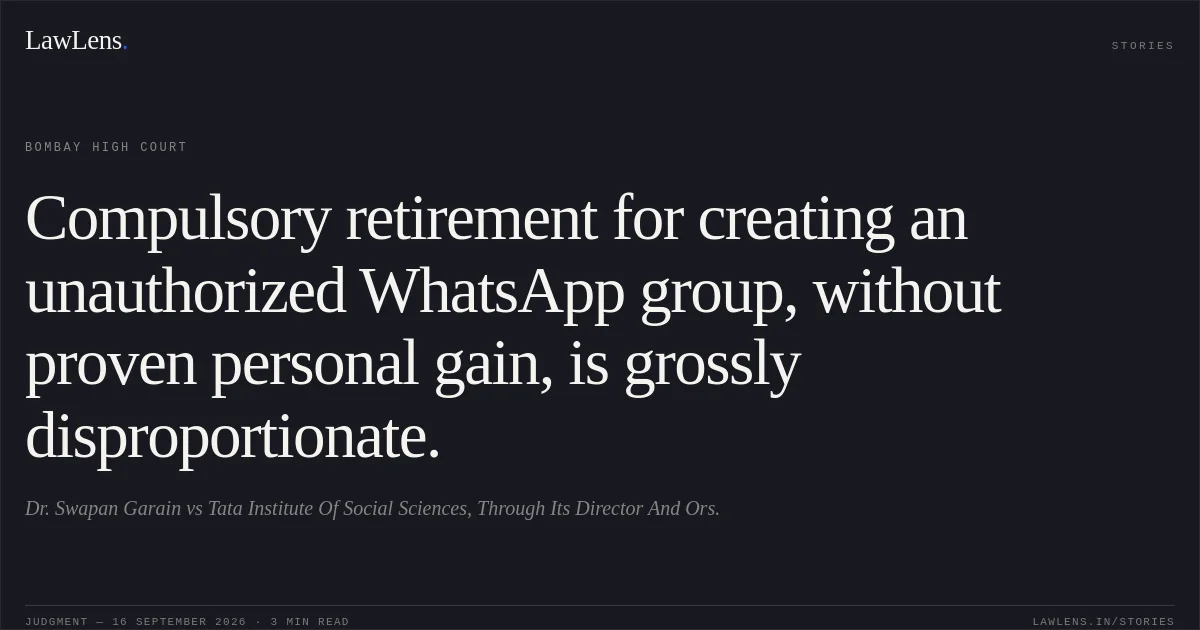
The Petitioner, a Professor employed by the Tata Institute of Social Sciences (“TISS”) since 13 July 1985, created a WhatsApp group titled “TISSians Career Impact2” for TISS alumni and students.
Source reference: pp.2; para. 2TISS alleged that the group used its official logo, operated as an unauthorised parallel placement service, involved the Petitioner in private trade or business, misused institutional resources and information, and was intended to secure personal gains.
Source reference: pp.10–13; para. 10The Petitioner was suspended on 29 March 2016 under Rule 10 of the CCS (CCA) Rules, 1965, and a charge memorandum was issued on 22 April 2016.
Source reference: pp.2–3; paras. 2–3The Inquiry Authority found against the Petitioner on the allegations. TISS thereafter imposed the penalty of compulsory retirement with effect from 6 September 2017. The Petitioner’s appeal was rejected on 16 January 2018.
Source reference: pp.4–5; para. 4Issues
Whether the findings of the Inquiry Authority and the disciplinary authorities that the Petitioner’s WhatsApp group constituted a parallel placement business, involved personal gain, and amounted to misconduct were perverse or unsupported by the evidence.
Source reference: pp.14–17; paras. 11–13, 17Whether the penalty of compulsory retirement was disproportionate to the misconduct allegedly established against the Petitioner.
Source reference: pp.16–19; paras. 13–16Whether the suspension order, compulsory-retirement order, and appellate order were liable to be quashed, and whether the Petitioner was entitled to reinstatement, continuity of service, back wages, and consequential retirement benefits.
Source reference: pp.18–21; paras. 18–19Law Applied
The Court applied the Central Civil Services (Conduct) Rules, 1964, particularly Rule 3(1), requiring integrity, devotion to duty, proper conduct and adherence to professional standards, and Rules 11 and 15(1), concerning misuse of official information and engagement in trade or business, as adopted by TISS.
Source reference: pp.10–13; para. 10The Court also considered Rule 15(2) of the CCS (CCA) Rules, 1965, concerning the employee’s opportunity to represent against the inquiry report.
Source reference: pp.6–8; paras. 4–5On judicial review, the Court reiterated that constitutional courts may interfere where disciplinary findings are perverse, suffer from patent error, or are findings which no reasonable person could have reached.
Source reference: p.20; para. 17Applying the doctrine of proportionality, the Court relied on Ranjit Thakur v. Union of India, (1987) 4 SCC 611, holding that punishment must be commensurate with the gravity of misconduct and that a grossly disproportionate penalty violates Article 14.
Source reference: pp.16–18; paras. 14–16It also relied on Omsairam Steels & Alloys (P) Ltd. v. State of Odisha, (2024) 9 SCC 697, and the principle that a “sledgehammer” cannot be used where a lesser measure would suffice.
Source reference: pp.18–19; para. 16Reasoning
The Court examined the WhatsApp exchanges and found no evidence that the Petitioner charged money for placement services or diverted any funds for personal benefit.
Source reference: pp.14–16; paras. 11–13The communications primarily circulated career opportunities, including a CSR opportunity, online government services and employment-related information for TISS alumni and students.
Source reference: pp.14–16; paras. 11–13The group was restricted to “TISSians,” and the registered TISS alumni association had neither complained nor participated in the proceedings, making the alleged prejudice to TISS difficult to establish.
Source reference: pp.14–15; paras. 11–12Although the Petitioner had not obtained TISS’s permission and had initially used its logo, the logo was subsequently removed. The Court held that these circumstances did not establish a parallel commercial placement service or personal gain.
Source reference: pp.15–17; para. 13The Inquiry Authority had failed to properly consider the Petitioner’s explanation, rendering its findings perverse.
Source reference: pp.15–17; para. 13Even assuming that unauthorised creation of the WhatsApp group constituted some infraction, compulsory retirement after a long career was manifestly excessive and disproportionate to the proved conduct.
Source reference: pp.16–19; paras. 14–16Holding
Since the penalty and underlying findings could not withstand judicial review, the consequential orders were also liable to be set aside.
The Bombay High Court allowed the writ petition and quashed the suspension order dated 29 March 2016, the compulsory-retirement order dated 6 September 2017, and the appellate order dated 16 January 2018.
Source reference: pp.20–21; para. 19It directed TISS to reinstate the Petitioner with continuity of service and to pay 50% of the back wages from the date of termination until the date of superannuation, together with all consequential benefits.
Source reference: p.20–21; paras. 18–19TISS was further directed to recompute the Petitioner’s retirement benefits and pay any arrears within three months. There was no order as to costs.
Source reference: p.21; para. 19Acts & Sections Cited
1 provisions across 1 statute referred to in this judgment. Each provision opens on LawLens.
Information Technology Act, 20001
Original Court PDF
Dr. Swapan GarainvsTata Institute Of Social Sciences, Through Its Director And Ors.
Click to open original judgment
Original judgment, available to read, download and summarize on LawLens.in