Facts
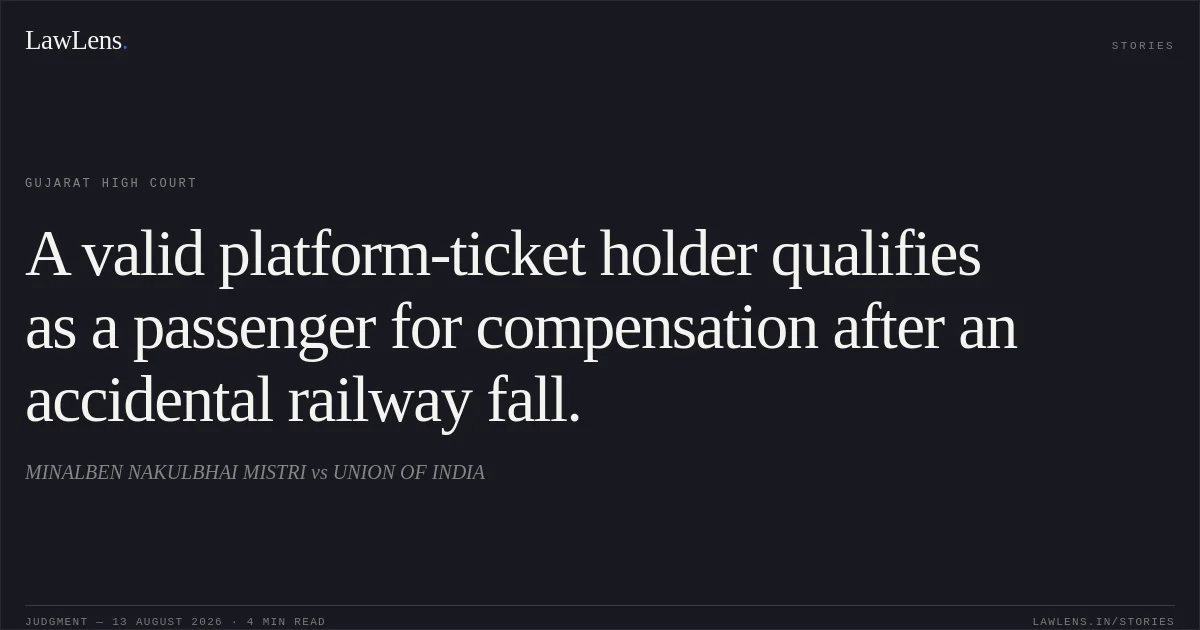
On 27 February 2023, the deceased, Nakulbhai Mistri, accompanied his wife and other claimants to Wankaner Railway Station to assist them in boarding Train No. 22717, Rajkot–Secunderabad Express, for their journey to Valsad. The deceased held a valid platform ticket and helped place their luggage inside the compartment. While he was attempting to de-board after dropping them, the train allegedly started with a sudden jerk and jolt, causing him to fall, be dragged by the train, and sustain fatal injuries.
Source reference: p.2The claimants filed an application before the Railway Claims Tribunal seeking ₹8,00,000 in compensation. The Railway Administration contended that the deceased was not a bona fide passenger because no travel ticket, pass, or authority had been recovered and that a platform ticket did not qualify its holder as a “passenger”.
Source reference: p.2–3The Railway Claims Tribunal accepted the platform-ticket position but dismissed the claim, holding that the deceased was not a bona fide passenger under Section 2(29) of the Railways Act, 1989 and the applicable railway manual provisions.
Source reference: p.3Issues
Whether a person holding a valid platform ticket falls within the statutory definition of “passenger” under the explanation to Section 124-A of the Railways Act, 1989, and is entitled to compensation for an untoward incident.
Source reference: p.1, p.4Whether the deceased’s accidental fall while attempting to de-board a passenger train constituted an “untoward incident” under Sections 123(c)(2) and 124-A of the Railways Act, 1989.
Source reference: p.17, p.19–20Whether the claimants were entitled to statutory compensation despite the absence of a regular travel ticket in the deceased’s possession.
Source reference: p.2–3, p.7–11Law Applied
Section 123(c)(2) of the Railways Act, 1989 defines an “untoward incident” to include the accidental falling of any passenger from a train carrying passengers. Section 124-A imposes strict/no-fault liability on the Railway Administration for death or injury caused by an untoward incident, subject to the statutory exceptions in clauses (a)–(e) of its proviso.
Source reference: p.17, p.4The explanation to Section 124-A inclusively treats as a “passenger” a person who has purchased a valid ticket for travel or a valid platform ticket and becomes a victim of an untoward incident.
Source reference: p.4–5Under Union of India v. Rina Devi and the principles reiterated in Rajni v. Union of India, the initial burden lies on the claimant to establish the relevant facts, after which the burden shifts to the Railways; mere absence of a ticket does not, by itself, negate bona fide passenger status.
Source reference: p.7–8In Union of India v. Prabhakaran Vijaya Kumar, (2008) 9 SCC 527, the Supreme Court held that the beneficial provisions of the Railways Act must receive a liberal rather than technical interpretation, and that accidental falling includes falling while attempting to board or alight from a train.
Source reference: p.20–21Negligence, without a malicious or criminal element, does not fall within the statutory exception for a passenger’s own criminal act, as explained in Jameela v. Union of India.
Source reference: p.16Reasoning
The High Court held that the Tribunal had adopted an unduly narrow and technical interpretation of “passenger.” The deceased’s possession of a valid platform ticket was sufficient to bring him within the inclusive explanation to Section 124-A once he became the victim of an untoward incident.
Source reference: p.4–5, p.19The undisputed circumstances showed that he had boarded the train to assist his family, was attempting to de-board, and fell because of a sudden jerk while the train was moving. Such a fall fell squarely within Section 123(c)(2), and the fact that he was not travelling with a regular journey ticket did not defeat the claim.
Source reference: p.19–20Relying on Prabhakaran Vijaya Kumar, the Court treated the act of falling while boarding or alighting as covered by the statutory expression “accidental falling,” regardless of whether the deceased was fully inside the train at the relevant moment.
Source reference: p.20–21The Railway Administration failed to establish any of the exceptions under the proviso to Section 124-A, including suicide, self-inflicted injury, intoxication, insanity, or a criminal act. Accordingly, the deceased qualified as a passenger for the limited purpose of statutory compensation.
Source reference: no citationHolding
The appeal was allowed. The High Court quashed and set aside the Railway Claims Tribunal’s judgment and award, holding that a person holding a valid platform ticket may be treated as a “passenger” under Section 124-A when he becomes a victim of an untoward incident.
The claimants were awarded ₹8,00,000 with interest at 9% per annum from the date of the accident until the date of the judgment. The Railway Administration was directed to deposit the decretal amount before the Railway Claims Tribunal, Ahmedabad Bench, within eight weeks, after which the Tribunal was directed to disburse the amount to the claimants upon verification of their identities.
Source reference: p.21–22Acts & Sections Cited
3 provisions across 1 statute referred to in this judgment. Each provision opens on LawLens.
Railways Act, 19893
Original Court PDF
MINALBEN NAKULBHAI MISTRIvsUNION OF INDIA
Click to open original judgment
Original judgment, available to read, download and summarize on LawLens.in