Facts
On 14.12.2002, Ghansham Pandey was travelling in Qualis car No. HR-01M-0004 from Delhi to Kurukshetra.
Source reference: p.2Near Meerut Chowk, Karnal, the car collided with the rear of truck No. PJA-9977 after the truck allegedly applied brakes, resulting in Ghansham Pandey’s death.
Source reference: p.2An FIR was registered under Sections 279, 337 and 304-A IPC.
Source reference: p.3The claimants—his wife and two children—alleged negligence by both drivers and claimed compensation on the basis that the deceased, aged 34, earned approximately Rs.6,000 per month as an accountant.
Source reference: p.2–3The Motor Accident Claims Tribunal, Kurukshetra, held both drivers contributorily negligent in equal proportions and awarded Rs.6,36,000.
Source reference: p.4–5Liability for 50% was imposed jointly and severally on the truck’s driver and owner, and liability for the remaining 50% on the Qualis driver, owner and insurer.
Source reference: p.4–5During the appeal, the original record was stated to have been destroyed in a fire, and the Court proceeded on the basis of the Award and the available paperbook.
Source reference: para.14Issues
Whether the accident was caused solely by the rash and negligent driving of the Qualis driver, or by contributory negligence of both the Qualis and truck drivers?
Source reference: para.2; pp.8–11Whether the High Court could reassess and enhance compensation in an appeal filed by the driver and owner, despite the claimants not having filed an appeal or cross-objections?
Source reference: para.19; pp.11–12Whether the compensation awarded by the Tribunal required enhancement in accordance with the principles governing future prospects, deductions, multiplier and conventional heads?
Source reference: paras.20–27; pp.12–15Law Applied
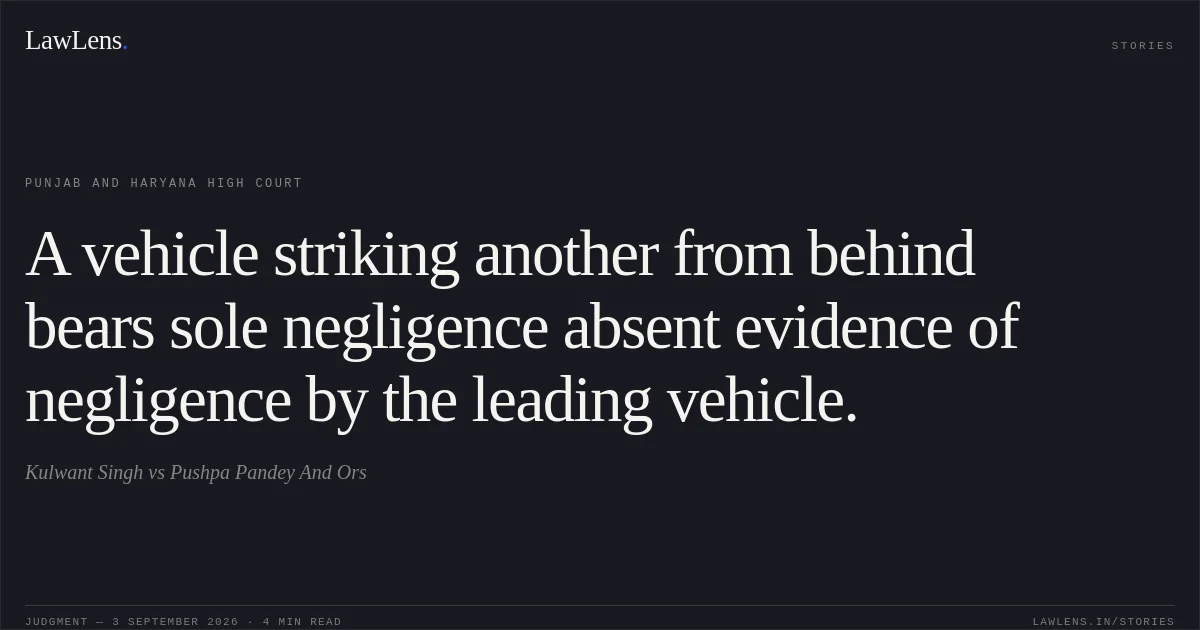
The Court applied the principle under Regulation 23 of the Rules of the Road Regulations, 1989, that a vehicle following another must maintain sufficient distance to avoid collision in the event of sudden slowing or stoppage of the vehicle ahead; failure to do so constitutes negligent driving.
Source reference: paras.16–17It relied on Oriental Insurance Co. Ltd. v. Tata AIG General Insurance Co. Ltd. and Others, including the principle affirmed in Nishan Singh v. Oriental Insurance Co. Ltd., that a rear vehicle is ordinarily negligent where it fails to maintain a safe distance and collides with the vehicle ahead.
Source reference: para.16For computation of compensation, the Court applied Sarla Verma v. Delhi Transport Corporation regarding the one-third deduction for three dependants and the multiplier of 16 for a deceased aged 34.
Source reference: paras.24–25It applied National Insurance Co. Ltd. v. Pranay Sethi for 40% addition towards future prospects and compensation under conventional heads.
Source reference: paras.23, 26It further applied Magma General Insurance Co. Ltd. v. Nanu Ram and United India Insurance Co. Ltd. v. Satinder Kaur for parental consortium payable to the children.
Source reference: para.26Relying on Surekha v. Santosh and United India Insurance Co. Ltd. v. Taraqqi Lal, the Court held that an appellate court may award just compensation even without a claimant’s cross-appeal or cross-objections, since determination of just compensation is a statutory duty and should not be defeated by procedural technicalities.
Source reference: para.19Reasoning
The Court accepted the unrebutted testimony of PW3, an occupant of the Qualis, who stated that the Qualis was being driven at a high speed, that he had repeatedly asked the driver to slow down, and that the driver failed to maintain adequate distance from the truck.
Source reference: paras.15–18The Qualis driver did not enter the witness box to contradict this evidence.
Source reference: paras.15–18Applying Regulation 23 and the rear-collision principle, the Court held that the Qualis driver should have maintained sufficient distance and controlled the vehicle even if the truck applied sudden brakes; the collision was therefore attributable solely to the Qualis driver, not to the truck driver.
Source reference: paras.16–18For quantum, the Court retained the Tribunal’s assessment of monthly income at Rs.5,500.
Source reference: para.22It added 40% future prospects, producing monthly income of Rs.7,700; deducted one-third for personal expenses; and calculated annual dependency loss at Rs.61,596.
Source reference: paras.23–25Applying multiplier 16 resulted in Rs.9,85,536 for loss of dependency.
Source reference: paras.23–25The Court then awarded Rs.70,000 to the wife under conventional heads and Rs.80,000 to the two children towards parental consortium, arriving at total compensation of Rs.11,35,536, rounded to Rs.11,35,500.
Source reference: paras.26–27It also held that enhancement was permissible notwithstanding the absence of a claimant’s appeal.
Source reference: para.19Holding
The appeal by the truck driver and owner was allowed.
The finding of 50:50 contributory negligence was set aside, and the Court held that the accident occurred solely due to the rash and negligent driving of the Qualis driver, respondent No.4.
Source reference: para.18The claimants were held entitled to total compensation of Rs.11,35,500, instead of Rs.6,36,000.
Source reference: paras.27–28The enhanced amount of Rs.4,99,500, with interest at 9% per annum from 18.10.2004 until realization, was made payable by respondents No.4 to 6—the Qualis driver, owner and insurer—jointly and severally.
Source reference: para.28From the enhanced amount, Rs.75,000 each, with proportionate interest, was directed to be paid to the two children, with the balance payable to the widow.
Source reference: para.28The Registry was directed to email the authenticated judgment to the insurer, and copies were directed to be sent to the MACT and DLSA for communication to the claimants.
Source reference: paras.29–30Acts & Sections Cited
2 provisions across 1 statute referred to in this judgment. Each provision opens on LawLens.
Indian Penal Code, 18602
Original Court PDF
Kulwant SinghvsPushpa Pandey And Ors
Click to open original judgment
Original judgment, available to read, download and summarize on LawLens.in