Facts
The Respondent was employed by the Petitioner from 1985 and was later promoted as Assistant Stores.
Source reference: paras. 3(b), 3(q)The Petitioner alleged repeated unauthorised absences, including absence from 16 January 2003 to 9 March 2003, and alleged that the Respondent reported for duty under the influence of liquor on 12 March 2003.
Source reference: paras. 3(g)–3(j)The Respondent attributed his absence to jaundice, hospitalisation, and medically advised bed rest, and asserted that he had submitted medical records and leave applications.
Source reference: paras. 3(r)–3(s)A domestic inquiry was conducted, which found the 53-day absence proved but did not establish the intoxication charge; the Respondent’s services were consequently terminated on 23 July 2004.
Source reference: paras. 3(l)–3(n)The Labour Court held the domestic inquiry violative of natural justice, permitted the Management to lead independent evidence, and ultimately found only approximately 20 days of absence unexplained. It set aside the termination and directed reinstatement with continuity of service, full back wages and consequential benefits.
Source reference: paras. 3(v)–3(y)The Petitioner challenged the Award under Articles 226 and 227 of the Constitution.
Source reference: para. 3(z)During the writ proceedings, the Respondent died on 23 March 2024, and the Petitioner stated that Rs. 8,78,590 had already been paid.
Source reference: para. 7(V)Issues
Whether the Labour Court erred in holding that the domestic inquiry was unfair and contrary to the principles of natural justice?
Source reference: para. 6(I)Whether misconduct was established against the Respondent and, if so, whether the Labour Court was justified under Section 11-A of the Industrial Disputes Act, 1947, in interfering with the punishment of dismissal and granting reinstatement, continuity of service, back wages and consequential benefits?
Source reference: para. 6(II)Whether the impugned Award suffered from perversity, patent illegality or jurisdictional error warranting interference under Articles 226 and 227 of the Constitution?
Source reference: para. 6(III)Law Applied
The Court held that its jurisdiction under Articles 226 and 227 is supervisory and does not permit appellate reappreciation of evidence; interference with a Labour Court’s Award is justified only for patent illegality, perversity, jurisdictional error or disregard of material evidence, applying Syed Yakoob v. K.S. Radhakrishnan, 1964 AIR 477.
Source reference: paras. 10–13Under B.C. Chaturvedi v. Union of India, (1995) 6 SCC 749, courts may interfere with disciplinary findings where natural justice is violated, statutory inquiry procedures are breached, or the finding is based on no evidence or is one that no reasonable person could reach.
Source reference: paras. 17–18Neeta Kaplish v. Presiding Officer, Labour Court, (1999) 1 SCC 517, establishes that where a domestic inquiry is held defective, the employer must be afforded an opportunity to lead independent evidence to prove the misconduct.
Source reference: para. 20Section 11-A of the Industrial Disputes Act, 1947 empowers the Labour Court to set aside dismissal or impose a lesser punishment, but such power must be exercised judicially and interference is warranted only where the punishment is unjustified or shockingly disproportionate, as explained in Workmen of Firestone Tyre & Rubber Co. v. Management, (1973) 1 SCC 813, and Mahindra & Mahindra Ltd. v. N.B. Narawade, (2005) 3 SCC 134.
Source reference: paras. 70–74Past misconduct may be considered while determining the appropriate punishment, and persistent unauthorised absence may support a finding of loss of confidence, subject to objective factual justification.
Source reference: paras. 76–80Reasoning
The Court upheld the Labour Court’s finding that the domestic inquiry was vitiated because the Inquiry Officer admitted that there was no documentary proof showing supply of relied-upon documents or that the Respondent had been given an effective opportunity to cross-examine the Management’s witnesses.
Source reference: paras. 21–30Mere participation in the inquiry did not amount to waiver of natural justice, since participation must constitute a meaningful opportunity of defence.
Source reference: paras. 24–29The Labour Court had also correctly granted the Management an opportunity to lead independent evidence after invalidating the inquiry, causing no procedural prejudice.
Source reference: paras. 31–34On the merits, the Court accepted that the Respondent’s hospitalisation and medically advised bed rest explained a substantial part of the absence, but held that approximately 20 days remained unauthorised and unsubstantiated, particularly because the Respondent had not timely intimated the Management about his continuing inability to attend duty.
Source reference: paras. 41–46, 51–57The intoxication charge was rightly rejected for want of medical evidence, contemporaneous material and testimony from the material witness.
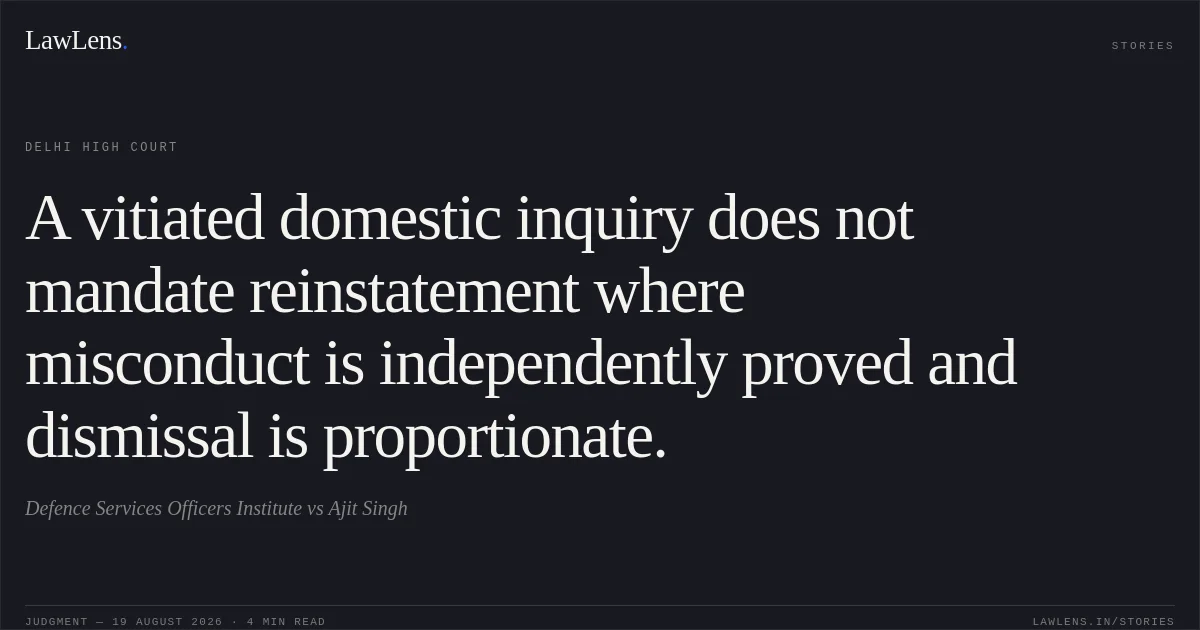
Source reference: paras. 49–50Nevertheless, considering the unexplained absence, lack of intimation, earlier absenteeism and the resulting loss of employer confidence, the Court held that the Labour Court had improperly interfered with the dismissal under Section 11-A.
Source reference: paras. 60–64, 76–90Reinstatement and full back wages were also not automatic and had been granted without examining gainful employment, financial consequences or the Respondent’s conduct.
Source reference: paras. 60–64, 76–90Holding
The writ petition was partly allowed. The Court upheld the Labour Court’s finding that the domestic inquiry violated natural justice, but held that misconduct—namely, approximately 20 days of unauthorised absence—was established and that dismissal was not so disproportionate as to justify interference under Section 11-A.
The directions for reinstatement, continuity of service, back wages and consequential benefits were set aside, and the Award dated 5 October 2012 was modified accordingly.
Source reference: paras. 95–96However, amounts already paid pursuant to the Award, including payments made to the Respondent’s legal representatives after his death, were protected from recovery.
Source reference: para. 97There was no order as to costs, and pending applications were disposed of.
Source reference: para. 98Acts & Sections Cited
1 provisions across 1 statute referred to in this judgment. Linked provisions open on LawLens.
Societies Registration Act, 18601
Original Court PDF
Defence Services Officers InstitutevsAjit Singh
Click to open original judgment
Original judgment, available to read, download and summarize on LawLens.in