Facts
The appellant and the deceased, Hasruddin Sarafuddin Shaikh, were acquaintances, room partners and fruit sellers residing in Surat. On 21 May 2013, they travelled to Daman, consumed liquor near Girish Bar, and allegedly quarrelled after the deceased refused to lift a bag containing liquor. The appellant allegedly assaulted the deceased repeatedly with a knife and fled.
Source reference: paras. 2(b)–(e)The injured deceased was found the next morning and was taken to Government Hospital, Marward, where he made oral statements to persons present and a written statement to the police naming “Tahir” as the assailant.
Source reference: paras. 24–28He was later shifted to J.J. Hospital, Mumbai, and died on 4 June 2013 due to septicemia with perforative peritonitis resulting from the stab injuries.
Source reference: paras. 17–21The appellant was arrested on 6 July 2013 and was convicted under Section 302 IPC by the Sessions Court, Daman, which sentenced him to life imprisonment and fine. He challenged the conviction in the present appeal.
Source reference: paras. 1, 4–5Issues
Whether the death of the deceased was homicidal and sufficiently connected to the injuries inflicted during the incident, notwithstanding the delay between the assault and death and the intervening septicemia?
Source reference: paras. 13–21Whether the oral and written statements made by the deceased constituted reliable and admissible dying declarations under Section 32(1) of the Evidence Act?
Source reference: paras. 23–41Whether the dying declarations were unreliable because they were not recorded by a Magistrate, lacked a separate medical fitness certificate, and were allegedly made while the deceased was semi-conscious?
Source reference: paras. 34–40Whether the prosecution established that the appellant was the person named as “Tahir”, “Tahir Pathan” or “Tahir Kunnu Pathan” in the dying declarations?
Source reference: paras. 42–48Whether the discrepancy in the IMEI numbers and the non-examination of the registered mobile-number holders created a reasonable doubt regarding the appellant’s identity?
Source reference: paras. 47–57Law Applied
The Court applied Section 302 IPC, which prescribes punishment for murder, and Section 32(1) of the Indian Evidence Act, 1872, under which a statement by a deceased person relating to the cause of death or the circumstances of the transaction resulting in death is relevant and may constitute substantive evidence.
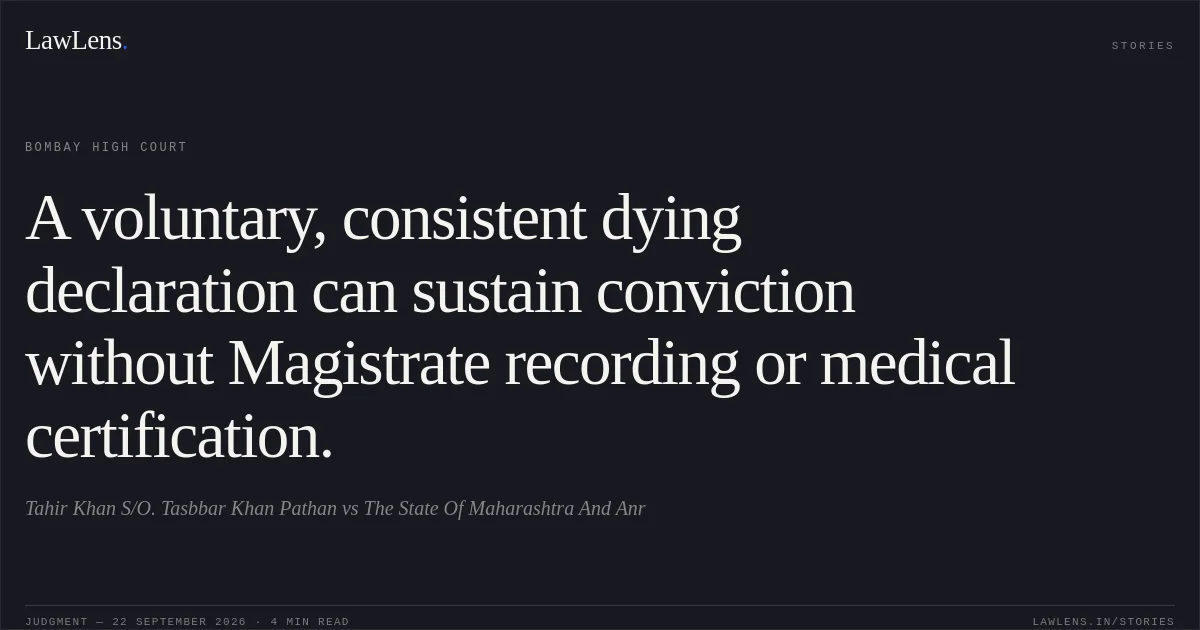
Source reference: no citationRelying on Laxman v. State of Maharashtra, the Court held that a dying declaration need not be recorded by a Magistrate or accompanied by a doctor’s certification if the Court is otherwise satisfied that it was voluntary, truthful and made by a person in a fit mental condition.
Source reference: para. 12Irfan @ Naka v. State of Uttar Pradesh was relied upon for assessing consistency, voluntariness, absence of tutoring, opportunity to identify the assailant and the effect of multiple declarations.
Source reference: para. 31The Court relied on Kans Raj v. State of Punjab, Tehal Singh v. State of Punjab, and Neeraj Kumar alias Neeraj Yadav v. State of U.P. for the proposition that imminent expectation of death is not necessary and that a statement recorded by a police officer may be admissible as a dying declaration.
Source reference: paras. 34–38Under Maniklal Sahu v. State of Chhattisgarh, septicemia or other complications naturally flowing from the original injuries do not break the causal chain where the injuries were fatal or sufficient in the ordinary course of nature to cause death.
Source reference: paras. 20–21The Court further applied Sundar alias Sundarrajan v. State, holding that a variation confined to the last digit of an IMEI number does not necessarily indicate a different device where the first fourteen digits correspond.
Source reference: paras. 54–55Reasoning
The medical evidence established that the deceased had sustained multiple incised and stab injuries caused by a hard and sharp weapon; the post-mortem doctor opined that the injuries were serious and sufficient in the ordinary course of nature to cause death.
Source reference: paras. 15–18The Court held that septicemia with perforative peritonitis was a complication directly resulting from those injuries and therefore did not sever causation merely because death occurred approximately thirteen days later.
Source reference: paras. 19–21The oral declarations made to the waiter and the Head Constable, together with the written declaration recorded by the police officer, consistently identified Tahir as the assailant and described the same motive and manner of assault.
Source reference: paras. 24–33The deceased was conscious and talking when the written statement was recorded, and the doctor had endorsed the statement; accordingly, the absence of a Magistrate’s recording or separate medical certificate was not fatal.
Source reference: paras. 27–28, 37–40The Court also rejected the identity challenge because the appellant offered only a bald plea of false implication, while the evidence showed that the mobile number initially attributed to him was linked through its IMEI to the handset recovered from him, with only the final digit differing—a discrepancy treated as non-material under the applicable technical principle.
Source reference: paras. 44–57The alleged supplementary statement from 26 May 2013 was not exhibited or proved and could not be relied upon to contradict the admitted evidence.
Source reference: para. 58Holding
The Court held that the deceased’s death was homicidal and causally connected to the knife injuries, and that the three consistent oral and written declarations were voluntary, truthful and admissible dying declarations capable of independently sustaining the conviction.
The identity of the appellant as the assailant was also held sufficiently established.
Source reference: paras. 60–61The appeal was dismissed, the conviction under Section 302 IPC and sentence of life imprisonment with fine of Rs. 500 were upheld, and all pending applications were disposed of.
Source reference: Order, paras. 1–2Acts & Sections Cited
7 provisions across 2 statutes referred to in this judgment. Each provision opens on LawLens.
Indian Penal Code, 18604
Code of Criminal Procedure, 19733
Original Court PDF
Tahir Khan S/O. Tasbbar Khan PathanvsThe State Of Maharashtra And Anr
Click to open original judgment
Original judgment, available to read, download and summarize on LawLens.in