Facts
The petitioner-husband challenged the judgment dated 12 December 2025 passed by the Family Court, Udaipur, Gomati District, in Crl. Misc. Case No. 06 of 2021, whereby the Family Court directed him to pay maintenance of ₹20,000 per month to his wife and minor daughter.
Source reference: p.2, para. 2The marriage was solemnised on 12 March 2019, and the parties had a daughter, Saanvi Das, born on 3 September 2020.
Source reference: p.6, para. 12–p.7, para. 13The wife alleged cruelty, harassment, dowry-related demands, and neglect, and claimed that she was compelled to leave the matrimonial home.
Source reference: p.6, para. 12–p.8, para. 16The husband admitted the marriage but contended that the wife had voluntarily withdrawn from his company and was therefore disentitled to maintenance under Section 125(4) CrPC.
Source reference: pp.2–4, paras. 3–8The evidence showed that the medical shop’s trade and municipal licences stood in the husband’s name, that he had no proven independent income, and that he was residing at her parental home with no income of her own.
Source reference: pp.9–12, paras. 20–28The Family Court assessed the husband’s monthly income at ₹75,000 and awarded ₹20,000 per month. In revision, the High Court partly modified the award and reduced the maintenance to ₹15,000 per month.
Source reference: pp.18–21, paras. 41–46Issues
Whether the wife was disentitled to maintenance under Section 125(4) CrPC on the ground that she had voluntarily left or withdrawn from the matrimonial home?
Source reference: pp.2–4, paras. 3–6; pp.13–14, paras. 31–32, 39Whether the husband had established that his income was only ₹4,000 per month and that he lacked the financial capacity to pay the maintenance awarded by the Family Court?
Source reference: pp.3–4, paras. 5–6; pp.12–13, paras. 27–29; pp.17–19, paras. 35–40Whether the maintenance payable under proceedings under the Domestic Violence Act was required to be considered for adjustment or set-off against the maintenance awarded under Section 125 CrPC?
Source reference: p.4, para. 7; pp.14–17, paras. 33–34Whether the Family Court’s award of ₹20,000 per month required interference in revision?
Source reference: pp.17–20, paras. 36–43Law Applied
The Court applied Section 125 CrPC, including Section 125(4), under which a wife is not entitled to maintenance if, without sufficient reason, she refuses to live with her husband or is living separately by mutual consent; however, separation supported by cruelty or other sufficient justification does not disentitle her to maintenance.
Source reference: pp.3–4, paras. 6; pp.13–14, paras. 31–32, 39The Court reaffirmed that an able-bodied husband has a legal obligation to maintain his wife and minor child and cannot avoid that obligation by making an unsubstantiated assertion of low income.
Source reference: pp.17–19, paras. 37–40It relied on Rajnesh v. Neha & Anr., (2021) 2 SCC 324, which requires disclosure of maintenance orders passed in parallel proceedings and mandates that courts consider adjustment or set-off of amounts awarded in earlier proceedings while determining the amount payable in subsequent proceedings.
Source reference: pp.14–17, paras. 33–34The Court also considered the parties’ assets, liabilities, earning capacity, standard of living, and actual financial circumstances while determining quantum.
Source reference: pp.17–20, paras. 35–43Reasoning
The High Court rejected the husband’s reliance on Section 125(4) CrPC because the evidence indicated continuing matrimonial discord and allegations of cruelty, and the wife stated that she had been compelled to leave the matrimonial home.
Source reference: pp.13–14, paras. 31–32, 39The decree for restitution of conjugal rights, by itself, did not establish that her withdrawal was unjustified or voluntary.
Source reference: pp.13–14, paras. 31–32, 39The husband’s assertion that he earned only ₹4,000 per month was not accepted because the medical shop’s licences stood in his name, the shop was situated in a commercial area near the Medical College, and he also acknowledged rental income; he did not produce reliable evidence proving inability to pay or correcting the relevant financial disclosure.
Source reference: pp.12–13, paras. 27–29; p.17, para. 35; pp.18–19, paras. 36–40Although the wife could not establish the precise amount of the husband’s income, the Court assessed his reasonable earning capacity at approximately ₹60,000–₹75,000 per month.
Source reference: pp.19–20, paras. 41–43It nevertheless considered the husband’s expenditure towards his father’s serious illness and found that the Family Court’s award of ₹20,000 should be moderately reduced to ₹15,000.
Source reference: pp.19–20, paras. 41–43On overlapping maintenance proceedings, the Court accepted the principle in Rajnesh that amounts awarded under the Domestic Violence Act must be disclosed and considered for adjustment or set-off, although the operative modification in the present revision was principally based on the assessment of income and financial circumstances.
Source reference: pp.14–17, paras. 33–34Holding
The revision petition was partly allowed.
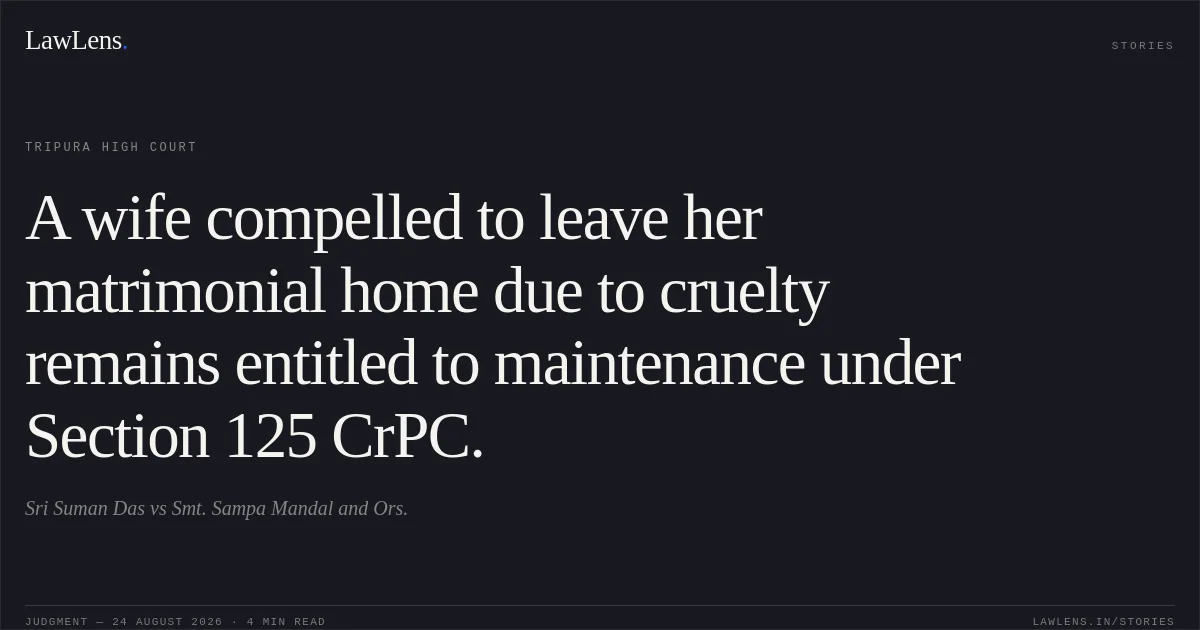
The High Court held that the wife was not disentitled to maintenance merely because she was living separately or because a decree for restitution of conjugal rights had been passed.
Source reference: pp.17–20, paras. 37–43The husband failed to prove that his income was limited to ₹4,000 per month, and his obligation to maintain his wife and minor daughter remained.
Source reference: pp.17–20, paras. 37–43The maintenance was reduced from ₹20,000 to ₹15,000 per month, apportioned as ₹9,000 per month to the wife and ₹6,000 per month to the minor daughter.
Source reference: p.20, para. 45The arrears were directed to be recalculated on the reduced basis and paid in the proportionate instalments directed by the Family Court.
Source reference: p.21, para. 46The judgment records the effective date as 13 December 2021 in the impugned order and as 13 January 2021 in the operative direction; this apparent date discrepancy appears in the text of the judgment itself.
Source reference: p.2, para. 2; p.20, para. 45Acts & Sections Cited
11 provisions across 3 statutes referred to in this judgment. Each provision opens on LawLens.
Code of Criminal Procedure, 19733
Bharatiya Nagarik Suraksha Sanhita, 20232
Protection of Women from Domestic Violence Act, 20056
Original Court PDF
Sri Suman DasvsSmt. Sampa Mandal and Ors.
Click to open original judgment
Original judgment, available to read, download and summarize on LawLens.in
![Courts will not interfere with transfers absent mala fides or violation of statutory rules.. M Ramya vs EMPLOYEES STATE INSURANCE CORPORATION (ESIC). CAT - ['Chennai']. LawLens](/stories/thumbnails/courts-will-not-interfere-with-transfers-absent-mala-fides-or-violation-of-statutory-rules-a6845e9ca6f548fca284c51c8351957f.webp)
![Courts cannot direct one-time recruitment age relaxation absent authority in the governing rules or advertisement.. UT OF PUDUCHERRY vs M ANDAL. CAT - ['Chennai']. LawLens](/stories/thumbnails/courts-cannot-direct-one-time-recruitment-age-relaxation-absent-authority-in-the-governing-895d78fde47143e2a8ed0207c4b6a44f.webp)
![A review cannot correct an allegedly erroneous decision absent an error apparent on the record.. Ajit Kumar Jha vs RAILWAY BOARD. CAT - ['Delhi']. LawLens](/stories/thumbnails/a-review-cannot-correct-an-allegedly-erroneous-decision-absent-an-error-apparent-on-the-re-8ac952fd4eba470c92f7da20af72a220.webp)