Facts
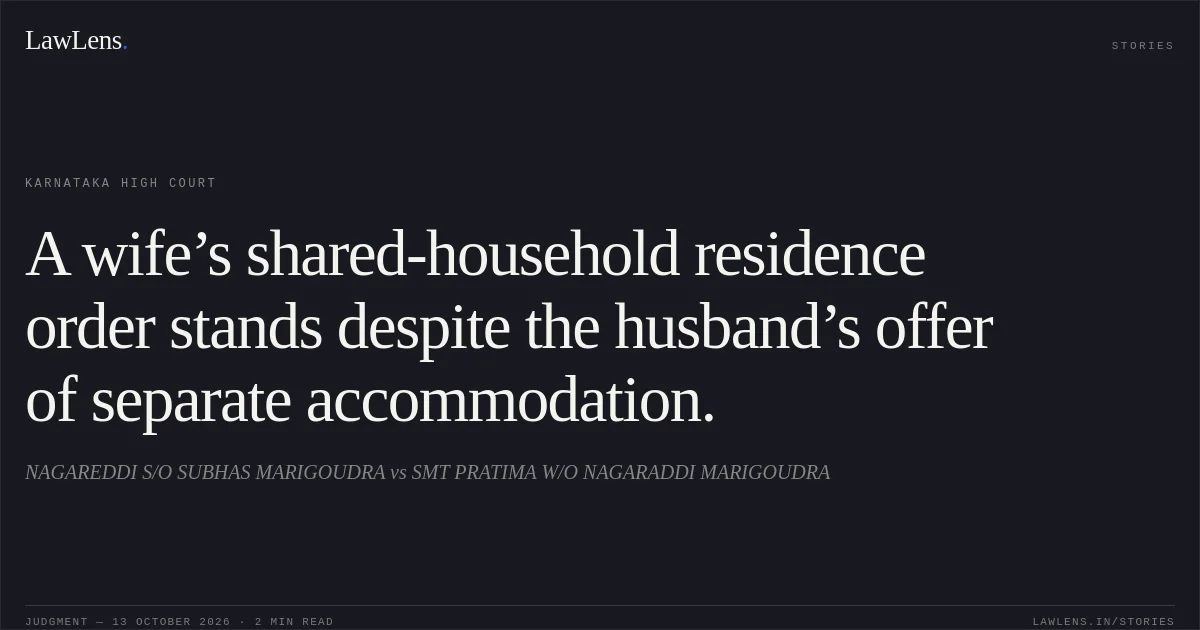
The wife and her minor son sought residence in a house at Belavanki, claiming it was their shared household and that the wife had been driven out by her husband and in-laws.
Source reference: paras. 3–7, pp. 3–6The husband and his family disputed that the house was a shared household, asserting that it belonged to his parents, and offered to provide separate accommodation.
Source reference: paras. 3–7, pp. 3–6The Magistrate allowed the wife’s application under Section 17(2) and (3) of the Protection of Women from Domestic Violence Act, 2005, permitting her to reside in the house and restraining the respondents from interfering with her residence.
Source reference: paras. 3–7, pp. 3–6The Sessions Court dismissed the husband’s appeal and affirmed that order.
Source reference: paras. 3–7, pp. 3–6The husband, his parents, and his brother then challenged the concurrent orders in revision.
Source reference: paras. 3–7, pp. 3–6Issues
Whether the courts below erred in permitting the wife to reside in the Belavanki house as a shared household, warranting interference in revision.
Source reference: paras. 7, 13, pp. 5–6, 10Whether the husband’s offer of separate accommodation, and the parties’ contentions concerning the wife’s residence and her in-laws, justified setting aside or modifying the orders below.
Source reference: paras. 9–12, pp. 7–9Law Applied
The application concerned the wife’s asserted right of residence under Section 17(2) and (3) of the Protection of Women from Domestic Violence Act, 2005; the petitioners also disputed whether the house met the definition of “shared household” in Section 2(s) of that Act.
Source reference: paras. 3, 7, pp. 3, 5–6The petition was brought under the revisional jurisdiction identified in the petition as Section 438 read with Section 442 of the Bharatiya Nagarik Suraksha Sanhita, 2023.
Source reference: no citationThe Court stated that interference was not warranted absent illegality, perversity, or jurisdictional error in the orders below.
Source reference: para. 13, p. 10Reasoning
The Court heard the parties, including the wife’s position that she would not accept alternative accommodation and wished to remain in the matrimonial house.
Source reference: paras. 9–13, pp. 7–10The husband’s side maintained that the house was ancestral property of his parents, alleged that the wife had driven them out, and relied on the husband’s offer of separate accommodation.
Source reference: paras. 9–13, pp. 7–10The wife denied having driven out her in-laws and said she was willing to live with and care for them; the Court directed that her parents not reside in the house during the proceedings.
Source reference: paras. 9–13, pp. 7–10Having considered these competing submissions and the circumstances, the Court found no illegality, perversity, or jurisdictional error in the concurrent orders that would justify revisional interference.
Source reference: paras. 9–13, pp. 7–10Holding
The High Court dismissed the revision petition, leaving in force the orders permitting the wife to reside in the Belavanki house.
It directed the wife not to allow her parents to reside there during the pendency of the proceedings, subject to further orders or modification by the competent court, and directed both parties to cooperate in expediting their pending proceedings.
Source reference: para. 14, p. 10Acts & Sections Cited
4 provisions across 2 statutes referred to in this judgment. Each provision opens on LawLens.
Bharatiya Nagarik Suraksha Sanhita, 20232
Protection of Women from Domestic Violence Act, 20052
Original Court PDF
NAGAREDDI S/O SUBHAS MARIGOUDRAvsSMT PRATIMA W/O NAGARADDI MARIGOUDRA
Click to open original judgment
Original judgment, available to read, download and summarize on LawLens.in