Facts
The appellant-plaintiff and the respondents were brothers and sons of Gangashankar Trikamji Vyas, who died on 24 October 1993.
Source reference: p.2, paras 3.1–3.3The plaintiff relied on a Will dated 8 June 1992, notarised before Advocate-Notary C.D. Ghore, claiming one-half share in the deceased’s immovable property and one-third share in the movable property.
Source reference: p.2, paras 3.1–3.3The plaintiff also sought compensation for use of the property and a permanent injunction against its alienation.
Source reference: p.2, para 3.3Defendant No. 1 substantially conceded the plaintiff’s claim, whereas Defendant No. 2 disputed the 1992 Will and relied upon other Wills, particularly a Will dated 12 June 1986.
Source reference: pp.3–4, paras 3.4–3.6Although the notary was examined and produced the relevant register, the plaintiff did not examine either attesting witness to the 1992 Will.
Source reference: p.5, para 5.1; p.13, para 15The Trial Court held that the 1992 Will was not proved in accordance with law, while treating the 1986 Will as duly proved through an attesting witness, and rejected the plaintiff’s claim on the material issue.
Source reference: pp.4–5, para 3.7; p.17, para 20The plaintiff challenged that decision under Section 96 CPC.
Source reference: no citationIssues
Whether the Will dated 8 June 1992 was duly executed and proved in accordance with Section 63 of the Indian Succession Act, 1925 and Section 68 of the Indian Evidence Act, 1872, despite the non-examination of any attesting witness?
Source reference: pp.10–13, paras 9–14Whether examination of the notary who notarised the Will could substitute the statutory requirement of examining at least one attesting witness?
Source reference: p.14, para 15Whether the plaintiff could invoke Sections 69 or 71 of the Indian Evidence Act, 1872, in the absence of evidence showing that the attesting witnesses were unavailable, or that they denied or failed to recollect execution?
Source reference: pp.15–16, paras 17–18; pp.21–22, paras 25–26Whether the Trial Court’s treatment of the Will dated 12 June 1986 and its consequent dismissal of the plaintiff’s claim warranted appellate interference?
Source reference: pp.16–18, paras 19–23; pp.22–23, paras 27–30Law Applied
The Court applied Section 63 of the Indian Succession Act, 1925, which requires an unprivileged Will to be signed by the testator and attested by at least two witnesses, each of whom must have witnessed the testator’s signature or received a personal acknowledgment of it and signed the Will in the testator’s presence.
Source reference: pp.11–12, para 10Section 68 of the Indian Evidence Act, 1872 requires at least one attesting witness to be examined to prove a document required by law to be attested, including a Will.
Source reference: pp.12–13, paras 10, 13–14Section 71 provides an alternative mode of proof only where an attesting witness denies or does not recollect execution, while Section 69 applies where the statutory conditions for proving execution through attesting witnesses are unavailable, such as death or genuine unavailability.
Source reference: pp.15–16, paras 17–18; pp.21–22, paras 25–26The Court relied on Janki Narayan Bhoir v. Narayan Namdeo Kadam, Yumnam Ongbi Tampha Ibemma Dev v. Yumnam Joykumar Singh, Beni Chand v. Smt. Kamla Kunwar, Shashi Kumar Banerjee v. Subodh Kumar Banerjee, Vijyaben Vashram v. State of Gujarat, and Lilian Coelho v. Myra Philomean Coelho, holding that proof of the testator’s signature alone is insufficient; due attestation must also be proved, and suspicious circumstances must be removed by the propounder.
Source reference: pp.18–21, paras 21–24The Court further relied on Pazhanathal v. Alamathal, holding that Section 69 is not a route of convenience where the propounder merely elects not to produce attesting witnesses, and that handwriting proof alone does not establish testamentary validity.
Source reference: pp.21–22, paras 25–26Reasoning
The plaintiff’s entire claim depended on the 1992 Will, but he examined neither of its attesting witnesses and produced no evidence that they were dead, untraceable despite diligent efforts, beyond the Court’s process, or otherwise unavailable.
Source reference: pp.13–15, paras 15–17; pp.21–22, para 26The notary’s testimony established, at most, the fact of notarisation and could not prove the statutory elements of attestation under Section 63(c) of the Succession Act.
Source reference: p.14, para 15Section 71 was also unavailable because no attesting witness had been called and therefore none had denied or failed to recollect execution.
Source reference: p.15, paras 17–18The Court consequently held that the 1992 Will had not been proved in the manner mandated by Sections 63 and 68.
Source reference: no citationIn contrast, the 1986 Will had been supported by the testimony of an attesting witness, who spoke to the testator’s signature and the execution formalities, and the Trial Court’s finding in that regard was not shown to be erroneous.
Source reference: p.17, para 20The alleged readiness expressed for the first time in appeal to examine the attesting witnesses was considered an unsubstantiated assertion and did not justify admission of additional evidence or interference with the Trial Court’s decree.
Source reference: pp.14–15, para 16; p.22, para 26Holding
The Court answered the principal issues against the plaintiff.
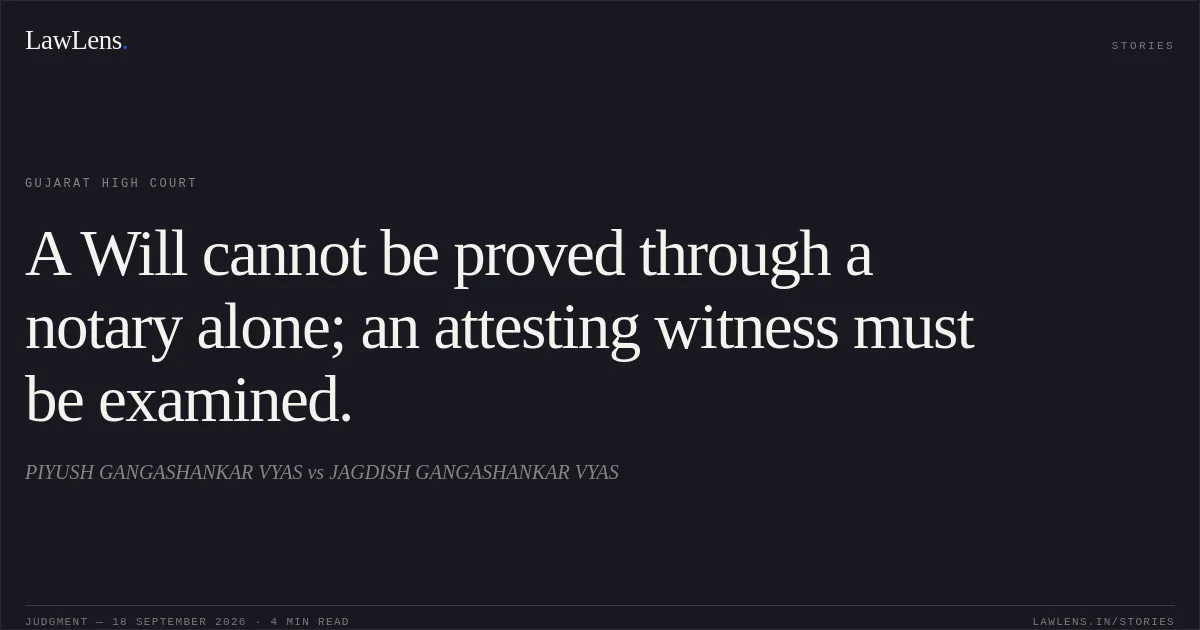
It held that the Will dated 8 June 1992 was not proved because no attesting witness was examined and no foundation was laid for invoking Sections 69 or 71 of the Evidence Act.
Source reference: p.23, para 28Examination of the notary was insufficient to establish valid execution and attestation.
Source reference: no citationThe appeal was accordingly dismissed, the judgment and decree dated 13 August 2009 of the City Civil Court, Ahmedabad, were confirmed, and any interim relief was vacated.
Source reference: p.23, paras 29–30The record and proceedings were directed to be returned to the Trial Court.
Source reference: p.24, para 31Acts & Sections Cited
2 provisions across 2 statutes referred to in this judgment. Each provision opens on LawLens.
Code of Civil Procedure, 19081
Indian Succession Act, 19251
Original Court PDF
PIYUSH GANGASHANKAR VYASvsJAGDISH GANGASHANKAR VYAS
Click to open original judgment
Original judgment, available to read, download and summarize on LawLens.in