Facts
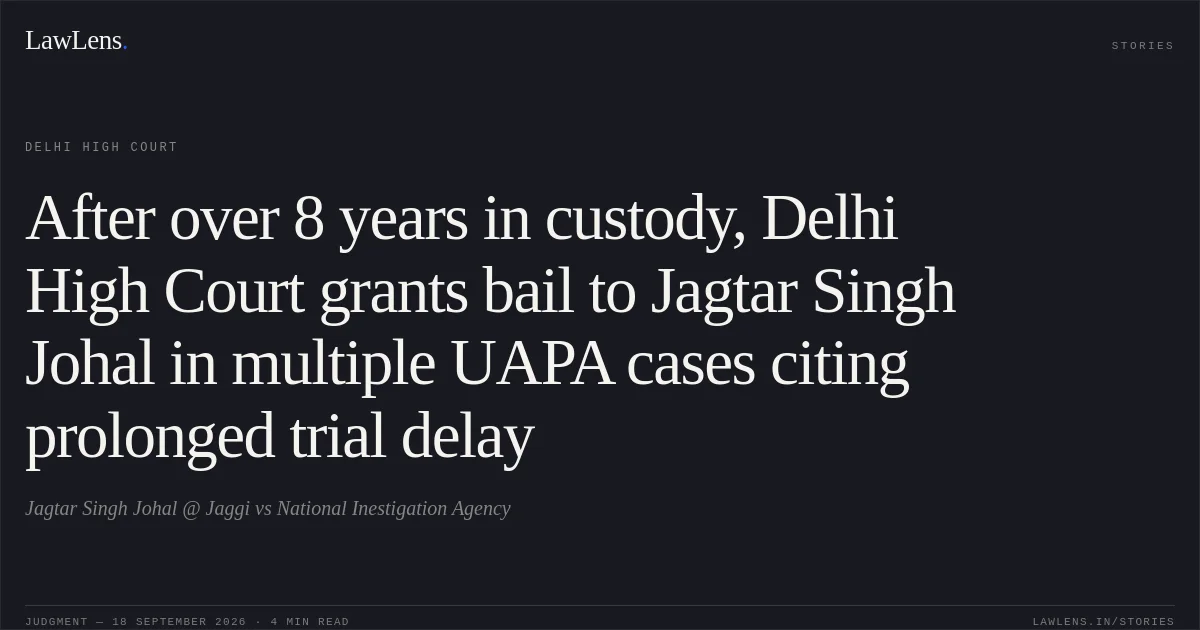
The appellant, Jagtar Singh Johal, was an accused in seven connected prosecutions arising from alleged terrorist activities, murders, criminal conspiracy, financing and offences under the Unlawful Activities (Prevention) Act, 1967 (“UAPA”), the Indian Penal Code, 1860 and the Arms Act, 1959.
Source reference: pp. 2–4, paras. 1–2The prosecution alleged that the appellant was a member of the Khalistan Liberation Force and had travelled from the United Kingdom to France to deliver GBP 3,000 to co-accused Harminder Singh @ Mintoo, part of which was allegedly used to recruit another accused for terrorist activities.
Source reference: pp. 6–7, para. 6The appellant had remained in custody since 4 November 2017, i.e. for more than eight years. Although charges had been framed, only 40 prosecution witnesses had been examined, while approximately 123 witnesses remained, including protected witnesses whose evidence had not yet been recorded despite directions of the Supreme Court to expedite the trial.
Source reference: pp. 8–10, para. 7; p. 24, para. 20A previous Coordinate Bench had dismissed some of the appeals on limitation and others on merits; the Supreme Court thereafter set aside that decision and remanded the matters for fresh consideration on merits without examining limitation.
Source reference: p. 5, paras. 3–4Issues
Whether the appellant was entitled to bail despite the restrictions under Section 43D(5) of the UAPA, having regard to his incarceration for more than eight years and the substantial delay in conclusion of the trial?
Source reference: pp. 12–24, paras. 19–20Whether the prosecution material disclosed a sufficient prima facie case against the appellant to justify continued detention under the UAPA?
Source reference: pp. 18–19, paras. 55–58; pp. 24–28, paras. 20–26Whether the appellant’s foreign nationality, alleged risk of flight and concerns regarding witness intimidation justified denial of bail?
Source reference: pp. 10–12, paras. 14–16; pp. 27–28, paras. 25–26What significance, if any, could be attached at the bail stage to the appellant’s acquittal in another prosecution involving similar allegations?
Source reference: pp. 26–27, paras. 22–24Law Applied
Section 43D(5) of the UAPA imposes a statutory restriction on bail where, upon perusal of the case diary or charge-sheet, the court is of the opinion that the accusation is prima facie true; however, that restriction does not exclude the constitutional jurisdiction of superior courts to protect the right to life and personal liberty under Article 21.
Source reference: pp. 13–15, para. 19Relying principally on Union of India v. K.A. Najeeb, the Court held that the rigour of Section 43D(5) may yield where the accused has undergone substantial incarceration and the trial is unlikely to conclude within a reasonable time.
Source reference: pp. 13–15, para. 19The Court also considered the structured prima-facie inquiry discussed in Gulfisha Fatima v. State (NCT of Delhi), including whether the prosecution material discloses the statutory ingredients and a real, individualised nexus between the accused and the alleged terrorist activity.
Source reference: pp. 15–19, paras. 53–55It further noted Syed Iftikhar Andrabi v. NIA, which reaffirmed that “bail is the rule and jail is the exception” even under the UAPA, subject to the facts of the particular case.
Source reference: pp. 19–21, para. 56The Court also considered the pending reference in Tasleem Ahmed v. State (NCT of Delhi) concerning the contextual assessment of delay, and applied the principle in Union Territory of Ladakh v. Jammu and Kashmir National Conference that High Courts must decide cases according to the law presently binding, notwithstanding a pending reference.
Source reference: pp. 21–24, paras. 58–60Reasoning
The Court held that the appellant’s more than eight years of custody, coupled with the limited progress of the trial—40 witnesses examined out of approximately 163 and protected witnesses still not examined—made it unlikely that the proceedings would conclude in the near future.
Source reference: p. 24, para. 20Applying Article 21 and K.A. Najeeb, the Court concluded that continued pre-trial detention could not be justified solely by the seriousness of the allegations or the statutory embargo under Section 43D(5).
Source reference: p. 24, para. 20The Court also gave persuasive, though not res judicata, value to the appellant’s acquittal in the Moga prosecution, where similar allegations of conspiracy, terrorist financing and association with terrorist activities had not been proved.
Source reference: pp. 26–27, paras. 22–24The prosecution’s concerns regarding flight risk and witness intimidation were addressed through stringent conditions.
Source reference: pp. 27–28, paras. 25–26The Court found no material establishing that the alleged threats to witnesses originated from or were connected with the appellant, and held that his foreign nationality alone could not justify indefinite incarceration.
Source reference: pp. 27–28, paras. 25–26The Court therefore balanced the statutory restrictions under the UAPA against the appellant’s individualised Article 21 claim, concluding that the prolonged and incomplete trial warranted release on conditional bail.
Source reference: pp. 27–28, paras. 25–26Holding
The Delhi High Court allowed all seven connected appeals, set aside the impugned orders refusing bail, and directed the appellant’s release on bail in the concerned prosecutions.
Bail was made subject to execution of a personal bond of ₹5,00,000 with two sureties of the like amount; surrender of his passport; maintenance of specified contact and residence details; regular appearance and cooperation with the trial; fortnightly reporting to the Investigating Officer; and strict prohibitions against contacting or influencing witnesses, tampering with evidence, delaying the trial, making public statements on the case, or engaging in activities prejudicial to public order or trial integrity.
Source reference: pp. 28–29, para. 27The prosecution was granted liberty to seek cancellation of bail in the event of breach of any condition.
Source reference: p. 30, para. 28Acts & Sections Cited
21 provisions across 4 statutes referred to in this judgment. Each provision opens on LawLens.
Unlawful Activities (Prevention) Act, 19678
Arms Act, 19592
Indian Penal Code, 1860
Narcotic Drugs and Psychotropic Substances Act, 19851
Original Court PDF
Jagtar Singh Johal @ JaggivsNational Inestigation Agency
Click to open original judgment
Original judgment, available to read, download and summarize on LawLens.in