Facts
The appellants instituted proceedings under Section 92 of the Code of Civil Procedure, 1908 (“CPC”), along with an application seeking leave to institute a suit concerning the management and affairs of the respondent public charitable trust.
Source reference: para. 4Pending consideration of the leave application, the Principal District and Sessions Judge, Mandya, appointed an ad hoc committee comprising the existing trustees under Order XL Rule 1(a) CPC to manage the trust’s day-to-day affairs.
Source reference: para. 4The Karnataka High Court set aside that order, holding that a Section 92 suit is “stillborn” until leave is granted and that the Civil Court lacks jurisdiction to pass interlocutory orders during the pendency of the leave application.
Source reference: para. 4The appellants challenged the High Court’s decision before the Supreme Court.
Source reference: para. 4Issues
Whether a Civil Court seized of a plaint under Section 92 CPC and an accompanying application for leave may pass protective or preservatory interim orders before leave to institute the suit is granted?
Source reference: para. 2Whether the Court may appoint a receiver under Section 94 read with Order XL Rule 1(a), or invoke its inherent powers under Section 151 CPC, during the pendency of the Section 92 leave application?
Source reference: paras. 5–17, 39–50Whether, in cases of compelling urgency, notice to the proposed defendants may be dispensed with before granting leave under Section 92 CPC?
Source reference: paras. 57–60Law Applied
Section 92 CPC requires persons instituting a representative suit concerning an alleged breach or administration of a public charitable or religious trust to have obtained the Court’s leave before instituting the suit; this requirement is mandatory and operates as a safeguard against vexatious litigation.
Source reference: paras. 30–34, 43Sections 26 and Order IV CPC ordinarily contemplate institution of a suit through presentation of a plaint, but a Section 92 suit does not come into existence until leave is granted.
Source reference: paras. 28–31, 35–38Section 94 CPC and Order XL Rule 1(a) CPC authorise supplemental relief, including appointment of a receiver, but such powers presuppose an underlying, validly instituted proceeding.
Source reference: paras. 39–46Section 141 CPC extends CPC procedure to miscellaneous proceedings only insofar as applicable and cannot override the substantive safeguards embodied in Section 92.
Source reference: paras. 42–47The inherent power under Section 151 CPC cannot be exercised in conflict with an express or implied statutory scheme, and general provisions cannot derogate from the special requirements of Section 92.
Source reference: paras. 48–52The Court relied on R.M. Narayana Chettiar v. N. Lakshmanan Chettiar, which treats leave under Section 92 as peremptory, and distinguished the broader protective approach in Manohar Lal Chopra v. Rai Bahadur Rao Raja Seth Hiralal and other authorities as unavailable where jurisdiction itself has not arisen.
Source reference: paras. 43, 48–50Nevertheless, following the principle recognised in R.M. Narayana Chettiar, the Court held that notice before granting leave may be dispensed with where urgent circumstances make prior notice impracticable, provided reasons are recorded.
Source reference: paras. 57–59Reasoning
The Court treated the leave application under Section 92 as a threshold or gateway proceeding rather than a substantive suit.
Source reference: paras. 35–38Although the application was registered separately under the Karnataka Civil Rules of Practice, that procedural registration did not create a pending suit or confer jurisdiction to entertain interlocutory applications.
Source reference: paras. 35–38Since no valid Section 92 suit existed before leave was granted, an application for appointment of a receiver under Order XL Rule 1(a) could not be maintained as a supplemental proceeding under Section 94; the phrase “whether before or after decree” in Order XL also presupposed a properly instituted suit.
Source reference: paras. 39–46The Court rejected the argument that the receiver’s allegedly preservatory character could cure the lack of jurisdiction, observing that appointment of a receiver in a public trust would displace existing management and could prejudice the trust if leave were ultimately refused.
Source reference: paras. 53–56Section 151 and the principle favouring an interpretation that preserves jurisdiction could not be invoked to bypass the mandatory statutory safeguard in Section 92.
Source reference: paras. 48–52At the same time, the Court balanced the protective purpose of Section 92 with the need to prevent imminent harm by holding that, where compelling urgency is shown, the Court may grant leave without prior notice and thereafter exercise interim jurisdiction in the instituted suit; such departure must be supported by cogent reasons and remains subject to challenge or revocation by the defendants.
Source reference: paras. 57–59Holding
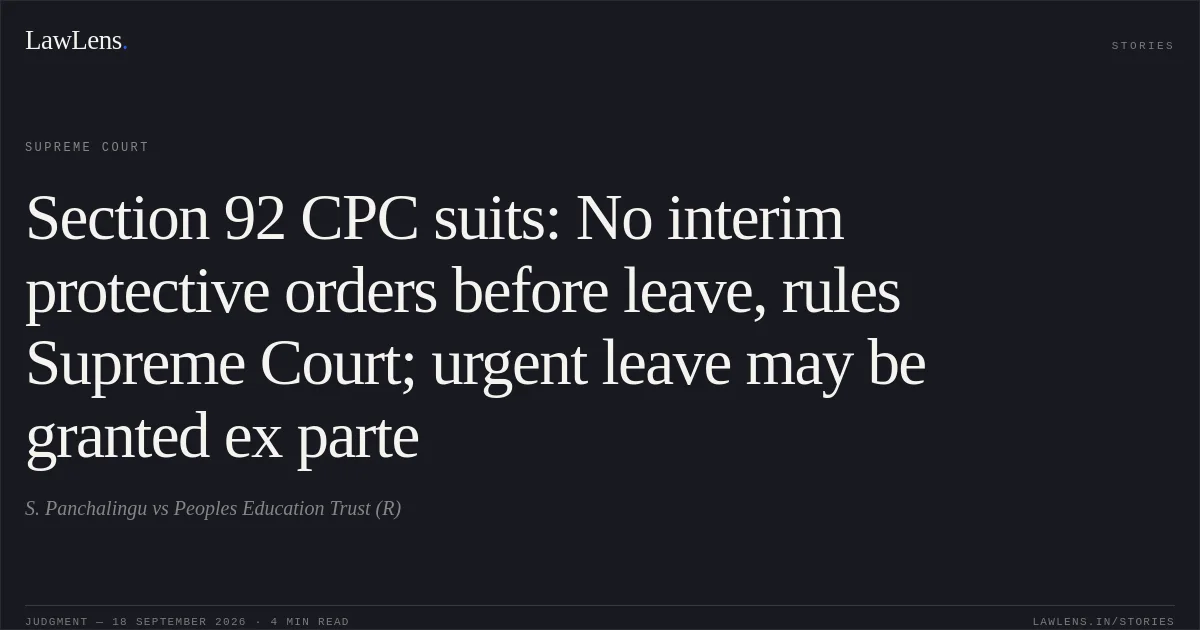
The Supreme Court held that a Civil Court cannot pass protective or preservatory interim orders, including appointing a receiver under Order XL Rule 1(a), while an application for leave under Section 92 CPC is pending.
Such jurisdiction arises only after leave has been granted and the suit is instituted.
Source reference: para. 60However, where compelling urgency is demonstrated, the Court may dispense with prior notice and grant leave ex parte, recording reasons in writing; interim relief may then be considered in the duly instituted suit.
Source reference: paras. 57–60With this clarification, the appeals were dismissed and the pending applications were disposed of.
Source reference: para. 61Acts & Sections Cited
11 provisions across 1 statute referred to in this judgment. Each provision opens on LawLens.
Code of Civil Procedure, 1908
Original Court PDF
S. PanchalinguvsPeoples Education Trust (R)
Click to open original judgment
Original judgment, available to read, download and summarize on LawLens.in