Facts
M/s ABB India Limited obtained an arbitral award dated 28 February 2019 against M/s Techno Aircon Industries Pvt. Ltd. for recovery of ₹92,29,230, interest and costs.
Source reference: pp. 1–5; paras. 3–9, 12, 18The award was challenged under Section 34 of the Arbitration and Conciliation Act, 1996, but the challenge was dismissed by the Delhi High Court on 20 December 2023; the subsequent Section 37 challenge was dismissed by the Division Bench and the Supreme Court declined further interference.
Source reference: pp. 1–5; paras. 3–9, 12, 18During execution, the petitioner, who was the authorised representative and former director of the judgment-debtor company, filed affidavits of assets on 1 February 2024 and 17 December 2024. These affidavits disclosed only an HDFC Bank account and omitted an ICICI Bank account.
Source reference: pp. 3–4; paras. 10–15Upon a specific query, the petitioner also stated that the company had no bank account in Delhi.
Source reference: pp. 3–4; paras. 10–15Pursuant to the executing court’s directions, bank statements subsequently revealed the ICICI account, which had remained operational until 23 July 2025, had a balance of ₹65,27,798.37 as on 1 February 2025, and reflected 13 withdrawals totalling ₹12,51,719 on 17 July 2025.
Source reference: pp. 4–5, 11–13; paras. 15, 19–20, 40–43The executing court concluded that the petitioner had withheld material information and, under Order XXI Rule 41(3) CPC, issued warrants of arrest on 11 May 2026 and fresh warrants on 23 July 2026.
Source reference: p. 5; paras. 21–22The petitioner challenged the latter order under Article 227 of the Constitution.
Source reference: p. 5; paras. 21–22Issues
Whether an authorised representative or officer of a judgment-debtor company, who was not a party to the arbitral or execution proceedings, could be subjected to coercive proceedings under Order XXI Rule 41(3) CPC without first lifting the corporate veil.
Source reference: pp. 9–11; paras. 33–37Whether the executing court had properly exercised its discretion in issuing warrants of arrest under Order XXI Rule 41(3) CPC for alleged non-compliance with the disclosure requirements under Rule 41(2).
Source reference: pp. 11–13; paras. 33, 38–44Whether the executing court had wrongly appreciated the material concerning the closure and operation of the ICICI Bank account.
Source reference: pp. 13–14; paras. 33, 45–47Law Applied
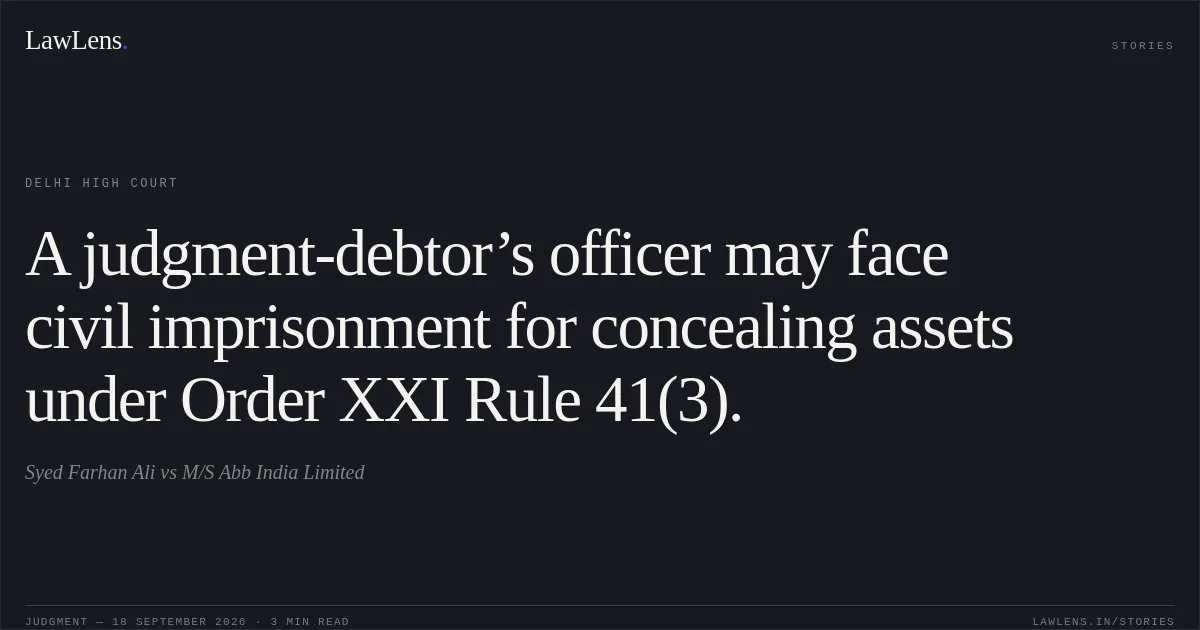
The Court applied Order XXI Rule 41(2) CPC, under which an officer of a judgment-debtor corporation may be directed to disclose, by affidavit, the particulars of the company’s assets, and Rule 41(3), which authorises coercive consequences, including detention in civil prison, for disobedience of such a direction.
Source reference: pp. 9–11; paras. 34–39The Court distinguished personal liability for the company’s decree from liability arising from an officer’s own non-compliance with a judicial disclosure direction.
Source reference: pp. 9–11; paras. 34–39It also applied Article 227 of the Constitution, holding that supervisory jurisdiction is not appellate jurisdiction and interference is warranted only for perversity, patent illegality or manifest jurisdictional error.
Source reference: p. 11; para. 38The principle of separate corporate personality does not immunise an officer from consequences arising from his own failure to comply with an order under Order XXI Rule 41.
Source reference: pp. 10–11; paras. 35–37Reasoning
The Court held that the petitioner was not being treated as the judgment-debtor or made personally liable for the arbitral award.
Source reference: pp. 9–11; paras. 34–37The proceedings were based on his own conduct as the company’s officer and authorised representative after he had been directed to furnish a complete affidavit of the company’s assets.
Source reference: pp. 9–11; paras. 34–37The affidavits omitted the ICICI account, and the omission persisted despite the executing court’s specific query regarding bank accounts in Delhi.
Source reference: pp. 11–13; paras. 40–43The later bank records established that the account was operational when both affidavits were filed, contained substantial funds, and was used for withdrawals shortly before closure.
Source reference: pp. 11–13; paras. 40–43Consequently, the filing of an affidavit, without complete and truthful disclosure, did not amount to substantial compliance with Rule 41(2), justifying action under Rule 41(3).
Source reference: pp. 11–13; paras. 40–43The petitioner’s reliance on a purported 2023 closure statement could not overcome the bank’s subsequent records showing closure only on 23 July 2025.
Source reference: pp. 13–14; paras. 45–47Since the challenge essentially sought factual reappraisal, no ground for interference under Article 227 was made out.
Source reference: pp. 13–14; paras. 45–47Holding
The High Court answered all three issues against the petitioner.
It held that the petitioner could be proceeded against under Order XXI Rule 41(3) CPC for his own failure to make complete disclosure, notwithstanding that he was not personally liable under the arbitral award and had not been a party to the arbitral proceedings.
Source reference: pp. 10–11, 13–14; paras. 35–37, 44, 48The executing court had properly exercised its discretion, and its appreciation of the ICICI Bank records disclosed no perversity or jurisdictional error.
Source reference: p. 14; paras. 48–50The petition challenging the fresh arrest warrants dated 23 July 2026, along with pending applications, was dismissed.
Source reference: p. 14; paras. 48–50Acts & Sections Cited
3 provisions across 2 statutes referred to in this judgment. Each provision opens on LawLens.
Arbitration and Conciliation Act, 19962
Code of Civil Procedure, 19081
Original Court PDF
Syed Farhan AlivsM/S Abb India Limited
Click to open original judgment
Original judgment, available to read, download and summarize on LawLens.in