Facts
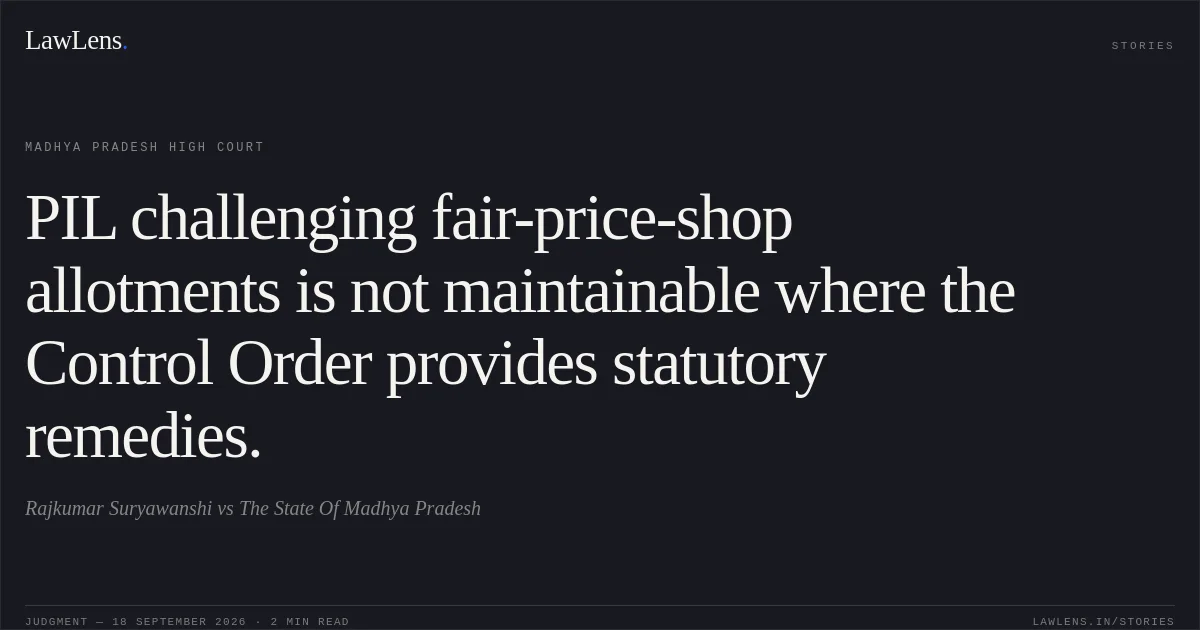
The petitioner filed a Public Interest Litigation challenging the alleged arbitrary allotment of fair price shops in Madhya Pradesh under the Madhya Pradesh Public Distribution System (Control) Order, 2015.
Source reference: para. 1–2He alleged that shops had been allotted to selected persons without advertisement and through a pick-and-choose method, relying partly on information obtained under the Right to Information Act.
Source reference: para. 1–2The petitioner had earlier approached the High Court in W.P. No. 1400 of 2025, which was disposed of, but he alleged that no action had thereafter been taken.
Source reference: para. 2–3When the present petition was heard, the State raised a preliminary objection that the affected allottees had not been impleaded.
Source reference: para. 4Although the petitioner sought time to implead them, he took no steps for more than eight months.
Source reference: para. 4The Court also noted that the Control Order provides statutory remedies, including punishment, cancellation, and an appellate mechanism.
Source reference: para. 5–6Issues
Whether the Public Interest Litigation challenging allotment of fair price shops could be entertained when the affected allottees had not been impleaded and had not been afforded an opportunity of hearing.
Source reference: para. 4Whether the petitioner should be relegated to the remedies of complaint and appeal available under the Madhya Pradesh Public Distribution System (Control) Order, 2015.
Source reference: para. 5–7Law Applied
The Court applied the principles of natural justice, particularly that an allotment affecting existing fair price shop allottees cannot be cancelled without giving them notice and an opportunity of hearing.
Source reference: para. 4Clause 16 authorises suspension or cancellation of a fair price shop authority letter upon contravention, subject to notice, representation, and compliance with natural justice; Clause 17 permits an aggrieved person or society to file an appeal within 30 days before the appellate authority, which must provide an opportunity of hearing.
Source reference: para. 6The Court further held that the Control Order constitutes a complete statutory code and that the existence of an efficacious statutory remedy militates against entertaining a PIL in the matter.
Source reference: para. 7Reasoning
The petitioner’s challenge directly questioned the validity of allotments made in favour of particular fair price shop allottees. Those allottees were therefore necessary and affected parties whose rights could not be adversely determined in their absence.
Source reference: para. 4Since the petitioner failed to implead them despite being granted time, any order cancelling or disturbing their allotments would violate natural justice.
Source reference: para. 4Independently, the Court found that the Control Order provides a specialised mechanism for raising grievances regarding allotment, seeking action for contraventions, and pursuing an appeal under Clause 17.
Source reference: para. 5–6Because the statutory framework is a complete code and the petitioner had an alternative remedy, the Court declined to exercise its writ jurisdiction through a PIL.
Source reference: para. 7Holding
The High Court dismissed the writ petition, holding that the PIL was not maintainable because the affected allottees had not been impleaded and the petitioner had failed to pursue the statutory remedies under the Control Order, 2015.
The dismissal was with liberty to the petitioner to avail the remedies available under the Control Order, including the applicable complaint or appellate mechanism.
Source reference: para. 8Acts & Sections Cited
1 provisions across 1 statute referred to in this judgment. Each provision opens on LawLens.
Essential Commodities Act, 19551
Original Court PDF
Rajkumar SuryawanshivsThe State Of Madhya Pradesh
Click to open original judgment
Original judgment, available to read, download and summarize on LawLens.in