Facts
M/s. Mount Industrial Estate developed land at Marol, Mumbai, and constructed Shantiniketan Industrial Estate comprising 42 industrial units/galas. Unit purchasers subsequently submitted an application in Form A for registration of a co-operative society, shown as having been signed by 20 promoters. The Deputy Registrar granted registration to the Petitioner-society on 9 November 2009.
Source reference: pp. 2, 5–6; paras. 2, 7Respondent No. 3, M/s. Dipti Builders Universal Pvt. Ltd., which had acquired rights in certain unsold premises from the developer, challenged the registration under Appeal No. 217 of 2010. The Divisional Joint Registrar condoned the delay in filing the appeal and, by order dated 2 September 2011, set aside the registration certificate on the ground that the 20 signatures represented only seven distinct promoters and therefore did not satisfy Section 6 of the Maharashtra Co-operative Societies Act, 1960 (“MCS Act”).
Source reference: pp. 2–3, 5–6; paras. 3, 7, 9The Petitioner did not challenge that order for approximately 13 years. It filed Revision Application No. 394 of 2024, which was dismissed by the Minister for Co-operation on 6 April 2026. The present writ petition challenged both orders.
Source reference: pp. 2–3, 10; paras. 1, 3, 11Issues
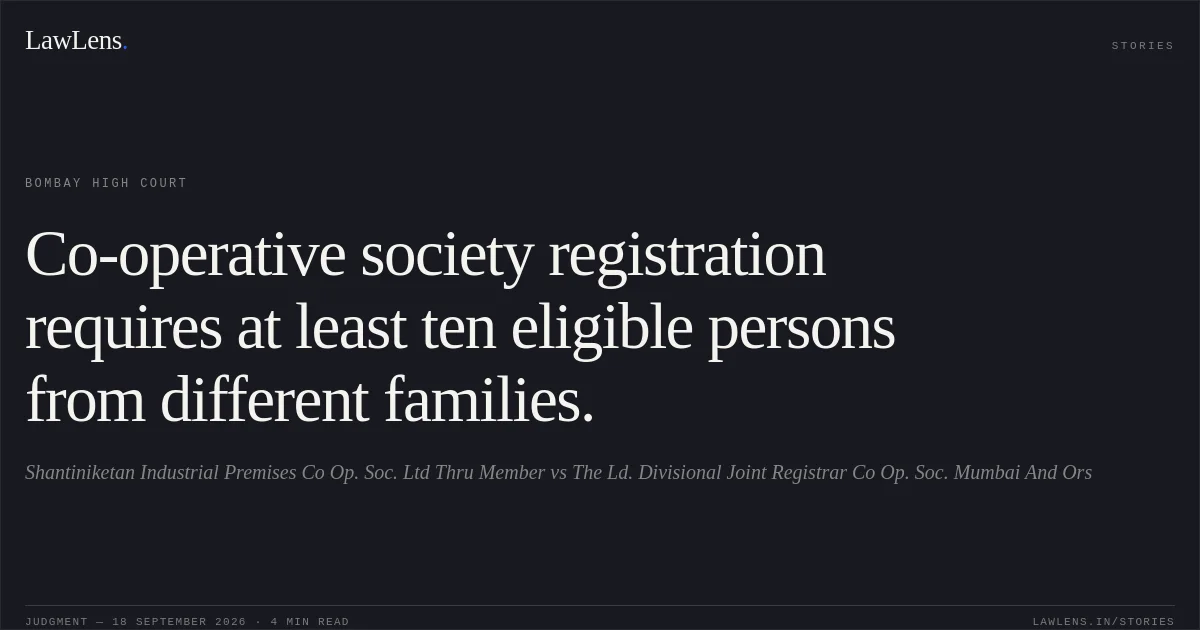
Whether the registration of the Petitioner-society was valid when the application, despite containing 20 signatures, was signed by only seven distinct promoters and did not satisfy the requirement of at least ten persons belonging to different families under Section 6(1) of the MCS Act?
Source reference: pp. 5–9; paras. 7–10Whether partnership firms, companies or other entities could be counted as separate persons for satisfying the minimum numerical requirement under Section 6(1), and whether Section 22 of the MCS Act affected that requirement?
Source reference: pp. 8–9; para. 10Whether Respondent No. 3 had locus to challenge the society’s registration, notwithstanding its subsequent sale of the relevant units in 2013?
Source reference: pp. 3–4, 10–11; paras. 4–5, 13–14Whether the writ petition and revision were maintainable after the society’s registration had been cancelled in 2011 and the challenge was instituted after a delay of approximately 13 years?
Source reference: pp. 10–12; paras. 11–12, 17Law Applied
Section 6(1) of the MCS Act requires a non-federal society to consist of at least ten persons, each belonging to a different family, who are qualified to become members and reside within the society’s area of operation; the Explanation to Section 6 defines “member of a family”.
Source reference: pp. 5–8The Court distinguished the requirement of ten distinct persons under Section 6 from the separate eligibility requirements for membership under Section 22: compliance with Section 22 does not dispense with the minimum numerical requirement under Section 6.
Source reference: pp. 7–9; paras. 8–10Sections 8 and 9 govern the application for registration and grant of registration, while an appeal against registration may be maintained under Section 152 of the MCS Act; such an appeal can succeed for failure to satisfy statutory requirements and does not necessarily require proof of fraud or misrepresentation.
Source reference: pp. 7, 11; paras. 8, 15–16Section 21A, concerning de-registration, and the requirement of fraud or misrepresentation applicable in that context, was held distinct from an appeal challenging an invalid registration.
Source reference: p. 11; para. 15The Court also considered Mukesh Mehta v. State of Maharashtra, which recognises that the statutory requirement of ten eligible persons from different families applies to other co-operative societies, including industrial premises societies.
Source reference: p. 12; para. 16Reasoning
The Court found that the Form A application contained repeated names: Ajit Thakker appeared twice, Velankani Info Systems appeared seven times, Bharat Thakker appeared six times, and Maya Developers appeared twice. Consequently, the 20 signatures represented only seven distinct promoters, not ten independent persons.
Source reference: p. 8; para. 9Even assuming that Maya Developers and Morarji Peraj & Co. were separate partnership entities, the statutory minimum of ten persons was still not met. Section 22 could not cure this foundational defect because membership eligibility is an additional requirement and does not replace the requirement that at least ten distinct persons initiate the registration.
Source reference: pp. 8–9; para. 10Respondent No. 3 had locus when it filed the appeal in 2010, since its subsequent sale of units in 2013 could not retrospectively extinguish its standing at the time of challenge.
Source reference: p. 10; para. 13The Court also held that the authorities were entitled to set aside the registration for non-compliance with Section 6 without establishing fraud or misrepresentation, distinguishing an appeal under Section 152 from de-registration under Section 21A.
Source reference: p. 11; para. 15The Court further noted that, after cancellation of registration in 2011 and in the absence of any stay or revival, the society became a non-existent entity for purposes of instituting the revision and writ petition. The 13-year delay was also unexplained. Although the Minister decided the revision on merits, the High Court found no reason to interfere because the substantive conclusion was correct.
Source reference: pp. 10–12; paras. 11–12, 17–18Holding
The Court held that the registration was invalid because the application did not satisfy Section 6(1) of the MCS Act: the apparent 20 promoters amounted to only seven distinct promoters, fewer than the required ten persons from different families.
Respondent No. 3 had valid locus to challenge the registration, and the subsequent sale of its units did not affect its standing in the 2010 appeal.
Source reference: p. 10; para. 13The Court upheld the Divisional Joint Registrar’s order dated 2 September 2011 and the Minister’s order dated 6 April 2026. The writ petition was dismissed, with no order as to costs.
Source reference: p. 12; para. 18Acts & Sections Cited
5 provisions across 1 statute referred to in this judgment. Each provision opens on LawLens.
Maharashtra Co-operative Societies Act, 19605
Original Court PDF
Shantiniketan Industrial Premises Co Op. Soc. Ltd Thru MembervsThe Ld. Divisional Joint Registrar Co Op. Soc. Mumbai And Ors
Click to open original judgment
Original judgment, available to read, download and summarize on LawLens.in