Facts
Disputes arose between the appellants and the respondent under an agreement containing an arbitration clause.
Source reference: no citationThe respondent allegedly appointed an Arbitral Tribunal on the basis of consent, but the appellants disputed that consent and objected to the Tribunal’s appointment, alleging that it had close links with the respondent.
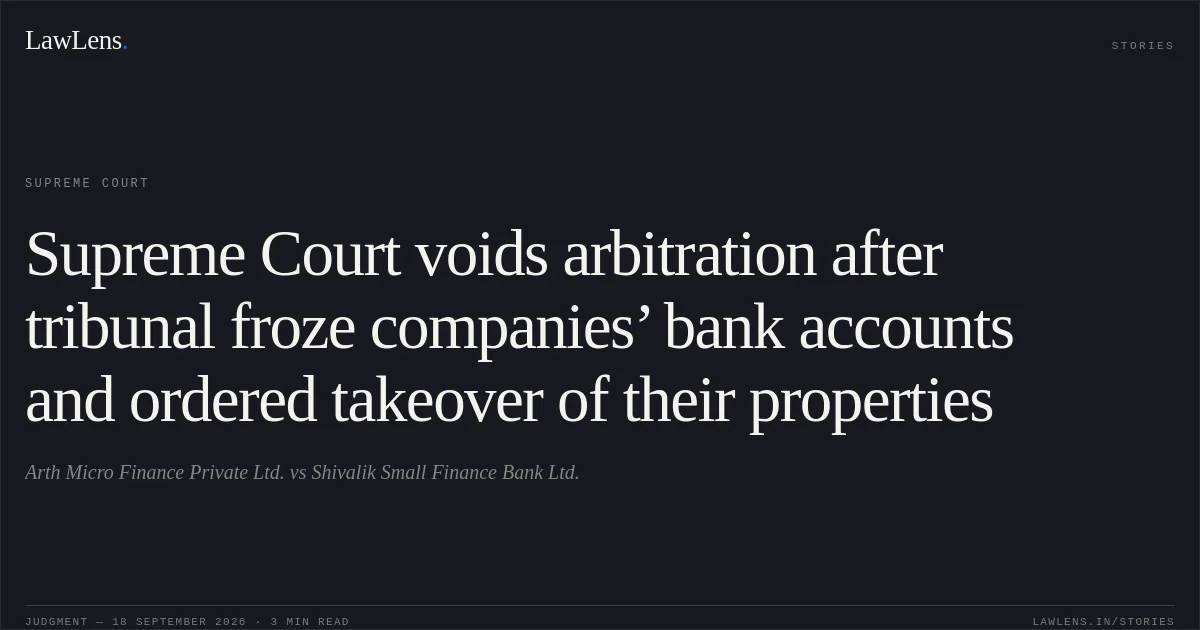
Source reference: p.1; para.3Despite the objection, the Tribunal passed three interim orders under Section 17 of the Arbitration and Conciliation Act, 1996, directing freezing of the appellants’ bank accounts, taking over their movable and immovable properties, and transferring amounts from their bank accounts to the respondent.
Source reference: pp.1–3; paras.3–4The appellants challenged those orders under Section 37 of the Act.
Source reference: no citationThe High Court dismissed the appeals on limitation, observing that no application for condonation of delay under Section 5 of the Limitation Act, 1963, had been filed.
Source reference: p.1; para.3The Supreme Court granted leave and examined the validity of the arbitral appointment and consequential interim orders.
Source reference: p.1; para.1Issues
Whether the arbitral proceedings and the appointment of the Arbitral Tribunal were legally valid when the appellants had not consented to the appointment and had objected to the Tribunal on grounds of alleged bias.
Source reference: pp.1–3; paras.3–5Whether the interim orders passed under Section 17 of the Arbitration and Conciliation Act, 1996, including freezing of bank accounts, taking over properties, and transfer of funds, could be sustained when the Tribunal’s appointment was non est in law.
Source reference: pp.2–4; paras.4–6Whether consequential restitution and appointment of a fresh arbitrator were warranted.
Source reference: pp.3–4; paras.6–7Law Applied
The Court applied the Arbitration and Conciliation Act, 1996, particularly Section 17, which concerns interim measures ordered by an arbitral tribunal, and Section 37, which provides for appeals against specified arbitral orders.
Source reference: pp.1–2; paras.3–4It also considered Section 5 of the Limitation Act, 1963, in relation to the High Court’s dismissal of the Section 37 appeals on limitation.
Source reference: p.1; para.3The Court emphasised that arbitration, including the constitution of an arbitral tribunal, cannot operate arbitrarily, and that an arbitral tribunal appointed without the parties’ consent, particularly despite a timely objection alleging bias, cannot validly exercise arbitral jurisdiction.
Source reference: pp.1–3; paras.2–5Orders passed by a tribunal whose appointment is non est in law cannot be sustained and may be set aside, with restitution directed where its orders have been acted upon.
Source reference: pp.3–4; para.6Reasoning
The Court found no material demonstrating that the appellants had consented to the respondent’s appointment of the Arbitral Tribunal, despite the respondent’s contention that the appointment was consensual.
Source reference: p.2; para.4The appellants had expressly challenged the appointment and alleged that the Tribunal had close links with the respondent, yet the Tribunal proceeded to issue coercive interim measures under Section 17.
Source reference: pp.1–3; paras.3–5In these circumstances, the Court held that the initiation of arbitration itself was non est in law and characterised the interim orders—including freezing accounts, taking possession of properties, and transferring funds—as arbitrary.
Source reference: p.3; paras.5–6The High Court’s limitation-based dismissal could not stand once the foundational arbitral appointment was found invalid.
Source reference: p.3; para.6Holding
The Supreme Court set aside the High Court’s order and held that the initiation of arbitration was non est in law.
It set aside the three interim orders passed by the Arbitral Tribunal.
Source reference: no citationAny amounts transferred from the appellants’ accounts to the respondent were directed to be remitted back within one week, failing which they would carry compound interest at 18% per annum with monthly rests from the date of debit, subject to set-off against any amount ultimately found payable to the respondent in arbitration.
Source reference: p.3; para.6Any attachment or takeover of the appellants’ movable or immovable properties was annulled and possession was directed to be restored.
Source reference: p.4; para.6The Court appointed Ms. Mayuri Raghuwanshi, Advocate, as the fresh arbitrator, directed the Registry to notify her, and left the merits of the parties’ disputes open for determination in arbitration.
Source reference: p.4; para.7The appeal was accordingly disposed of.
Source reference: p.4; para.8Acts & Sections Cited
3 provisions across 2 statutes referred to in this judgment. Each provision opens on LawLens.
Arbitration and Conciliation Act, 19962
Limitation Act, 19631
Original Court PDF
Arth Micro Finance Private Ltd.vsShivalik Small Finance Bank Ltd.
Click to open original judgment
Original judgment, available to read, download and summarize on LawLens.in