Facts
The appellants-plaintiffs leased land to the respondents-defendants under a registered lease deed dated 17.10.2011 for 33 years, at a monthly rent of ₹92,550 with a 7% annual increase.
Source reference: p.2A supplementary lease deed dated 15.02.2013 was subsequently executed to modify certain terms, including the rent payable; the plaintiffs asserted that it was executed in continuation of the registered lease and did not require registration.
Source reference: pp.2–3, 9–10Alleging default in payment of rent under the modified terms, the plaintiffs issued a notice under Section 106 of the Transfer of Property Act, 1882, and filed a suit for eviction and arrears of rent.
Source reference: p.3The defendants sought rejection of the plaint under Order VII Rule 11(a) and (d) of the Code of Civil Procedure, 1908, contending that the unregistered supplementary lease deed was inadmissible under Section 49 of the Registration Act, 1908, and that the plaint therefore disclosed no cause of action and was barred by law.
Source reference: pp.3–4, 11–12The trial court rejected the application, but the Patna High Court set aside that order and remanded the matter for reconsideration.
Source reference: pp.4–6Issues
Whether the alleged inadmissibility of the unregistered supplementary lease deed could be considered as a ground for rejection of the plaint under Order VII Rule 11(a) or (d) CPC before commencement of trial.
Source reference: para. 1; pp.8–9Whether, on a meaningful reading of the plaint and the documents filed with it, the plaint disclosed a cause of action or was barred by law under Order VII Rule 11(a) or (d) CPC.
Source reference: paras. 14–18; pp.13–18Whether the question of registration and admissibility of the supplementary lease deed was required to be adjudicated during trial, including in light of the proviso to Section 49 of the Registration Act, 1908.
Source reference: para. 15; pp.14–16Law Applied
The Court applied Order VII Rule 11(a) and (d) CPC, under which a plaint may be rejected only where, on reading the plaint as a whole, it does not disclose a cause of action or the suit appears from the plaint to be barred by law.
Source reference: paras. 14, 18; pp.13–18At this stage, the plaint averments and documents filed with the plaint are material, while the defendant’s defence is irrelevant.
Source reference: no citationThe Court relied on P.V. Guru Raj Reddy v. P. Neeradha Reddy, 2015 INSC 113, for the principle that rejection of a plaint is a drastic threshold remedy and that disputed matters ordinarily require trial.
Source reference: para. 14; pp.14–15Section 49 of the Registration Act, 1908 restricts the use of an unregistered document required to be registered, but its proviso permits such a document to be received as evidence of a collateral transaction not required to be effected by a registered instrument.
Source reference: para. 15; pp.15–16The Court further distinguished authorities concerning admissibility at trial, including M/s K.B. Saha & Sons Pvt. Ltd. v. M/s Development Consultant Ltd., 2008 INSC 639, and held that admissibility cannot ordinarily be conclusively determined while considering an application under Order VII Rule 11.
Source reference: pp.5–6, 15–18Reasoning
The plaint specifically pleaded the existence of the registered lease, execution of the supplementary lease deed, modification of the lease terms, default in payment of rent, termination of the tenancy, and the consequent entitlement to eviction and arrears.
Source reference: paras. 10, 12; pp.9–13These averments, if accepted as true—as required at the Order VII Rule 11 stage—disclosed a prima facie cause of action.
Source reference: no citationThe defendants’ contention that the supplementary lease deed required registration constituted a defence and raised a disputed question concerning the document’s legal effect and admissibility.
Source reference: no citationThe plaintiffs had expressly pleaded that the document merely modified the earlier lease and did not require registration.
Source reference: paras. 10, 16; pp.9–11, 16–17Determining whether the document was registrable, whether it could be proved, or whether it could be relied upon for a collateral transaction required evidence and could not be decided conclusively before trial.
Source reference: para. 15; pp.15–16Consequently, the High Court erred by recording a premature finding of inadmissibility and directing reconsideration of the rejection application on that basis.
Source reference: para. 17; pp.17–18Holding
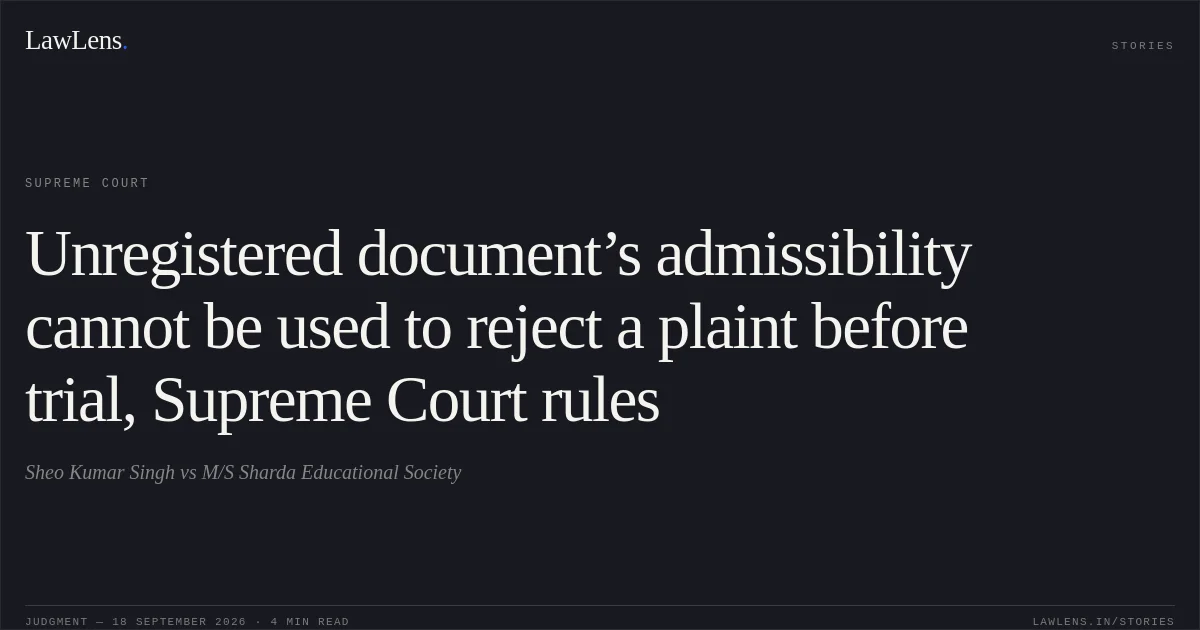
The Supreme Court held that the admissibility or otherwise of the unregistered supplementary lease deed could not be made the basis for rejecting the plaint under Order VII Rule 11(a) or (d) CPC.
The plaint disclosed a cause of action and was not, on its face, barred by law.
Source reference: para. 18; p.18The High Court’s order dated 17.12.2024 was set aside, the defendants’ application under Order VII Rule 11(a) and (d) was rejected, and the trial court was directed to proceed with the suit on its merits in accordance with law.
Source reference: para. 19; p.19The Court clarified that it had not decided the ultimate admissibility or legal effect of the supplementary lease deed, which was left open for determination at trial.
Source reference: para. 19; p.19Acts & Sections Cited
5 provisions across 3 statutes referred to in this judgment. Each provision opens on LawLens.
Transfer of Property Act, 18822
Registration Act, 19082
Code of Civil Procedure, 19081
Original Court PDF
Sheo Kumar SinghvsM/S Sharda Educational Society
Click to open original judgment
Original judgment, available to read, download and summarize on LawLens.in