Facts
The petitioner, a legally wedded wife, sought a writ of mandamus permitting the medical termination of her pregnancy, which was at 13 weeks and 1 day at the time of filing.
Source reference: para. 3, 10The petitioner and her husband (Respondent No. 3) had initially agreed to a compromise and divorce following criminal proceedings; however, the husband subsequently withdrew his willingness to proceed with the divorce.
Source reference: para. 3The petitioner alleged that continuing the pregnancy would cause her severe mental trauma, emotional suffering, and socio-economic instability.
Source reference: para. 3Although the pregnancy was within the statutory 20-week limit where court intervention is generally not mandatory, the petitioner approached the High Court seeking protection against potential legal objections from her husband.
Source reference: para. 5Issues
1. Whether a woman has the sole reproductive autonomy to terminate an unwanted pregnancy resulting from a change in matrimonial circumstances under Article 21 of the Constitution.
Source reference: para. 7, 112. Whether the consent of the husband is a prerequisite for a woman to undergo medical termination of pregnancy under the MTP Act.
Source reference: para. 7, 13Law Applied
Section 3(2) of the Medical Termination of Pregnancy (MTP) Act, 1971, which allows termination up to 20 weeks based on the opinion of a registered medical practitioner.
Source reference: para. 8Rule 3B(c) of the MTP Rules, 2003, which recognizes a "change of marital status" during pregnancy as a valid ground for termination.
Source reference: para. 9The constitutional principles of reproductive autonomy and bodily integrity under Article 21 as established in X v. Principal Secretary, Health and Family Welfare Department (2023) 9 SCC 433, which held that the woman is the ultimate decision-maker regarding her pregnancy.
Source reference: para. 11Kerala High Court's precedent in X v. Union of India (2022) clarifying that a husband's permission is not required.
Source reference: para. 13Reasoning
The Court observed that the petitioner’s pregnancy (13 weeks) fell squarely within the permissible statutory limit of Section 3(2)(a) of the Act.
Source reference: para. 10Applying the ratio from the Apex Court in X v. Principal Secretary, the Court reasoned that the burden of an unwanted pregnancy falls disproportionately on the woman, affecting her mental and physical health regardless of marital status.
Source reference: para. 11The Court found that the breakdown of the matrimonial relationship and the impending divorce constituted a "change in material circumstances" as contemplated by Rule 3B, rendering the petitioner eligible for termination.
Source reference: para. 11, 13The Court further determined that since the right to reproductive choice is a fundamental facet of personal liberty under Article 21, the husband’s lack of consent or absence in the proceedings was legally insignificant to the petitioner's right to terminate the pregnancy.
Source reference: para. 7, 13Holding
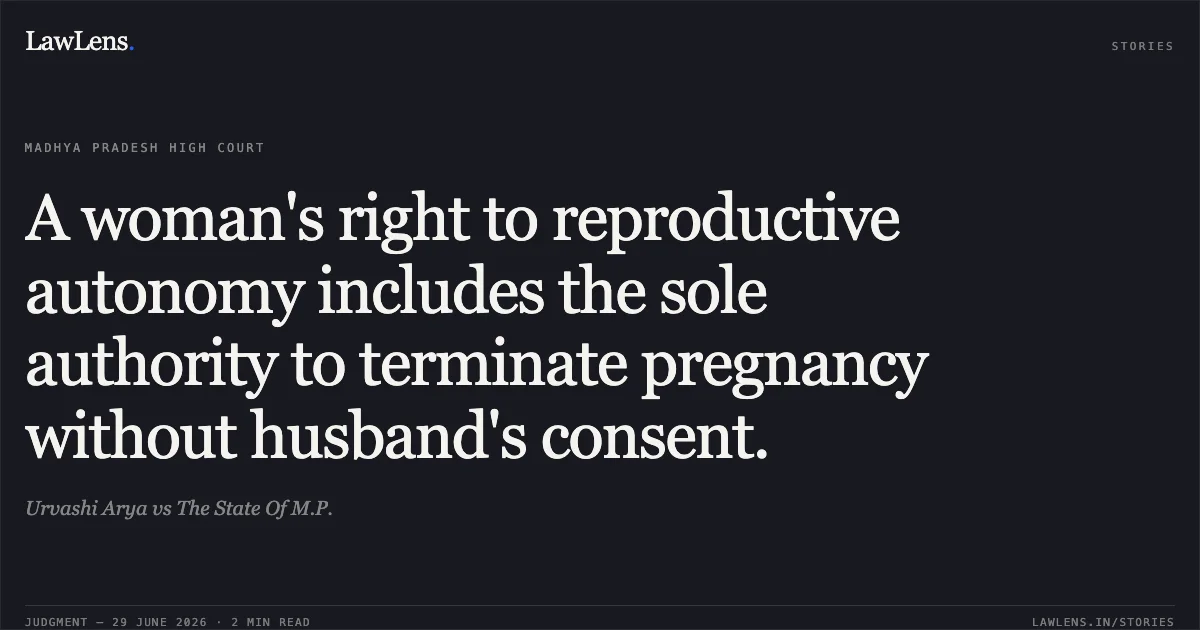
The Court answered the issues in the affirmative, holding that the woman is the sole decision-maker regarding her body and reproductive choices.
It granted the petition and permitted the petitioner to undergo medical termination of her pregnancy.
Source reference: para. 15, 16The Court directed the medical practitioners to follow standard protocols and safety guidelines issued by the Ministry of Health and the Apex Court, while noting that since no criminal offence was involved, the preservation of fetal DNA was not required in this specific instance.
Source reference: para. 15Acts & Sections Cited
2 provisions across 1 statute referred to in this judgment. Each provision opens on LawLens.
Original Court PDF
Urvashi AryavsThe State Of M.P.
Click to open original judgment
Original judgment, available to read, download and summarize on LawLens.in